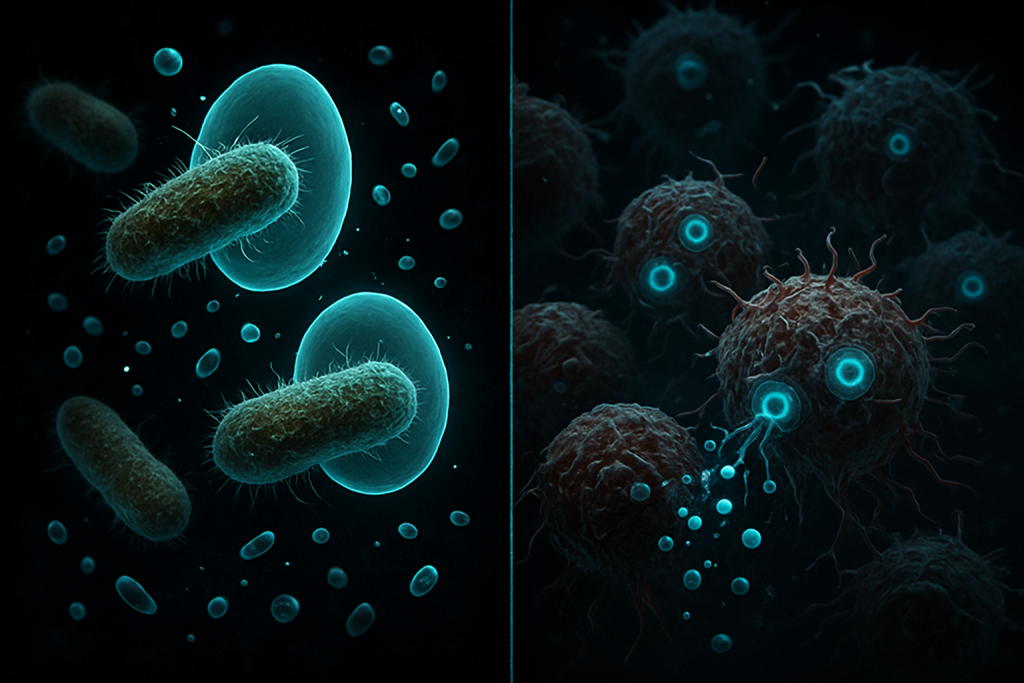
Image generated by AI
Every year, bacteria that once fell readily to antibiotics now shrug them off with impunity. Cancer cells treated with chemotherapy drugs evolve evasion strategies faster than pharmaceutical companies can design new compounds. The invisible enemy isn’t gaining new superpowers—it’s simply following the oldest rule in biology: adapt or die. Drug resistance, the phenomenon whereby pathogens and malignant cells become impervious to the medications designed to kill them, represents one of the most consequential challenges in modern medicine, a problem rooted not in medical failure but in the relentless logic of evolution.
The stakes have never been higher. The World Health Organization estimates that antibiotic resistance could cause up to 10 million deaths annually by 2050 if current trends continue—more than cancer deaths today. Meanwhile, cancer drug resistance claims hundreds of thousands of lives each year, turning initially effective treatments into biological dead ends. Understanding drug resistance isn’t merely an academic curiosity; it’s essential to preserving the medical advances that have extended human lifespans and transformed once-deadly diseases into manageable conditions. The question isn’t whether resistance will develop, but how we can stay ahead of it.
What Is Drug Resistance in Pathogens and Cancer?
Drug resistance occurs when a microorganism or cancer cell population evolves the ability to survive exposure to medications that would normally kill or inhibit them. This isn’t a sudden transformation but rather the enrichment of pre-existing genetic variants within a population—some cells or bacteria, by chance or through acquired mutations, possess traits that allow them to metabolize drugs differently, pump them out of their cells faster, or chemically inactivate them before they can cause damage. When a drug is applied to a mixed population of pathogens or cancer cells, it acts as a powerful selective pressure: susceptible individuals die, while resistant ones survive to reproduce. Over successive generations, the population shifts from predominantly vulnerable to increasingly resistant, rendering the drug progressively less effective.
The phenomenon was first systematically documented in the 1940s, just as antibiotics were revolutionizing medicine. Alexander Fleming observed that bacteria exposed to penicillin sometimes produced resistant strains, a discovery that seemed troubling but manageable—the assumption was that new drugs could always be developed faster than resistance could emerge. Decades later, the prescient microbiologist Joshua Lederberg was awarded the Nobel Prize partly for demonstrating that bacterial resistance arose through selection of mutations, not through the direct modification of bacteria by the drug itself. For cancer, drug resistance became evident as chemotherapy progressed from theoretical promise to clinical reality in the 1960s and 1970s, when patients initially responding to drugs would relapse as their tumors evolved resistance mechanisms. What had seemed like isolated clinical observations were, in fact, the inevitable consequence of applying evolutionary pressure to genetically diverse populations.
How It Works in Nature
The mechanism underlying drug resistance operates through a deceptively simple principle: genetic variation within populations combined with environmental selection. Every time a bacterium divides or a cancer cell copies its genome, errors accumulate—mutations that may be neutral, beneficial, or harmful. Within any large population of pathogens or cancer cells, some individuals will harbor mutations that confer advantages in the presence of a drug. Perhaps a mutation changes the structure of a protein that the antibiotic targets, making them incompatible; perhaps another mutation activates a pump protein that ejects the drug before it can act; perhaps a third mutation enables the cell to chemically degrade the toxic molecule. When the drug is introduced, these rare, pre-existing variants suddenly have an enormous advantage—they survive while their neighbors perish. Their descendants multiply, and the population composition shifts. What was once a minority trait becomes dominant. The drug, which was killing 99.9% of the population yesterday, now kills only a fraction today.
Consider a concrete analogy: imagine a field of moths living near a coal-burning factory. Most moths are light-colored, well-camouaged against tree bark. A few carry mutations that make them dark. Predators easily spot the dark moths, so they remain rare. But when industrial soot blackens the landscape, the equation inverts—dark moths disappear into the darkness while light moths become obvious prey. Within a few generations, the population is predominantly dark. The moths haven’t evolved special anti-predator powers; rather, environmental change has simply revealed which pre-existing variant thrives. Similarly, when antibiotics flood a bacterial community, susceptible strains vanish like light moths in soot, leaving only those whose genetics happen to confer resistance. The drug isn’t creating resistance; it’s merely exposing and amplifying what was already there.
Medical and Scientific Relevance
Drug resistance transforms treatment planning and clinical outcomes across multiple therapeutic domains. In infectious disease, the rise of multidrug-resistant tuberculosis and extensively drug-resistant bacteria like methicillin-resistant Staphylococcus aureus (MRSA) has forced physicians to cycle through increasingly toxic and expensive medications, and sometimes to face patients for whom no effective treatment exists. In oncology, drug resistance is the primary cause of cancer relapse and progression—tumors initially shrink under chemotherapy, immunotherapy, or targeted therapy, only to return months or years later in a chemically altered form that bypasses the drug’s mechanism of action. The clinical consequences are profound: a patient whose acute leukemia responds beautifully to a targeted tyrosine kinase inhibitor may, within months, face recurrence driven by cancer cells that have acquired mutations in the drug’s target, rendering it useless. This isn’t treatment failure in the traditional sense; it’s the inevitable outcome of applying selection pressure to a genetically heterogeneous population.
Current clinical practice attempts to manage resistance through several strategies. For infections, physicians employ combination therapy—using multiple drugs with different mechanisms simultaneously to reduce the probability that a pathogen carries resistance to all of them. For cancer, oncologists increasingly use sequential or alternating therapies, switching drugs when resistance begins to emerge, though this approach is limited by the finite number of available treatments. Researchers are developing new approaches including adaptive dosing regimens, where drug concentrations are varied to make it mathematically harder for resistance to accumulate, and rational combination strategies designed to target the specific resistance mechanisms a tumor has already evolved. In parallel, diagnostic tools like next-generation sequencing can identify resistance mutations in real time, allowing clinicians to personalize treatment before resistance becomes clinically apparent.
Recent Breakthroughs in Drug Resistance in Pathogens and Cancer
The past three years have witnessed significant advances in understanding and combating drug resistance. In 2023 and 2024, researchers using single-cell genomic sequencing have demonstrated that cancer cell populations exhibit far greater genetic diversity than previously appreciated, with many patients harboring multiple coexisting resistance clones even before treatment begins. This insight has profound implications: it suggests that some cancers come pre-loaded with cells destined to survive conventional therapy, making upfront treatment with combination approaches logically necessary rather than optional. Simultaneously, structural biology advances have enabled scientists to design next-generation inhibitors that bind to mutated versions of drug targets that resistant cancer cells produce—essentially playing a molecular game of chess where each resistance mutation is anticipated and countered. In microbiology, CRISPR-based approaches are being adapted as both diagnostic tools to detect resistance genes in real time and potentially as therapeutic approaches, where engineered systems could degrade plasmids (circular DNA segments often carrying resistance genes) or even edit resistance mutations out of bacterial populations.
Current research frontiers are focusing on prediction and prevention rather than reaction and cure. Computational models are improving our ability to forecast which resistance mutations will emerge under specific drug regimens, potentially allowing clinicians to preemptively switch treatments before resistance becomes dominant. Evolutionary game theory is being applied to design drug schedules that exploit fundamental tradeoffs—resistance mutations that confer survival benefits often carry fitness costs, and researchers are investigating whether carefully timed drug holidays might allow susceptible cells to re-emerge and outcompete resistant ones. For pathogens, phage therapy—using viruses that specifically target bacteria—is experiencing a renaissance as a potential alternative or complement to antibiotics, though resistance to phages can also evolve. The open questions remain formidable: Can we predict individual patient outcomes with enough precision to optimize therapy? Can we develop drugs that stay permanently ahead of resistance? Can we harness resistance mechanisms themselves as vulnerabilities to exploit?
Why Drug Resistance in Pathogens and Cancer Matters for the Future
Drug resistance represents not merely a medical challenge but a fundamental test of whether human ingenuity can outpace evolutionary processes. The trajectory of antibiotic resistance suggests that without intervention, common infections could become untreatable within decades—a prospect so dire that major health organizations have declared antimicrobial resistance a global health emergency. Cancer drug resistance likewise threatens to undermine decades of progress in oncology; as tumors evolve faster and more efficiently to evade available therapies, the survival gains achieved through new drugs may plateau. The broader implication is sobering: our pharmacological arsenal, once seemingly infinite, is finite and subject to biological erosion. The very success of our drug discoveries—the fact that billions of doses are administered annually—accelerates the selection pressures that generate resistance. This creates a paradox central to medicine in the 21st century: we must use drugs to save lives while simultaneously recognizing that use itself sows the seeds of failure.
Overcoming drug resistance will require integration across multiple scientific disciplines and a fundamental shift in how medicine approaches treatment. No single drug will remain effective indefinitely; instead, we must move toward dynamic, adaptive treatment strategies informed by real-time genomic monitoring of pathogens and cancers. This demands investment in infrastructure for rapid diagnostic sequencing, computational infrastructure to interpret that sequencing, and clinical systems nimble enough to respond by changing treatments within days rather than months. Additionally, we must slow the development of resistance through stewardship—reducing unnecessary antibiotic use, optimizing dosing schedules, and designing combination therapies from the outset rather than sequentially adding drugs as resistance emerges. The remaining challenges are not primarily biological but logistical, economic, and social: Can healthcare systems worldwide be reorganized to practice such precision medicine? Can pharmaceutical companies invest in drugs that will eventually face resistance? Can society accept that some infections and cancers may never be cured, only managed, and do so compassionately?
Key Takeaways
- Drug resistance arises through natural selection when medications kill susceptible organisms or cells while allowing pre-existing resistant variants to survive and reproduce.
- The mechanism operates identically in bacteria, viruses, and cancer cells: genetic diversity within populations combined with selective pressure from drugs creates evolutionary advantage for resistant individuals.
- The most promising approaches combine real-time genomic monitoring of pathogens and tumors with adaptive treatment strategies that anticipate and preempt resistance evolution.
- Current research is advancing rapidly toward predictive models and next-generation drugs designed to target resistance mutations before they become clinically dominant.
- Drug resistance poses an existential threat to modern medicine, requiring fundamental restructuring of how we diagnose, monitor, and treat infections and cancer globally.
Explore TED Talks on Drug Resistance in Pathogens and Cancer:
TED content is used under CC BY-NC-ND 4.0. © TED Conferences, LLC.
Frequently Asked Questions
Why do bacteria and cancer cells develop drug resistance through the same evolutionary principle?
Both pathogens and cancer cells are populations subject to natural selection: individuals with genetic variations that confer resistance survive treatment while susceptible ones die, causing resistance to become dominant in subsequent generations. This follows the fundamental biological rule of 'adapt or die' rather than representing a unique property of either system.
How does drug resistance in cancer cells differ mechanistically from antibiotic resistance in bacteria?
Cancer cells develop resistance through mutations in tumor suppressor genes, drug target modifications, and activation of survival pathways, while bacteria acquire resistance via horizontal gene transfer, enzymatic degradation of antibiotics, or efflux pump activation. Though the mechanisms differ, both processes involve genetic changes that reduce the drug's lethal effect.
What is the relationship between the speed of resistance development and the size of a pathogen or cancer cell population?
Larger populations generate more genetic variation through random mutations, increasing the probability that resistant variants will spontaneously arise and survive selection pressure from drug treatment. This is why infections with high bacterial loads and advanced cancers with billions of cells develop resistance more rapidly than smaller populations.
Can drug resistance in pathogens and cancer be prevented entirely, or only delayed?
Complete prevention is biologically impossible because resistance arises from random mutations and natural selection, which are inevitable in any large population exposed to sustained drug pressure. The realistic goal is to delay resistance emergence through strategies like combination therapy, rotating drugs, and reducing unnecessary treatment exposure.