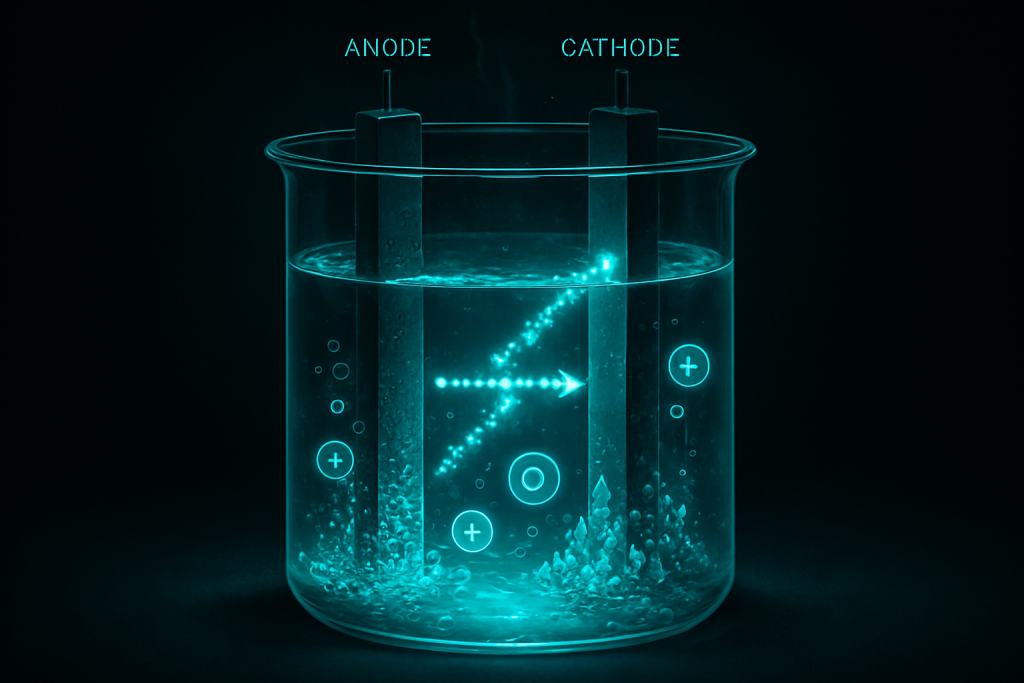
Image generated by AI
When you charge your smartphone or start your car, electrons are flowing through circuits in ways you never see—but what if you could harness that flow of electricity to clean polluted water, treat cancer, or manufacture chemicals more efficiently than ever before? Electrochemistry is the science that makes this possible, turning the invisible dance of electrons into tangible transformations of matter. Yet despite its profound importance to modern life, most people remain unaware of how electrochemical reactions power everything from water purification plants to advanced medical therapies. This gap between scientific potential and public understanding makes it the perfect time to explore what electrochemistry is and why it’s becoming increasingly central to solving some of humanity’s most pressing challenges.
The world faces mounting environmental and energy crises that demand innovative solutions beyond what traditional chemistry alone can deliver. Electrochemical treatment technologies are emerging as critical tools for addressing water contamination, reducing industrial emissions, and enabling the transition to sustainable energy systems. As governments worldwide commit to net-zero carbon goals and circular economy principles, electrochemistry offers pathways that were previously considered science fiction—from removing forever chemicals from drinking water to storing renewable energy at an unprecedented scale. Understanding electrochemistry isn’t merely academic curiosity; it’s essential knowledge for anyone seeking to comprehend how the next generation of environmental remediation, energy storage, and medical technologies will function.
What Is Electrochemistry and Electrochemical Treatment?
Electrochemistry is the branch of chemistry that studies reactions driven or produced by the passage of electric current through matter. At its core, it deals with the transfer of electrons between chemical species—a process that can either require energy input (like charging a battery) or release energy (like discharging one). Electrochemical treatment, more specifically, refers to using electrical current to induce chemical reactions for practical purposes: cleaning contaminated water, producing chemicals, treating disease, or recovering valuable materials from waste streams. Unlike traditional chemical methods that rely on adding reagents or heat, electrochemical processes harness the power of electrons themselves, offering remarkable precision and often producing fewer harmful byproducts. The fundamental principle is elegantly simple: apply voltage to a solution containing ions, and you orchestrate a controlled transformation of its chemical composition.
The foundations of electrochemistry trace back to the late 18th century when Italian physicist Luigi Galvani discovered that muscle tissue could be made to twitch using electrical current—a phenomenon that fascinated his contemporaries and raised profound questions about the nature of electricity itself. His work inspired Alessandro Volta to invent the voltaic pile in 1800, the first true electrical battery, which provided scientists with a reliable source of electric current and enabled systematic study of electrical phenomena in chemical systems. Throughout the 19th century, pioneers like Michael Faraday established the quantitative laws governing electrochemistry, demonstrating that electrical current could decompose water into hydrogen and oxygen and that the amount of chemical change was directly proportional to the electrical charge applied. These early breakthroughs transformed electrochemistry from a curious experimental science into a practical technology, eventually enabling the large-scale industrial production of chemicals like chlorine and caustic soda that remain foundational to modern civilization.
The Chemistry Behind It
To understand electrochemistry, imagine a U-shaped tube—called an electrochemical cell—filled with an electrically conductive solution containing dissolved ions. Two electrodes, typically made of inert metals like platinum or specialized materials, are inserted into this solution: the anode (positive electrode) and the cathode (negative electrode). When voltage is applied, electrons flow from the negative terminal of a power source through an external circuit to the cathode, while the positive terminal draws electrons away from the anode. This flow of electrons drives what happens inside the cell: at the cathode, ions in the solution gain electrons in a process called reduction; simultaneously, at the anode, other ions or dissolved molecules lose electrons in a process called oxidation. These coupled processes—oxidation at the anode and reduction at the cathode—form the heart of every electrochemical reaction, whether occurring in a laboratory beaker or an industrial water treatment plant.
Consider a practical analogy: imagine a crowded restaurant where diners (ions) are constantly moving between two sections (the two electrodes) separated by a barrier. When a manager (the applied voltage) signals from one side, diners begin migrating in specific directions, some carrying trays (electrons) with them. These electrons get passed from person to person across the barrier through a hidden tunnel (the external circuit), accomplishing chemical work in the process. Some diners arrive at one section and deposit their electrons, undergoing a chemical transformation; others arrive at the second section and pick up fresh electrons, becoming chemically changed in a complementary way. The beauty of this system is that by controlling the voltage, current intensity, and the materials used for electrodes, scientists and engineers can precisely choreograph which chemical transformations occur and at what rate, making electrochemistry remarkably versatile and controllable.
Where It Is Used Today
Electrochemical treatment has become indispensable across numerous industries, solving problems that conventional methods struggle to address. In water treatment, electrochemical oxidation systems are now deployed globally to eliminate persistent organic pollutants, pharmaceuticals, and industrial contaminants that resist traditional filtration or biological treatment. The mining industry uses electrorefining to purify metals like copper and gold to extraordinary levels of purity, an application that has been central to modern mining for over a century. In energy storage, lithium-ion batteries—which depend entirely on electrochemical principles—have revolutionized consumer electronics and are pivotal to the electric vehicle revolution. Beyond these industrial giants, electrochemistry is being adapted for emerging applications in food preservation, textile manufacturing, and corrosion prevention on infrastructure like bridges and pipelines.
Medical applications represent some of the most innovative frontiers. Electrochemical detection systems now enable rapid, portable disease diagnostics that rival laboratory accuracy. Electrochemotherapy, which uses electrical pulses to make cell membranes permeable to anticancer drugs, has shown remarkable promise in treating certain cancers and is now approved in dozens of countries. Water purification systems using electrochemical disinfection—where electric current directly kills bacteria and viruses without adding chemicals—are being deployed in remote communities, hospitals, and military operations. Industrial chemical production employs electrochemistry to synthesize compounds ranging from hydrogen peroxide to organic pharmaceuticals with unprecedented atom economy, meaning less waste and more useful product per unit of raw material. These diverse applications underscore that electrochemistry isn’t a niche scientific curiosity but a foundational technology embedded throughout modern infrastructure and industry.
Recent Breakthroughs in Electrochemistry and Electrochemical Treatment
The past three years have witnessed accelerated progress in electrochemical technology, driven by the urgent need for sustainable alternatives to energy-intensive chemical production and environmental remediation. Researchers have developed novel electrode materials—including graphene-based composites and metal-organic frameworks—that dramatically increase the efficiency of electrochemical reactions while reducing the overpotential, the extra voltage needed to drive reactions. A particularly significant breakthrough involves the electrochemical reduction of carbon dioxide directly into valuable chemicals like ethylene and methanol, offering a potential pathway to transform industrial emissions into commodity chemicals while capturing carbon. Meanwhile, advances in flow electrochemistry—where reactants continuously pass through an electrochemical cell rather than sitting in a static bath—have enabled production-scale synthesis of pharmaceuticals and fine chemicals with improvements in safety, scalability, and reproducibility that are attracting major pharmaceutical companies to adopt the technology.
Current research frontiers are pushing electrochemistry into increasingly ambitious territory. Scientists are exploring electrochemical systems that can simultaneously treat multiple contaminants in complex wastewater streams, crucial for industries that generate mixtures of pollutants. Others are developing wireless electrochemical sensors that could revolutionize monitoring of environmental contamination and human health biomarkers. The integration of machine learning with electrochemical systems promises to optimize reaction conditions in real-time, potentially improving efficiency by tens of percent. A pressing open question remains how to scale these laboratory innovations economically—the challenge isn’t usually the chemistry but rather making it cost-competitive with established industrial processes and ensuring the required electrical power comes from renewable sources rather than fossil fuels.
Why Electrochemistry and Electrochemical Treatment Matters for the Future
As the world transitions toward renewable energy and circular economy models, electrochemistry becomes increasingly central to this transformation. The electrochemical synthesis of ammonia—the primary component of nitrogen fertilizers—using renewable electricity could dramatically reduce the carbon footprint of agriculture, which currently consumes 2% of global energy through the Haber-Bosch process. Electrochemical water treatment can address “forever chemicals” like PFOA and PFOS that contaminate groundwater in thousands of communities and resist traditional remediation, offering hope where conventional solutions have failed. The storage of renewable energy through advanced batteries and other electrochemical systems is essential to decoupling electricity generation from consumption, solving the fundamental intermittency problem of solar and wind power. Beyond climate mitigation, electrochemical medical technologies promise to make precision cancer treatment more accessible globally while reducing side effects, potentially transforming how millions of people experience healthcare. These applications reveal electrochemistry not as a marginal technology but as a central pillar of sustainable development.
Yet substantial challenges remain before electrochemical treatment can achieve its full potential. The electricity consumption of many electrochemical processes remains higher than ideal, and without renewable energy sources, these systems can inadvertently increase carbon emissions rather than reduce them—a critical consideration that demands coupling technological development with energy transition. Electrode materials often degrade over time, requiring replacement and adding operational costs that limit economic viability in resource-constrained regions. The regulatory landscape for electrochemical products remains underdeveloped in many jurisdictions, creating uncertainty for companies investing in commercialization. Additionally, electrochemical processes often require specialized expertise and infrastructure that may not be readily available in developing nations where environmental challenges are often most acute, raising important questions about equitable access to these powerful technologies.
Key Takeaways
- Electrochemistry harnesses the flow of electrons to drive chemical transformations, offering precise control over reactions that traditional chemistry cannot match.
- The process works through coupled oxidation and reduction reactions at two electrodes, where applied voltage choreographs the movement of ions and electrons through a solution.
- The most promising near-term applications include removing persistent water contaminants, enabling sustainable production of chemicals like ammonia, and advancing cancer treatment through electrochemotherapy.
- Recent breakthroughs in electrode materials and carbon dioxide reduction show that laboratory innovations are moving toward industrial scale, though economic and energetic challenges remain.
- Electrochemistry will likely define the sustainability technologies of the coming decades, particularly for water purification, renewable energy storage, and decarbonized chemical manufacturing—making it essential knowledge for understanding our future.
Explore TED Talks on Electrochemistry and Electrochemical Treatment:
TED content is used under CC BY-NC-ND 4.0. © TED Conferences, LLC.
Frequently Asked Questions
How do electrons flowing through a circuit actually remove pollutants from water during electrochemical treatment?
Electrochemical treatment uses electrical current to drive oxidation or reduction reactions at electrodes, which either break down contaminant molecules directly or generate reactive species like hydroxyl radicals that destroy pollutants. The electrons transferred between electrodes provide the energy needed to transform harmful substances into harmless byproducts or precipitates that can be separated from water.
What is the fundamental difference between electrochemistry and traditional chemical reactions?
Electrochemistry harnesses electrical energy to drive or control chemical reactions, whereas traditional chemistry relies on thermal energy, pressure, or reactant concentrations. This gives electrochemistry precise control over reaction rates and selectivity, making it more efficient for specific transformations like removing forever chemicals or manufacturing fine chemicals.
Why is electrochemical treatment particularly effective at removing persistent pollutants like forever chemicals from drinking water?
Forever chemicals have strong carbon-fluorine bonds that resist biodegradation and conventional oxidation methods, but electrochemical oxidation can generate highly reactive species capable of breaking these extremely stable bonds. The direct electron transfer at electrode surfaces provides sufficient energy to mineralize these resistant compounds into harmless inorganic products.
Can electrochemical processes help store renewable energy at large scales?
Yes, electrochemical cells like batteries and fuel cells can store electrical energy from renewable sources by converting it into chemical energy, which can then be released on demand. Advanced electrochemical systems can also enable power-to-chemical conversion, storing renewable electricity in chemical bonds of molecules like hydrogen or synthetic fuels for later use.