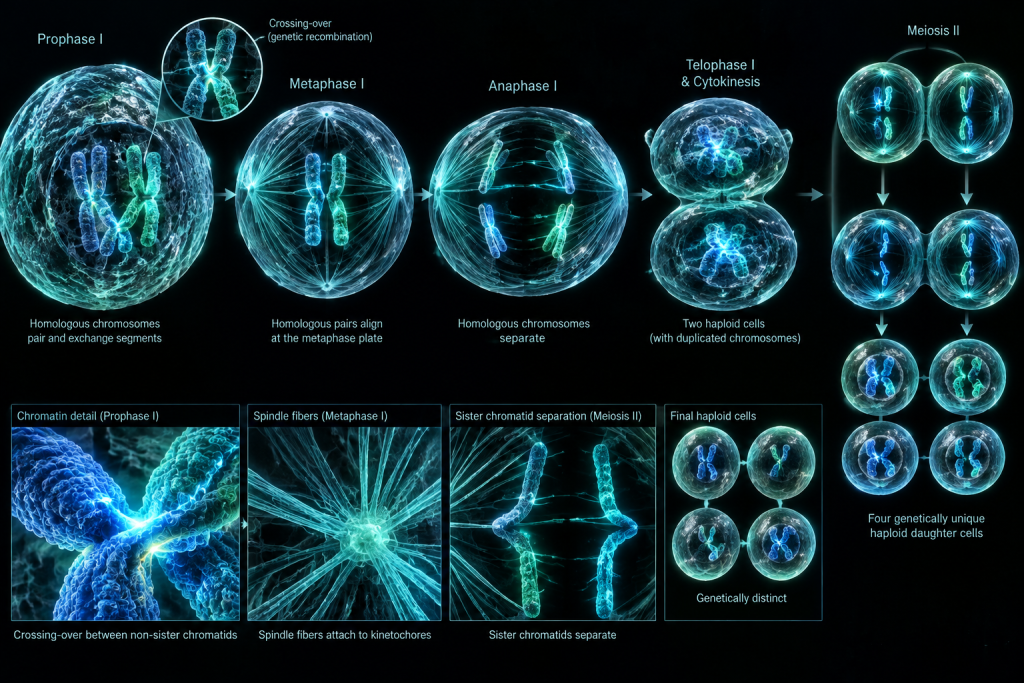
Image generated by AI
Every human being alive today exists because of a microscopic dance that happens millions of times per second inside our bodies. This dance, called meiosis, is so fundamental to life that without it, you simply would not exist. Yet despite its absolute centrality to human reproduction, most of us never learn how this cellular drama actually unfolds—or why evolution has maintained such an intricate, seemingly wasteful process for over a billion years. What could be so important about dividing a cell into four when one clean division into two would seem simpler?
The answer reveals something profound about the nature of life itself. Meiosis is not just a biological mechanism; it is a solution to one of evolution’s greatest challenges: how to create genetic diversity while maintaining stability across generations. In an era of advancing reproductive medicine, persistent infertility crises, and emerging threats to human fertility from environmental stressors, understanding meiosis has never been more urgent. From treating genetic diseases before birth to preserving endangered species, the science of how we divide our reproductive cells is reshaping medicine and conservation biology alike.
What Is Meiosis and Reproductive Cell Division?
Meiosis is a form of cell division that produces sex cells—sperm in males and eggs in females—each containing half the genetic material of the parent cell. Unlike mitosis, the process that creates identical copies of cells for growth and repair, meiosis is deliberately designed to shuffle and divide genetic information. It takes a diploid cell (one with two complete sets of chromosomes, one from each parent) and transforms it into four haploid cells (each with a single set of chromosomes). This halving of genetic information is essential because when sperm and egg fuse during fertilization, they restore the full diploid number, ensuring that offspring have the right amount of DNA without doubling it with each generation.
Meiosis was first observed in the 1880s by Belgian scientist Edouard van Beneden, who noticed that sea urchin eggs contained half the chromosomes of body cells. However, it was not until the early twentieth century that biologists fully mapped the choreography of the process and recognized its profound significance for heredity and evolution. August Weismann, a German biologist, theorized that a reduction division must occur before reproduction, and his prediction proved correct. This discovery helped lay the groundwork for understanding Mendelian genetics and eventually modern molecular biology. Today, meiosis stands as one of the most thoroughly studied and elegant processes in all of biology.
How It Works in Nature
Meiosis unfolds across two sequential divisions, dubbed Meiosis I and Meiosis II, each composed of distinct phases similar in name to mitosis but dramatically different in function. During Meiosis I, homologous chromosomes—pairs that carry similar genes but come from different parents—line up and physically exchange segments in a process called crossing over or recombination. This exchange is not random shuffling; it is a precisely choreographed dance involving hundreds of molecular proteins that ensure breaks occur at correct locations and are properly repaired. The homologous pairs then separate, with one chromosome from each pair moving to opposite poles of the cell. Meiosis II proceeds much like a normal mitotic division, with sister chromatids separating. By the end, four genetically unique haploid cells emerge where one diploid cell began.
Consider a more tangible analogy: imagine each chromosome as a cookbook, and genes as recipes. Your mother gave you one cookbook and your father gave you another—they contain similar recipes but with slight variations. During Meiosis I, these cookbooks are laid open and pages are physically swapped between them, creating new combinations that never existed before. When Meiosis II occurs, each modified cookbook is then photocopied and the copies separated. The result is four cookbooks, each unique, each containing recipes never seen in exactly this combination in your family before. This is why siblings look similar but different, why identical twins are such statistical miracles, and why the genetic lottery feels so profound.
Medical and Scientific Relevance
Meiotic errors are among the most common causes of human genetic disease and reproductive failure. When crossing over goes wrong or chromosomes fail to separate properly—a phenomenon called nondisjunction—the resulting gametes contain too many or too few chromosomes. If such a gamete participates in fertilization, the embryo inherits an abnormal chromosomal number, often leading to miscarriage or conditions like Down syndrome (trisomy 21). Advanced maternal age increases the risk of meiotic errors dramatically, which is why women over 35 face higher rates of chromosomal abnormalities. Understanding the molecular mechanisms that prevent these errors has become central to reproductive medicine and genetic counseling.
Today, this knowledge fuels practical applications that touch millions of lives. Preimplantation genetic testing (PGT) allows embryos created through in vitro fertilization to be screened for chromosomal abnormalities before implantation, dramatically reducing the risk of genetically abnormal pregnancies. Assisted reproductive technologies rely fundamentally on understanding what conditions optimize meiosis in laboratory settings. Additionally, research into meiotic regulation informs cancer biology, since many cancers arise from defects in the same checkpoint mechanisms that ensure accurate meiosis. Pharmaceutical companies and biotech firms are investing heavily in compounds that could protect meiotic fidelity, potentially expanding reproductive windows and improving success rates in fertility treatment.
Recent Breakthroughs in Meiosis and Reproductive Cell Division
In 2023 and 2024, several landmark discoveries have illuminated previously mysterious aspects of meiotic regulation. Researchers using advanced imaging techniques have visualized in real-time how the synaptonemal complex—the protein scaffold that holds homologous chromosomes together—assembles and disassembles with molecular precision. A team at MIT discovered that a key protein called Hormad1 acts as a “quality control” sensor that delays Meiosis I if crossing over has not occurred correctly, preventing gametes with improper recombination from being produced. Simultaneously, structural biologists have mapped the atomic-level architecture of recombination proteins, revealing how they find matching DNA sequences and facilitate exchange with stunning accuracy. These mechanistic insights are opening doors to interventions that could prevent meiotic errors.
Current research frontiers include developing methods to extend fertility by rejuvenating aging oocytes (egg cells), understanding why some individuals are infertile despite having no obvious chromosomal problems, and exploring whether environmental toxins interfere with meiotic regulation. Scientists are also investigating whether the meiotic machinery can be hacked to create gametes from somatic (body) cells, which could revolutionize reproductive medicine for those with damaged reproductive organs. Gene editing technologies like CRISPR are being cautiously explored for correcting genetic defects in meiotic cells, though ethical and safety questions remain unresolved.
Why Meiosis and Reproductive Cell Division Matters for the Future
As climate change and pollution increasingly threaten global biodiversity, understanding meiosis has become crucial for conservation biology. Species facing extinction often suffer from reduced genetic diversity, which makes populations vulnerable to disease and environmental change. Meiosis is the engine that generates the genetic variation populations need to adapt and survive. Techniques like assisted reproductive technology, developed initially for human medicine, are now being applied to endangered species breeding programs. By optimizing meiosis in captive populations of endangered animals, conservationists hope to maintain genetic health and even reintroduce diverse, genetically viable populations into the wild. The gray wolf, Arabian oryx, and California condor have all benefited from reproductive technologies grounded in meiotic biology.
The human implications are equally profound. As average childbearing age increases and environmental stressors accumulate, age-related decline in meiotic competence is becoming a more serious limitation to fertility. Developing drugs or therapies that preserve the capacity for accurate meiosis could extend reproductive windows, particularly for women. Conversely, some researchers worry that human-caused environmental disruptions—microplastics, endocrine-disrupting chemicals, radiation—may be silently damaging meiotic processes in millions of people, potentially creating a public health crisis that remains largely unrecognized. Understanding these risks requires deeper knowledge of meiotic vulnerability.
Key Takeaways
- Meiosis is a specialized form of cell division that produces sex cells with half the genetic material of parent cells, enabling sexual reproduction and genetic diversity across generations.
- The process involves two sequential divisions and a critical exchange of genetic material between homologous chromosomes called crossing over, which creates genetic variation in every gamete.
- Errors in meiosis cause most chromosomal abnormalities in human embryos, making it a central focus of reproductive medicine and preimplantation genetic testing technologies.
- Recent breakthroughs have revealed molecular-level quality control mechanisms in meiosis and opened possibilities for interventions to prevent genetic errors and potentially extend human fertility.
- Understanding meiosis is increasingly vital for addressing fertility challenges, conserving endangered species, and protecting human reproductive health against environmental threats.
Explore TED Talks on Meiosis and Reproductive Cell Division:
TED content is used under CC BY-NC-ND 4.0. © TED Conferences, LLC.
Frequently Asked Questions
Why does meiosis produce four cells with half the genetic material instead of just dividing a cell in two like mitosis does?
Meiosis produces four haploid cells (with half the DNA) so that when sperm and egg fuse during fertilization, the resulting offspring has the correct diploid number of chromosomes from both parents. This two-division process also creates genetic diversity through recombination and independent assortment, which is crucial for evolution and species survival.
How does meiosis create genetic diversity, and why is this important for populations?
Meiosis generates genetic diversity through two mechanisms: crossing over (recombination of DNA between homologous chromosomes) and independent assortment (random distribution of chromosome pairs). This diversity ensures that each offspring is genetically unique, which increases a population's ability to adapt to environmental changes and resist diseases.
What is the relationship between meiosis and infertility, and how does understanding meiosis help treat reproductive problems?
Errors during meiosis—such as nondisjunction (improper chromosome separation) or defective recombination—can produce gametes with abnormal chromosome numbers, leading to infertility or genetic disorders. Understanding these meiotic mechanisms allows reproductive medicine to diagnose chromosomal abnormalities, screen embryos for genetic diseases, and develop treatments to improve fertility outcomes.
Why has evolution maintained the complex process of meiosis for over a billion years despite it seeming inefficient?
Evolution has preserved meiosis because the genetic diversity it produces far outweighs the efficiency cost, giving sexually reproducing organisms a significant survival advantage in changing environments and against pathogens. The genetic variation created by meiosis allows populations to adapt and evolve much faster than asexual reproduction, making it ultimately more "efficient" for long-term species survival.