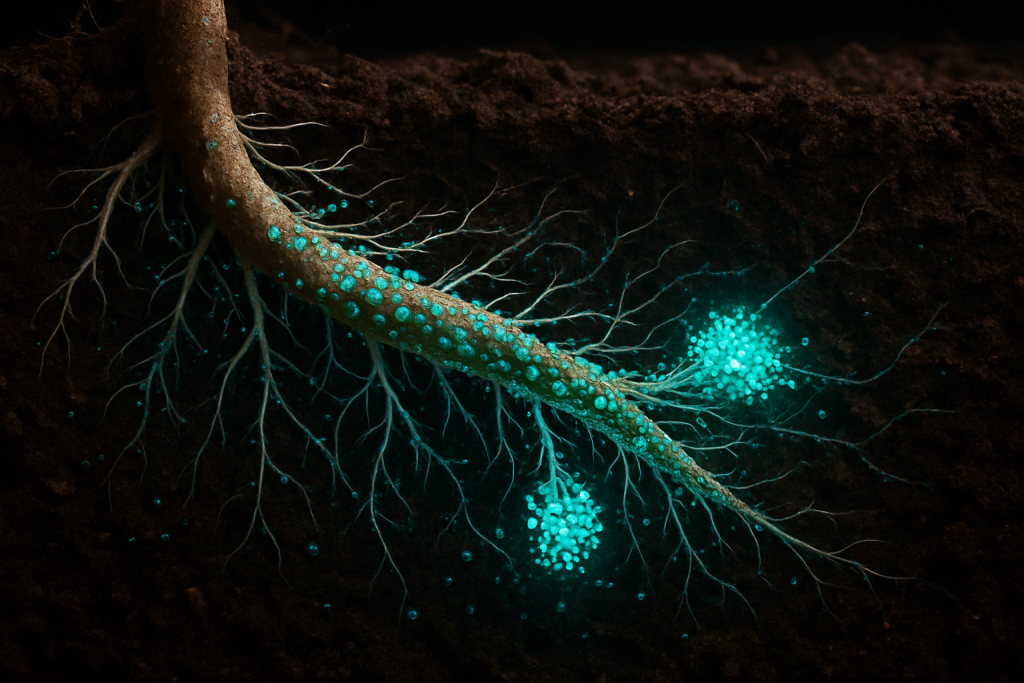
Image generated by AI
Beneath every plant’s roots lies an invisible economy of extraordinary complexity. Trillions of microorganisms—bacteria, fungi, and archaea—form intricate partnerships with plants, fundamentally reshaping how these organisms acquire the nutrients necessary for survival. These microbial-plant root interactions represent one of nature’s most consequential yet underappreciated collaborations, one that has literally shaped the evolution of terrestrial life. Without this partnership, plants as we know them would not exist, and neither would the ecosystems that depend on them.
Today, as we face the dual pressures of feeding a growing global population and addressing climate change, understanding these root-level partnerships has become urgently practical. Agricultural researchers and biotechnologists are increasingly turning to these microbial associations as a pathway toward sustainable farming, reduced chemical inputs, and crops resilient to environmental stress. The more scientists uncover about how microbes and roots communicate and trade resources, the closer we move toward reimagining agriculture itself—and potentially solving some of our most pressing ecological challenges.
What Is Microbial-Plant Root Interactions and Nutrient Acquisition?
Microbial-plant root interactions refer to the complex, mutually beneficial relationships that develop between plant roots and soil microorganisms. At its core, this is a resource-exchange system: plants produce sugars through photosynthesis and exude these carbon-rich compounds into the soil around their roots; in return, symbiotic microbes unlock nutrients like nitrogen, phosphorus, and other minerals that would otherwise remain inaccessible to the plant. This is not a simple transfer but rather a sophisticated dialogue, mediated by chemical signals, genetic exchanges, and even physical structures that both partners contribute. The microbes essentially become an extension of the plant’s root system, vastly expanding its capacity to forage in the soil environment.
The study of these interactions traces back to the late 1800s, though the full significance was not recognized until decades later. German botanist Albert Frank first documented mycorrhizal associations—relationships between fungi and plant roots—in 1885, observing that certain fungi seemed to depend on living within plant tissues rather than decomposing dead matter. Russian microbiologist Sergei Winogradsky discovered nitrogen-fixing bacteria in soil around the same period, establishing that microorganisms could transform atmospheric nitrogen into forms plants could use. However, it wasn’t until the second half of the twentieth century, with advances in molecular biology and microscopy, that scientists began to understand the genetic and biochemical sophistication underlying these partnerships. Today, we recognize these interactions as among the most evolutionarily ancient and ecologically important collaborations in nature.
How It Works in Nature
The mechanism of nutrient acquisition through microbial partnerships operates through several distinct but interconnected pathways. The most widespread and economically significant involves arbuscular mycorrhizal (AM) fungi, which penetrate the root cell walls of approximately eighty percent of terrestrial plants. The fungus extends threadlike filaments called hyphae deep into the soil, creating an underground network that can extend hundreds of times further than the plant’s roots alone. These hyphae possess enzymatic and chemical capabilities that allow them to break down complex organic matter and dissolve mineral-bound nutrients in the soil. In exchange, the fungus receives up to thirty percent of the plant’s photosynthetically derived sugars—a substantial metabolic investment that reflects the value of the relationship to both partners.
Consider a forest scene as a concrete analogy: imagine a plant’s roots as a small town, and the soil as a vast landscape. Without microbial partners, the roots could only scout resources within their immediate vicinity—perhaps a few millimeters away. But when fungi colonize the roots, they establish highways and trade routes extending far beyond the town’s borders, bringing back resources and information. The fungal filaments even communicate using chemical signals, essentially telling the plant “phosphorus is abundant to the north” or “water stress is increasing.” Simultaneously, nitrogen-fixing bacteria like those in the genus Rhizobium establish specialized nodules on legume roots, directly reducing atmospheric nitrogen gas into ammonia that the plant can incorporate into proteins. This process, called biological nitrogen fixation, generates usable nitrogen without the energy-intensive industrial Haber-Bosch process that currently underpins global agriculture.
Medical and Scientific Relevance
The implications of understanding microbial-plant root interactions extend far beyond academic botany into domains affecting human nutrition, health, and environmental security. Since the vast majority of terrestrial plants depend to some degree on these microbial associations, the health and diversity of soil microbial communities directly determines the nutrient density and yield of crops we consume. Research has shown that plants grown in soils with reduced microbial diversity often have lower concentrations of micronutrients like zinc and iron, potentially contributing to nutritional deficiencies affecting billions of people globally. Furthermore, these microbial associations can enhance plant resistance to pathogens and environmental stressors, reducing the need for chemical pesticides and creating more resilient agricultural systems. Understanding how to foster and optimize these relationships thus becomes a question not merely of agricultural efficiency but of public health.
Practical applications are already emerging in multiple industries. Biofertilizer companies now produce inoculants containing beneficial microbial consortia that farmers apply to seeds or soil to enhance nutrient acquisition and stress tolerance. Organic and regenerative agriculture practitioners increasingly emphasize soil microbial health as central to their philosophy, moving away from chemical fertilizers toward microbial partnerships. Pharmaceutical companies investigate root-associated microbes as sources of bioactive compounds, since the close chemical crosstalk in root zones has driven the evolution of potent secondary metabolites. Biotechnology firms are engineering crop varieties with enhanced ability to partner with beneficial microbes, creating what some call “super-cooperative” plants that extract more value from their microbial associations.
Recent Breakthroughs in Microbial-Plant Root Interactions and Nutrient Acquisition
Recent years have witnessed remarkable advances in deciphering the molecular language plants and microbes use to recognize and communicate with each other. In 2022 and 2023, research teams identified novel signaling compounds and receptor proteins that facilitate the initial “handshake” between plant roots and fungal partners, revealing an even more intricate chemical dialogue than previously understood. Scientists used cutting-edge techniques including metagenomic sequencing and single-cell transcriptomics to map the gene expression patterns in both plant and microbial partners simultaneously, showing how each responds to and influences the other in real time. One particularly striking finding emerged from studies of the “holobiont” concept—the idea that a plant and its associated microbes function as an integrated biological unit with shared evolutionary interests, rather than as separate organisms that merely cooperate. This conceptual shift has profound implications for how we understand plant biology and design agricultural interventions.
Current research frontiers include efforts to predict which microbial consortia will most benefit specific plant varieties in particular soil and climate conditions—essentially creating personalized microbial prescriptions for crops. Scientists are also investigating whether we can enhance the efficiency of nutrient transfer across the mycorrhizal symbiosis, potentially increasing crop yields by ten to twenty percent without additional chemical inputs. Another active area explores how climate change might disrupt these finely-tuned partnerships, and whether we can identify or breed microbial strains resilient to projected future conditions. Open questions remain about the full diversity of root-associated microbes and their collective functions—current estimates suggest we have identified only a small fraction of the microbial species present in soil root zones.
Why Microbial-Plant Root Interactions and Nutrient Acquisition Matters for the Future
As global agriculture faces converging crises—soil degradation, freshwater scarcity, chemical pollution, and climate instability—optimizing microbial-plant partnerships represents perhaps the most promising lever for creating truly sustainable food systems. By harnessing these natural collaborations more effectively, we could reduce synthetic fertilizer use by thirty to fifty percent while maintaining or increasing yields, simultaneously reducing the substantial environmental footprint of industrial agriculture and improving soil carbon sequestration. This matters profoundly for climate mitigation, since soils represent the largest terrestrial carbon reservoir, and microbial communities play crucial roles in determining whether soil acts as a carbon sink or source. For developing nations with limited access to expensive agrochemicals, enhancing microbial partnerships could dramatically improve food security and farmer livelihoods without requiring costly infrastructure investments. The transition toward microbial-mediated agriculture also offers a pathway toward decoupling food production from fossil fuel dependency, since nitrogen fixation by microbes requires only atmospheric nitrogen and plant sugars, not petroleum-derived inputs.
However, significant challenges remain before this vision can be fully realized. Soil microbial communities are extraordinarily complex, and intervening in these systems remains somewhat imprecise—introducing beneficial microbes doesn’t always succeed, particularly in degraded soils where existing microbial diversity is compromised. Scaling microbial inoculants to the billions of hectares under cultivation globally presents logistical and economic challenges. Regulatory frameworks for microbial products lag significantly behind the science, creating uncertainty for companies developing these applications. Additionally, we must ensure that emphasizing microbial partnerships doesn’t diminish focus on other critical agricultural practices, such as crop rotation, reduced tillage, and diverse polycultures that all support soil health through different mechanisms.
Key Takeaways
- Microbial-plant root interactions represent ancient, sophisticated partnerships where microbes help plants acquire otherwise inaccessible nutrients in exchange for photosynthetically-derived sugars, benefiting both partners.
- The primary mechanisms involve arbuscular mycorrhizal fungi extending root-like filaments into soil to access nutrients and water, and nitrogen-fixing bacteria converting atmospheric nitrogen into plant-usable forms.
- Practical applications include microbial inoculants for agriculture, reduced chemical fertilizer use, enhanced crop resilience to stress, and improved nutrient density in food crops.
- Recent breakthroughs have mapped the molecular signaling systems between plants and microbes in unprecedented detail, revealing these relationships as integrated “holobionts” with shared evolutionary interests.
- Optimizing these partnerships offers transformative potential for sustainable agriculture, climate mitigation, and global food security, though challenges in scalability and complexity remain.
Explore TED Talks on Microbial-Plant Root Interactions and Nutrient Acquisition:
TED content is used under CC BY-NC-ND 4.0. © TED Conferences, LLC.
Frequently Asked Questions
How do microorganisms in the soil actually transfer nutrients to plant roots?
Microorganisms break down organic matter and mineral compounds in soil through enzymatic processes, making nutrients bioavailable, while fungi form symbiotic associations like mycorrhizae that extend root reach and facilitate direct nutrient exchange across fungal-plant cell membranes. Bacteria also solubilize phosphorus and fix atmospheric nitrogen into forms plants can absorb.
What is the mechanism behind mutual benefit in microbial-plant root partnerships?
Plants provide microorganisms with carbohydrates and organic compounds through root exudates, while microorganisms enhance nutrient acquisition and stress tolerance for the plant in a reciprocal exchange. This mutualism evolved because both partners gain survival advantages that outweigh the metabolic costs of cooperation.
Can microbial-plant root interactions reduce the need for chemical fertilizers in agriculture?
Yes, by leveraging naturally occurring microbial associations, farmers can enhance nutrient availability and uptake efficiency, potentially decreasing dependence on synthetic fertilizers while improving soil health and crop resilience. However, effectiveness depends on soil conditions, crop type, and microbial community composition.
Why would plants have evolved such complex relationships with soil microorganisms?
Plants evolved these partnerships because soil microorganisms solve a critical constraint: most essential nutrients like phosphorus and nitrogen are locked in forms plants cannot directly access, making microbial partners essential for terrestrial survival. This co-evolution over millions of years created interdependence that fundamentally shaped the development of land ecosystems.