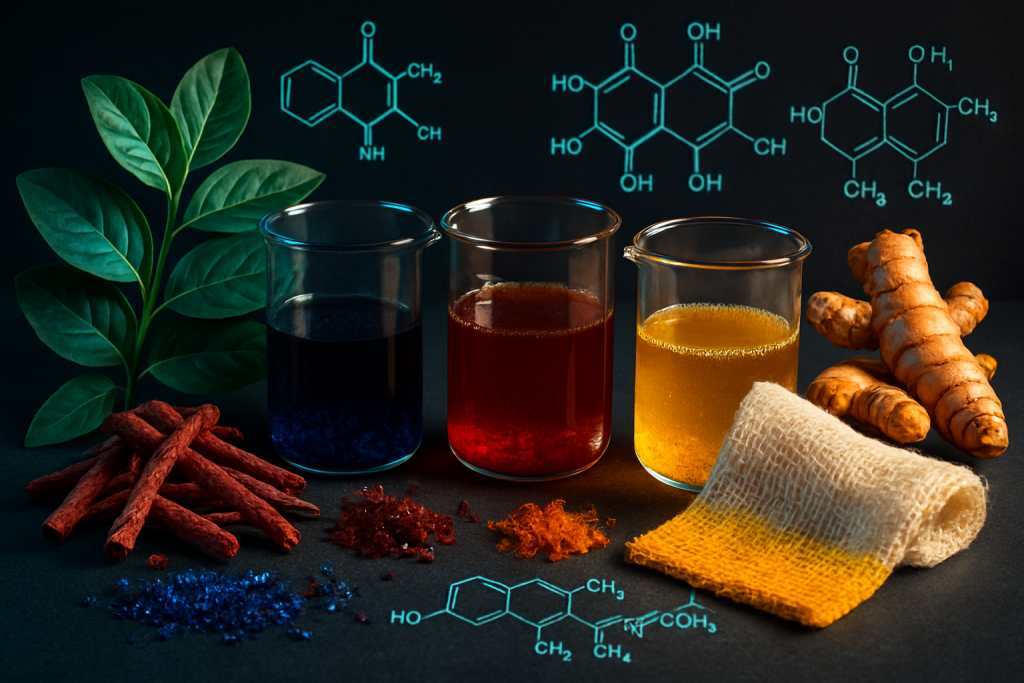
Image generated by AI
Every vibrant red dress, ocean-blue sweater, and forest-green jacket you own likely owes its color to synthetic chemistry—but that wasn’t always the case. For thousands of years, humans dyed fabrics using crushed insects, plant extracts, and mineral compounds, creating colors so vivid and enduring that ancient textile treasures still display their original hues today. Yet despite the sophistication of modern synthetic dyes, which now dominate the $25 billion global textile industry, scientists are increasingly returning to nature’s palette, reimagining ancient techniques through cutting-edge chemistry to solve one of fashion’s most intractable problems: the environmental catastrophe of industrial dyeing.
The fashion industry ranks among the world’s largest polluters, with textile dyeing and treatment accounting for nearly 10 percent of global carbon emissions and consuming more water than any other industry except agriculture. As climate change accelerates and consumers demand greater transparency about the products they wear, textile manufacturers, chemists, and fashion brands are racing to develop a new generation of natural dyes that could transform how clothing gets its color—without sacrificing the durability, consistency, or affordability that modern consumers expect. This scientific renaissance in natural dyes represents far more than nostalgia; it reflects a fundamental shift in how we think about chemistry itself, from linear industrial processes toward circular, biological solutions that work with nature rather than against it.
What Is Natural Dyes and Sustainable Textile Chemistry?
Natural dyes are colorants extracted from biological sources—primarily plants, insects, and minerals—that chemically bond with textile fibers to produce color that resists fading through washing and sunlight exposure. Unlike synthetic dyes, which are petroleum-derived compounds engineered in laboratories, natural dyes work through the same fundamental chemical principles but originate from living organisms or earth. The key distinction lies not in whether the chemistry is “natural” or “artificial”—all dyes operate through identical mechanisms of molecular interaction—but rather in the feedstocks used to create them and the environmental implications of their production, processing, and disposal.
Humans began dyeing textiles at least 5,000 years ago, with archaeological evidence suggesting that Egyptians used indigo from the indigofera plant and madder root for crimson dyes as early as 2500 BCE. Throughout the medieval period and Renaissance, European dyers developed sophisticated knowledge systems around natural colorants, commanding enormous prices for rare compounds like cochineal (a bright red from insects native to Mexico) and lapis lazuli (a vivid blue mineral from Afghanistan). The Industrial Revolution transformed this landscape entirely when chemists, beginning with William Henry Perkin’s accidental discovery of the first synthetic dye in 1856, developed petroleum-based alternatives that could be manufactured cheaply, consistently, and in unlimited quantities, rendering natural dyes economically obsolete almost overnight.
The Chemistry Behind It
At their core, all dyes work through a process called chromophore-fiber interaction, where colored molecular structures (chromophores) attach to textile fibers through various chemical bonds. Natural dyes typically contain polyphenolic compounds—molecules with multiple hydroxyl groups (-OH) that readily form hydrogen bonds and coordinate bonds with the cellulose in cotton or the protein structures in wool and silk. What makes a dye effective isn’t whether it’s natural or synthetic but whether these molecular bonds are sufficiently strong and numerous to withstand the mechanical and chemical stresses of washing, wearing, and exposure to ultraviolet radiation. The challenge that stymied natural dyes for over a century was achieving the consistency, strength, and lightfastness that synthetic dyes provided through careful molecular engineering.
Consider indigo, perhaps the most historically important natural dye and still the colorant of choice for denim despite most modern jeans using synthetic indigo. Indigo molecules are large, planar structures that stack on top of each other on the fiber surface, creating a deep blue through a process called van der Waals interactions—weak but numerous physical attractions between molecules. In traditional dyeing, fabric is repeatedly dipped in an indigo vat that contains alkaline conditions and a reducing agent, gradually building up layers of indigo molecules. Modern chemists have discovered that by adjusting pH levels, adding natural mordants (chemical fixatives that create bridges between dye and fiber), and controlling fermentation processes, they can achieve indigo colors indistinguishable from synthetic versions while using plant-derived sources, demonstrating that the divide between “natural” and “synthetic” is ultimately a matter of production methods rather than chemical properties.
Where It Is Used Today
Natural dyes have experienced a remarkable resurgence in premium fashion and artisanal textiles over the past decade, with luxury brands like Hermès, Patagonia, and smaller sustainable labels increasingly incorporating plant-based and mineral colorants into their collections. Beyond fashion, researchers have identified applications in home textiles, automotive upholstery, medical textiles (where reduced chemical exposure becomes medically relevant), and even technical fabrics for outdoor gear. The global natural dyes market, valued at approximately $1.5 billion in 2023, is projected to grow at over 8 percent annually as regulations around wastewater from synthetic dye facilities tighten and consumer awareness of environmental impacts increases, creating both economic incentives and market pull for natural alternatives.
Major textile producers in India, Indonesia, and Peru have begun establishing supply chains for natural dye sources, with companies like Archroma and DyStar developing hybrid approaches that combine natural colorants with novel fixation techniques. Indian textile manufacturers in clusters around Jaipur and Varanasi have revived centuries-old dyeing traditions while incorporating modern chemistry, producing fabrics that maintain the aesthetic qualities consumers associate with hand-dyed textiles while achieving industrial-scale consistency. In Japan, the traditional indigo dyeing technique called aizome has experienced a cultural and commercial revival, with contemporary designers proving that natural indigo can meet performance requirements equivalent to synthetic alternatives for contemporary wardrobes, suggesting that market adoption depends not on technological impossibility but on scaling production economics and developing adequate supply chains.
Recent Breakthroughs in Natural Dyes and Sustainable Textile Chemistry
One of the most significant developments in the field emerged from research published in Nature Sustainability in 2023, where scientists discovered that black soldier fly larvae can efficiently convert agricultural waste into chitin-based compounds that function as natural mordants—dramatically reducing the chemical processing required to fix plant-based dyes to fabrics. Simultaneously, researchers at the University of Georgia and collaborators in India developed enzymatic processes using peroxidase enzymes (proteins that accelerate chemical reactions) derived from horseradish and mushrooms to chemically activate plant extracts, creating deeper, faster color development without requiring heavy metal mordants like chromium or copper that have plagued natural dyeing’s environmental reputation. These breakthroughs suggest a pathway toward truly “clean” natural dyeing where bioprocessing—using living organisms to generate desired chemical outcomes—replaces the industrial chemistry that made synthetic dyes seem superior in the first place.
Ongoing research focuses on two frontier challenges: expanding the color palette available from natural sources and improving the lightfastness of certain hues, particularly reds and yellows derived from plants. Scientists are exploring how genetic modification of dye-producing plants could enhance chromophore concentration, reducing the land area and water required to produce equivalent quantities of colorant, while computational chemistry researchers are modeling how different polyphenolic structures interact with fiber proteins to predict which plant compounds might produce novel colors. Simultaneously, researchers are investigating whether certain dye compounds from agricultural waste streams—such as the anthocyanins in grape pomace or the tannins in chestnut shells—might be extracted and concentrated to replace more traditional sources, turning byproducts into valuable inputs.
Why Natural Dyes and Sustainable Textile Chemistry Matters for the Future
The rise of natural dyes represents a fundamental reimagining of how chemistry can serve sustainability—not through prohibition of chemicals but through smarter molecular design and the adoption of biological processes that can operate at scale. As the fashion industry confronts binding commitments to reduce water consumption and carbon emissions, and as regulatory frameworks in Europe, China, and California increasingly restrict the discharge of synthetic dye byproducts into waterways, the competitive advantage shifts toward companies that can deliver color through renewable, less chemically intensive processes. The broader significance extends beyond textiles: the principles underlying natural dye chemistry—understanding how biological molecules interact with materials, developing enzymatic processes for chemical transformations, and creating supply chains that convert agricultural byproducts into valuable compounds—offer templates for sustainability across the chemical industry.
Yet substantial obstacles remain before natural dyes can meaningfully displace synthetic alternatives at the industrial scale required to impact global environmental metrics. The cost structure still favors synthetic indigo and azo dyes, which benefit from over a century of manufacturing optimization and petroleum subsidies; natural dyes remain 2 to 5 times more expensive at equivalent color depth and consistency. Variability in natural sources—seasonal fluctuations in plant composition, geographical differences in mineral deposits, crop failures—creates supply chain vulnerabilities that fashion’s just-in-time manufacturing systems struggle to accommodate. Additionally, the romance of “natural” obscures genuine complications: scaling natural dye production to replace synthetic alternatives would require converting vast agricultural land to dye plant cultivation, potentially creating new environmental pressures through monoculture farming, increased pesticide use, and altered land use patterns.
Key Takeaways
- Natural dyes are plant, insect, and mineral-derived colorants that work through identical chemical mechanisms as synthetic dyes, producing color through molecular bonds with textile fibers rather than fundamentally different chemistry.
- The dyeing process bonds chromophore molecules to fibers through hydrogen bonding, coordinate bonds, and van der Waals interactions, with the strength and durability of these bonds determining color quality regardless of whether the dye originates from nature or petroleum.
- The most promising near-term applications combine traditional dye sources like indigo and madder with modern chemistry techniques including enzymatic activation and bioengineered mordants that improve efficiency and reduce environmental impact.
- Recent breakthroughs in using enzyme-mediated processes and agricultural waste streams demonstrate that truly sustainable dyeing chemistry may emerge not from abandoning chemistry but from applying biological processes at industrial scale.
- Natural dyes matter for the future because they offer a pathway toward closing the feedback loop between fashion and agriculture, transforming the textile industry from a linear resource-extraction model toward circular systems that create value from biological waste streams.
Explore TED Talks on Natural Dyes and Sustainable Textile Chemistry:
TED content is used under CC BY-NC-ND 4.0. © TED Conferences, LLC.
Frequently Asked Questions
How do natural dyes chemically bond to fabric fibers differently than synthetic dyes?
Natural dyes typically rely on mordants—metal salts like alum or iron—that form coordinate bonds between the dye molecules and protein or cellulose fibers, whereas synthetic dyes often contain reactive groups that covalently bind directly to fabrics. This mordant-dependent mechanism in natural dyes can require additional chemical treatment steps but can produce highly stable color compounds once properly fixed.
Why have ancient textiles dyed with natural dyes retained their color better than expected over thousands of years?
Many natural dyes, particularly those from plant tannins and mineral sources, form extremely stable chemical complexes with fibers—especially when mordanted—that resist photodegradation and chemical breakdown far better than initially predicted. The chemical structure of these compounds, combined with the protective effects of mordant bonding, creates exceptionally durable colorfast textiles that can outlast many modern synthetic alternatives.
What are the main environmental advantages of natural dyes over the synthetic dyes that dominate the $25 billion textile industry?
Natural dyes eliminate the synthesis of petroleum-derived aromatic compounds and reduce toxic byproducts like azo dyes and heavy metal catalysts, while also being biodegradable and requiring fewer chemical processing steps in many cases. However, natural dyes often require more water for extraction and larger land use for cultivation, making the overall environmental calculation complex and dependent on specific sourcing and application methods.
Can natural dyes achieve the same color consistency and fastness (durability) standards as modern synthetic dyes without sacrificing affordability?
This remains an active area of scientific research, as natural dyes currently struggle with batch-to-batch variability and sometimes require multiple applications or extended mordanting times to match synthetic dye performance. Emerging techniques using natural dye concentrates, optimized mordant chemistry, and novel extraction methods show promise for improving consistency and reducing costs, though scaling these solutions to industrial production levels is still being developed.