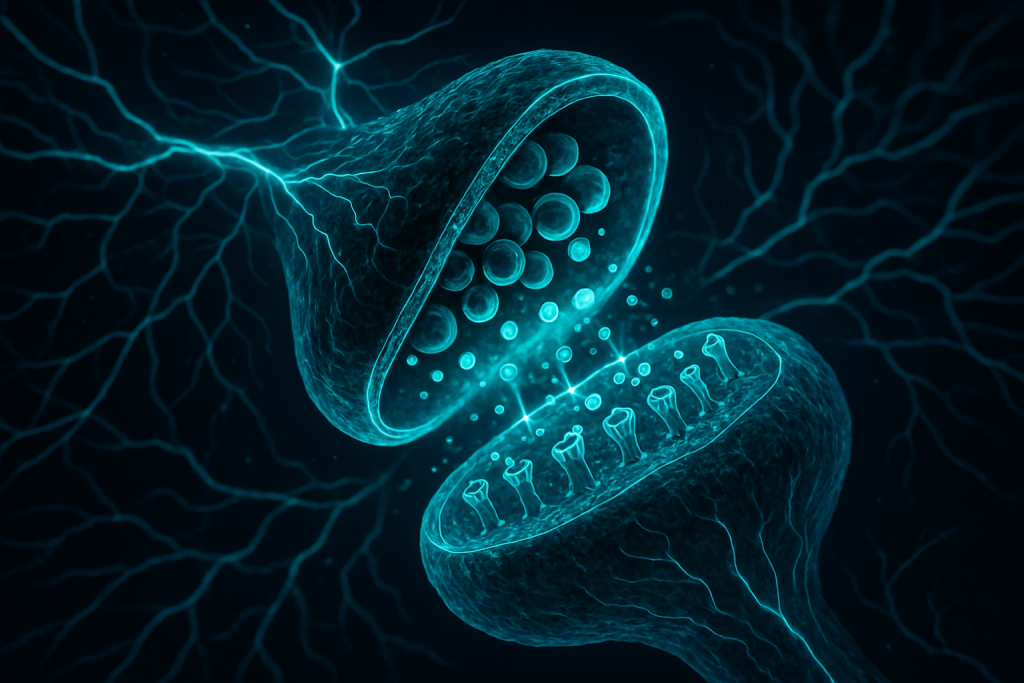
Image generated by AI
Every decision you make, every emotion you feel, every thought that crosses your mind emerges from an intricate chemical conversation happening inside your brain. Billions of neurons fire in coordinated patterns, communicating through tiny gaps called synapses by releasing molecules called neurotransmitters. These chemical messengers—dopamine, serotonin, glutamate, GABA, and dozens of others—don’t just relay signals; they fundamentally shape how you perceive the world, regulate your mood, and respond to stress. Yet for most of human history, we had no idea these molecules existed, let alone that they were the biological foundation of consciousness itself.
Understanding neurotransmitter systems has become one of the most urgent scientific frontiers of our time. Depression, anxiety, schizophrenia, attention deficit disorders, and addiction affect hundreds of millions of people worldwide, yet we still cannot fully predict who will develop these conditions or why our current treatments work for some patients but not others. Recent advances in neuroscience are finally revealing how neurotransmitter imbalances translate into suffering, and researchers are developing increasingly sophisticated ways to monitor and manipulate these systems. The stakes could not be higher: by decoding the chemistry of mental states, we may unlock new treatments for conditions that have resisted cure for centuries.
What Is Neurotransmitter Systems and Mental State?
Neurotransmitter systems are the brain’s chemical communication networks—complex, interconnected pathways where specific molecules bind to receptors on neurons to alter electrical activity and influence behavior, cognition, and emotion. A neurotransmitter is a small molecule synthesized and released by neurons to transmit signals to other neurons, muscle cells, or glands across synaptic gaps. When a neuron fires, an electrical impulse travels down its axon until it reaches the synapse, where the electrical signal triggers the release of neurotransmitter molecules into the synaptic cleft. These molecules diffuse across the gap and bind to receptors on the receiving cell, either exciting or inhibiting its activity. The system is exquisitely regulated: neurotransmitters are broken down by enzymes, reabsorbed by the releasing neuron, or diffuse away, ensuring that signals don’t persist indefinitely and that the brain maintains balance.
The discovery of neurotransmitters fundamentally transformed our understanding of the brain’s mechanics. In the late 1800s, Santiago Ramón y Cajal and Camillo Golgi revealed through microscopy that the brain was not a continuous network but rather a collection of distinct cells—neurons—that communicated across gaps. Yet how signals jumped these gaps remained mysterious until the 1920s, when Otto Loewi conducted his famous experiment demonstrating that the heart’s vagus nerve released a chemical substance that could slow another heart’s beating even when the nerve was not directly connected. This discovery established that neurons communicated chemically, not electrically. Over the following decades, scientists identified the major neurotransmitters and their receptors, revealing that the brain was essentially a chemical system—a revelation that would eventually lead to psychiatric medications targeting these molecules.
How It Works in Nature
Neurotransmitter systems operate through a process of remarkable specificity and temporal precision. Each neurotransmitter is synthesized from precursor molecules in the cell body or axon terminal, packaged into tiny vesicles, and held in readiness for release. When an action potential arrives at the axon terminal, voltage-gated calcium channels open, and calcium floods in, triggering a cascade of molecular interactions that cause vesicles to fuse with the cell membrane and release their contents into the synaptic cleft. The released neurotransmitter molecules diffuse across the synapse and encounter receptors on the postsynaptic cell—lock-and-key structures that are highly selective for specific neurotransmitters. When a neurotransmitter binds to its receptor, it causes the receptor to change shape, typically opening or closing an ion channel that allows charged particles to flow into or out of the cell, altering its electrical potential and making it more or less likely to fire.
Consider dopamine, one of the brain’s most consequential neurotransmitters. Dopamine is produced in small clusters of neurons in the midbrain but projects to virtually every major brain region. When you anticipate a reward—a delicious meal, social approval, or solving a difficult problem—dopamine-releasing neurons fire in a coordinated burst, creating a surge of dopamine in the prefrontal cortex and striatum. This surge doesn’t make you feel pleasure directly; rather, it encodes the expectation of reward and motivates you to pursue the goal. The same dopamine system is disrupted in addiction: repeated exposure to drugs causes dopamine neurons to become hyper-responsive to drug-related cues while becoming less responsive to natural rewards, creating the craving and anhedonia—inability to feel pleasure—that characterize addiction. This is why understanding dopamine systems has proven essential for treating substance use disorders and why dopamine-modulating medications are among the most prescribed psychiatric drugs.
Medical and Scientific Relevance
The clinical implications of neurotransmitter science are profound and far-reaching. The discovery that depression was associated with low levels of serotonin led to the development of selective serotonin reuptake inhibitors (SSRIs), medications that prevent serotonin reabsorption and thus increase its availability in synapses. SSRIs have become the most commonly prescribed antidepressants worldwide, benefiting millions of people, though they work only in about 60-70 percent of patients and take weeks to exert their effects—suggesting that the serotonin hypothesis, while important, does not capture the full picture of depression. Similarly, antipsychotic medications block dopamine receptors, which effectively reduces hallucinations and delusions in schizophrenia, though they often cause movement disorders as a side effect. Understanding these mechanisms has revealed why one-size-fits-all approaches fail: patients have different genetic variations in the enzymes that synthesize and metabolize neurotransmitters, in the receptors that bind them, and in the systems that regulate their release.
Pharmaceutical companies now invest billions in drug development targeting neurotransmitter systems, with novel antidepressants, anxiety medications, and cognitive enhancers in various stages of clinical trials. Psychedelic substances like psilocybin and LSD, which interact with serotonin receptors, are undergoing renaissance research for treatment-resistant depression and PTSD, with some early trials showing remarkable efficacy. Researchers are also exploring ketamine, which blocks glutamate receptors and produces rapid antidepressant effects, sometimes within hours rather than weeks. Additionally, neurotransmitter biomarkers are increasingly used in research and clinical settings to predict treatment response and guide personalized medicine—measuring cerebrospinal fluid or blood levels of neurotransmitter metabolites, or using advanced imaging techniques to visualize receptor availability in living brains.
Recent Breakthroughs in Neurotransmitter Systems and Mental State
The past few years have witnessed remarkable advances in our ability to map and manipulate neurotransmitter systems with unprecedented precision. In 2023 and 2024, researchers developed new optical and chemical tools that allow them to visualize neurotransmitter release in real time at single-synapse resolution, revealing that neurotransmitter signaling is far more complex and spatially organized than previously appreciated. These studies showed that neurotransmitters don’t diffuse uniformly across synapses but rather activate different receptors in distinct microdomains, with different temporal dynamics—some receptors are activated milliseconds after release while others are activated minutes later. This fine-grained understanding is reshaping drug design, as researchers now appreciate that blocking all receptors for a neurotransmitter may be counterproductive; instead, selectively targeting specific receptor subtypes in specific brain regions might provide benefits without side effects.
Another major breakthrough involves understanding how neurotransmitter systems change across the lifespan and in response to experience. Longitudinal studies are revealing that mental health conditions involve not static neurotransmitter imbalances but rather dynamic changes in how neurotransmitter systems respond to environmental challenges. Researchers are also uncovering the epigenetic mechanisms—changes in gene expression that don’t involve DNA sequence mutations—by which stress, trauma, and early life experiences reshape neurotransmitter systems. Simultaneously, computational neuroscience is making progress in modeling how billions of neurons with diverse neurotransmitter profiles interact to produce thoughts and emotions, though these models remain incomplete. Open questions include how to predict individual treatment response, how to restore balance to severely dysregulated systems, and how to leverage neurotransmitter knowledge to prevent mental illness rather than merely treating it after onset.
Why Neurotransmitter Systems and Mental State Matters for the Future
As neurotransmitter science advances, it promises to revolutionize psychiatry and neurology from a symptom-management discipline into a mechanistic, precision-medicine field. Imagine a future in which psychiatrists can measure a patient’s specific neurotransmitter profile—their genetic predispositions, receptor availability, and current brain chemistry—and predict with high accuracy which medications will work, which doses will be effective, and what side effects to expect. Such precision medicine approaches are beginning to emerge, informed by large-scale studies linking genetic variations in neurotransmitter-related genes to treatment response. The implications extend beyond individual therapy: understanding neurotransmitter systems in populations could inform public health policies, revealing how social determinants like poverty, discrimination, and social isolation affect brain chemistry and mental health. This understanding might also inform prevention strategies, such as targeted lifestyle interventions that support healthy neurotransmitter function before illness develops.
However, significant challenges remain. The brain’s neurotransmitter systems are staggeringly complex, with over 100 different neurotransmitters and thousands of distinct receptor subtypes, many of which have not been fully characterized. Neurotransmitter systems interact in nonlinear ways, such that manipulating one system often produces unexpected effects on others. Additionally, while medications can modulate neurotransmitter levels, the brain possesses remarkable plasticity and compensatory mechanisms that limit how much behavior and emotion can be altered through chemistry alone—explaining why psychotherapy, lifestyle changes, and social connection remain essential components of mental health treatment. The ethical implications are also profound: as we gain the ability to modify mental states through neurotransmitter manipulation, societies will grapple with questions about authenticity, coercion, and the right to mental diversity.
Key Takeaways
- Neurotransmitter systems are the brain’s chemical communication networks, where molecules like dopamine, serotonin, and glutamate bind to receptors and shape thoughts, emotions, and behavior.
- Neurotransmitter signaling occurs through exquisite molecular mechanisms: synthesis, packaging, calcium-triggered release, receptor binding, and reuptake or degradation, ensuring precise temporal and spatial control of neural communication.
- Most psychiatric medications target neurotransmitter systems, though their mechanisms remain incompletely understood and individual treatment response varies dramatically due to genetic and experiential factors.
- Recent breakthroughs in optical imaging, computational modeling, and epigenetic research are revealing that neurotransmitter systems are vastly more complex than previously appreciated, changing how researchers approach drug design and precision psychiatry.
- Understanding neurotransmitter systems is essential for developing more effective treatments for depression, anxiety, schizophrenia, addiction, and neurological diseases, while also raising profound questions about the nature of consciousness and personal autonomy.
Explore TED Talks on Neurotransmitter Systems and Mental State:
TED content is used under CC BY-NC-ND 4.0. © TED Conferences, LLC.
Frequently Asked Questions
How do neurotransmitters actually transmit signals between neurons across synapses?
When a neuron fires, it releases neurotransmitter molecules into the synaptic gap, where they bind to specific receptors on the receiving neuron's membrane, either exciting or inhibiting its electrical activity. This chemical-to-electrical conversion allows billions of neurons to communicate and coordinate their firing patterns throughout the brain.
Why do neurotransmitter imbalances lead to mental health conditions like depression and anxiety?
Neurotransmitters regulate critical brain functions including mood regulation, stress response, and emotional processing; when their levels or receptor sensitivity become dysregulated, these systems malfunction and produce symptoms of mental illness. For example, low serotonin is associated with depression because serotonin normally promotes mood stability and emotional resilience.
What makes current neurotransmitter-based treatments effective for some patients but not others?
Individual differences in neurotransmitter receptor genetics, enzyme activity, and brain chemistry variations mean that the same medication produces different biochemical effects across patients, explaining why selective serotonin reuptake inhibitors (SSRIs) help some people but not others. Researchers still cannot fully predict these individual responses, which is why personalized medicine approaches are increasingly important.
Are researchers able to directly measure neurotransmitter levels in a living human brain?
Modern neuroimaging techniques like positron emission tomography (PET) and functional magnetic resonance imaging (fMRI) can indirectly measure neurotransmitter activity and receptor binding in living brains, though direct chemical sampling remains limited to research settings. These advancing technologies are helping scientists understand the specific neurotransmitter patterns associated with different mental states and disorders.