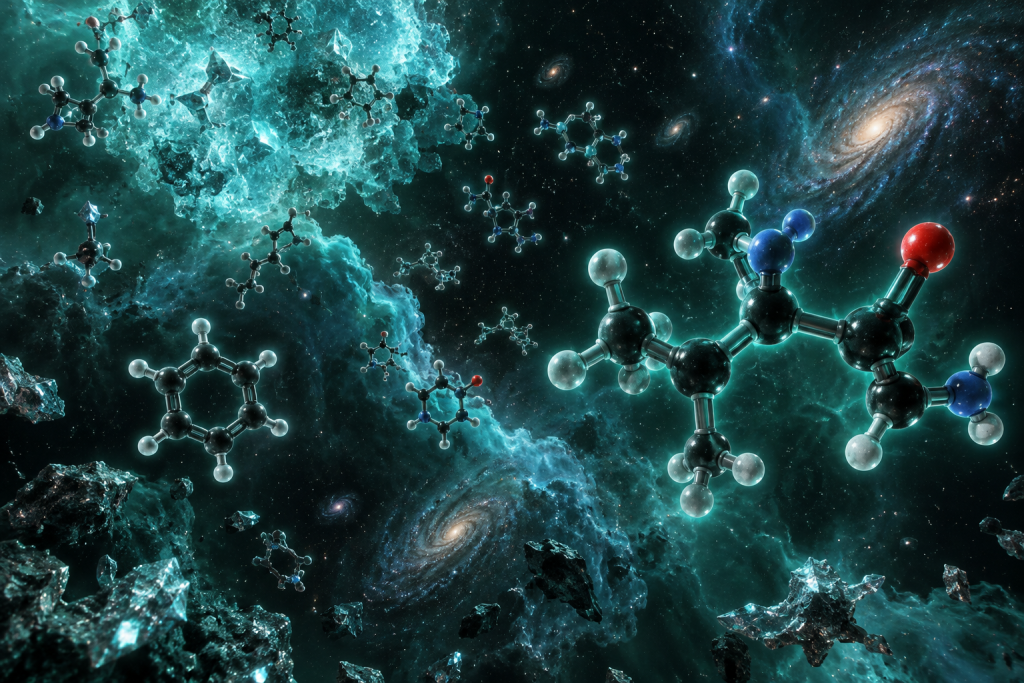
Image generated by AI
Deep in the void between stars, where temperatures plunge to near absolute zero and radiation bathes the cosmos in harsh ultraviolet light, chemistry thrives in ways that earthbound laboratories can barely replicate. Scientists have discovered that space is not the sterile, empty expanse we once imagined, but rather a cosmic laboratory where organic molecules—the very building blocks of life as we know it—form spontaneously in interstellar clouds, on the surfaces of asteroids, and in the atmospheres of distant planets. This revelation fundamentally challenges our understanding of how chemistry works and raises a profound question: if complex organic molecules can assemble themselves in the hostile environment of space, what does that tell us about life’s origins and its prevalence throughout the cosmos?
The discovery of organic molecules in space has ignited a scientific revolution with implications that extend far beyond astronomy. Researchers now understand that the chemical complexity we observe in distant nebulae and comets may hold crucial clues about how life began on Earth and whether biological processes might emerge elsewhere in the universe. This knowledge shapes ongoing missions to asteroids and moons, informs our search for extraterrestrial life, and even influences how we think about contamination and protection when we send spacecraft to other worlds. Understanding these cosmic chemical processes has become essential to astrobiology, planetary science, and our fundamental conception of how the universe works.
What Is Organic Molecules and Chemical Complexity in Space?
Organic molecules are carbon-based compounds that, on Earth, are the foundation of all living things. In space, these molecules form through non-biological processes—chemistry stripped of life, operating under extreme conditions that would seem impossible for complex structures to emerge. When we speak of chemical complexity in space, we mean the surprising ability of these cosmic environments to produce increasingly intricate molecular structures, from simple carbon monoxide and formaldehyde to elaborate compounds like sugars, amino acids, and polycyclic aromatic hydrocarbons (PAHs). These molecules don’t require a planet, an atmosphere, or anything resembling Earth’s conditions to form; they spontaneously assemble in the cold darkness between stars, on meteorite surfaces, and in the tails of comets. The sheer existence of organic chemistry in space suggests that the building blocks for life may be far more ubiquitous than life itself.
The recognition of organic molecules in space began in earnest during the 1960s and 1970s, when astronomers using radio telescopes detected the spectral signatures of simple molecules like ammonia and water vapor in interstellar clouds. The landmark discovery came in 1969 when scientists examined the Murchison meteorite that fell in Australia, revealing it contained over 100 different amino acids—the very compounds that form proteins in living organisms. Subsequent observations from space-based and ground-based telescopes pushed the boundaries further, revealing increasingly complex molecules: ethylene glycol (antifreeze), naphthalene (found in mothballs), and even molecules with twenty or more atoms. Each discovery expanded our catalog of cosmic chemistry and demonstrated that the universe possessed a hidden chemical sophistication we had barely begun to appreciate.
What We Know So Far
Organic molecules in space form through several interconnected mechanisms, each contributing to the remarkable chemical diversity astronomers observe. In cold, dense interstellar clouds where temperatures hover around 10 Kelvin, gas-phase chemistry occurs as individual atoms and molecules collide and bond, often catalyzed by the surfaces of dust grains that provide stable platforms for reactions. Ultraviolet light from distant stars and cosmic rays energize these reactions, breaking apart existing molecules and creating reactive intermediates that recombine into new structures. On the surfaces of meteorites and comets—which possess a far greater molecular concentration than the diffuse interstellar medium—chemistry proceeds even more rapidly and can create remarkably complex compounds through radiation-driven reactions occurring over millions of years. The process resembles a vast chemical synthesis machine, where time, energy, and available atoms combine to produce ever-more-intricate structures without any guidance from biology.
Consider the formation of a simple organic molecule like formaldehyde (CH₂O), which has been detected in numerous interstellar clouds. The process begins when hydrogen atoms and carbon monoxide molecules, both abundant in space, encounter one another on the surface of a dust grain composed of ice and silicates. Cosmic rays or ultraviolet photons provide the energy to drive a reaction between these simple molecules, creating formaldehyde, which bonds to the grain’s surface. If formaldehyde molecules accumulate and encounter other reactive species like methanol or ammonia, they can link together to form larger structures. This same process, repeated millions of times with different starting materials across billions of dust grains over eons, produces the remarkable diversity of organic compounds we now know exists in space—from the relatively simple to the genuinely complex.
The Future of Exploration
Modern research into cosmic organic chemistry has direct applications for understanding planetary habitability and our search for extraterrestrial life. Missions to asteroids like Ryugu and Bennu have returned pristine samples of carbon-rich material that contain diverse organic compounds, allowing scientists to conduct detailed laboratory analyses that inform how similar chemistry might occur on other worlds. These findings shape the design of future rovers for Mars, Europa, and Enceladus—worlds where subsurface water interacts with rocky material, potentially generating the chemical complexity necessary for prebiotic processes to emerge. Understanding how organic molecules survive radiation, temperature extremes, and chemical degradation in space directly influences how scientists evaluate the potential for life on exoplanets and distant moons. This knowledge transforms abstract astronomical observations into practical constraints and possibilities for astrobiology.
Current applications extend to technology and industry as well. The study of how complex organic molecules form in extreme environments informs nanotechnology research, helping scientists understand how to synthesize materials under conditions where conventional chemistry would fail. Pharmaceutical companies examine how amino acids and other biologically relevant compounds can spontaneously assemble without biological intervention, potentially opening new routes for synthesizing drugs in microgravity environments or on future space stations. NASA’s James Webb Space Telescope now regularly detects organic molecules in the atmospheres of distant exoplanets and in the most remote regions of space, creating an unprecedented inventory of cosmic chemistry that researchers are only beginning to interpret and apply to practical problems.
Recent Breakthroughs in Organic Molecules and Chemical Complexity in Space
The past three years have witnessed extraordinary advances in detecting and characterizing organic molecules in space. In 2022 and 2023, the James Webb Space Telescope revealed the presence of complex organic molecules in the interstellar medium at unprecedented distances and with unprecedented clarity, detecting carbon-bearing compounds in regions previously thought too hostile for chemistry. Simultaneously, analysis of samples returned by the Hayabusa2 mission to asteroid Ryugu provided direct evidence that meteorites contain an astonishing diversity of organic compounds, including amino acids, nucleotide bases, and other molecules essential to life. These discoveries revealed that carbonaceous asteroids are essentially repositories of cosmic chemistry, having preserved organic molecules largely unchanged for billions of years. The convergence of these observational and sample-return results has created an exciting moment where theory, observation, and physical evidence align to provide an increasingly coherent picture of how organic chemistry populates the cosmos.
Researchers now focus on understanding the mechanisms that link simpler detected molecules to more complex ones, particularly examining whether certain organic compounds can undergo synthesis without any biological process or liquid water present. Scientists are actively investigating the role of ice chemistry—reactions occurring on the surfaces of frozen dust grains—in producing the most elaborate organic structures. Open questions remain about the precise conditions necessary for prebiotic chemistry to transition into proto-life, the extent to which organic molecules are distributed throughout the galaxy versus concentrated in specific regions, and whether the organic chemistry we observe in space on Earth would have the same character and abundance as on other planets.
Why Organic Molecules and Chemical Complexity in Space Matters for the Future
The implications of cosmic organic chemistry extend to fundamental questions about life’s place in the universe and our future as a spacefaring civilization. If complex organic molecules spontaneously form throughout the cosmos, then the chemical prerequisites for life are not rare or special—they are common. This realization dramatically increases the probability that life has emerged multiple times across the universe, potentially transforming us from viewing Earth’s biosphere as a unique accident into seeing it as one example of a widespread phenomenon. For astrobiology, this means that searching for life on other worlds becomes not a long shot but a reasonable scientific expectation. For humanity, understanding these processes positions us to better recognize signs of past life on Mars or present life in the subsurface oceans of icy moons, potentially answering one of our species’ oldest questions.
However, significant challenges remain in translating cosmic observations into practical understanding. The extreme conditions of space—ultra-low temperatures, high vacuum, intense radiation—make laboratory replication difficult and sometimes impossible, requiring scientists to develop creative experimental approaches and computational models to simulate cosmic chemistry. The detection of organic molecules in space relies on indirect evidence through spectroscopy, meaning ambiguity can arise in identifying which specific compounds are actually present. Furthermore, the pathway from the organic chemistry we observe in space to the emergence of life itself remains poorly understood; detecting prebiotic molecules and finding evidence of their synthesis tells us that the chemical building blocks are available, but does not explain the enormous leap to self-replicating systems, metabolism, or anything resembling life.
Key Takeaways
- Organic molecules—carbon-based compounds fundamental to life—spontaneously form in the harsh environment of space through chemistry driven by radiation, temperature extremes, and billions of years of molecular interactions on dust grain surfaces.
- Complex organic molecules form in space through gas-phase chemistry in cold interstellar clouds and through solid-state reactions on meteorite and comet surfaces, producing compounds ranging from simple formaldehyde to elaborate amino acids and polycyclic aromatic hydrocarbons.
- The most promising application of cosmic organic chemistry research is identifying locations in our solar system and beyond where conditions might support the emergence of life, with direct implications for designing space missions and interpreting their results.
- Recent breakthroughs from the James Webb Space Telescope and asteroid sample-return missions have dramatically expanded our catalog of detected organic molecules and confirmed that carbonaceous asteroids preserve pristine examples of cosmic chemistry.
- Understanding how organic chemistry operates in space is essential for answering whether life is rare or common in the universe, informing our search for extraterrestrial biology, and preparing humanity for the discovery of life beyond Earth.
Explore TED Talks on Organic Molecules and Chemical Complexity in Space:
TED content is used under CC BY-NC-ND 4.0. © TED Conferences, LLC.
Frequently Asked Questions
How do organic molecules form in the extreme conditions of interstellar space where temperatures are near absolute zero?
Organic molecules form on the surfaces of dust grains and ice in interstellar clouds through chemical reactions driven by cosmic rays, ultraviolet radiation, and energetic particles, even at extremely low temperatures where thermal energy is minimal. These reactions occur on solid substrates that concentrate reactants and facilitate bond formation in ways that would be impossible in the gas phase alone.
What types of organic molecules have scientists actually detected in space, and how do they measure them?
Scientists have detected over 200 organic molecules in space, including amino acids, sugars, alcohols, and hydrocarbons, primarily using radio telescopes and spectroscopy that identify unique electromagnetic signatures of specific molecules. Methods like infrared spectroscopy and mass spectrometry from meteorite samples provide direct chemical composition data of extraterrestrial organic material.
Why is the discovery of chemical complexity in space significant for understanding the origin of life on Earth?
The presence of complex organic molecules in space suggests that prebiotic chemical building blocks were available in the interstellar medium and likely delivered to early Earth via meteorites and comets, potentially jumpstarting the chemical processes necessary for life. This demonstrates that the chemistry required for life's emergence is not unique to Earth but rather a natural consequence of chemical processes occurring throughout the universe.
How does understanding organic molecules in space influence planetary protection strategies for space missions?
Knowledge of organic chemistry in space helps scientists identify which molecules and microorganisms could potentially survive interplanetary transfer or contaminate other worlds, informing sterilization protocols and safe landing procedures. This understanding ensures that spacecraft are properly decontaminated to avoid inadvertently introducing Earth organisms to other planets or moons, and to prevent back-contamination that could compromise scientific investigations.