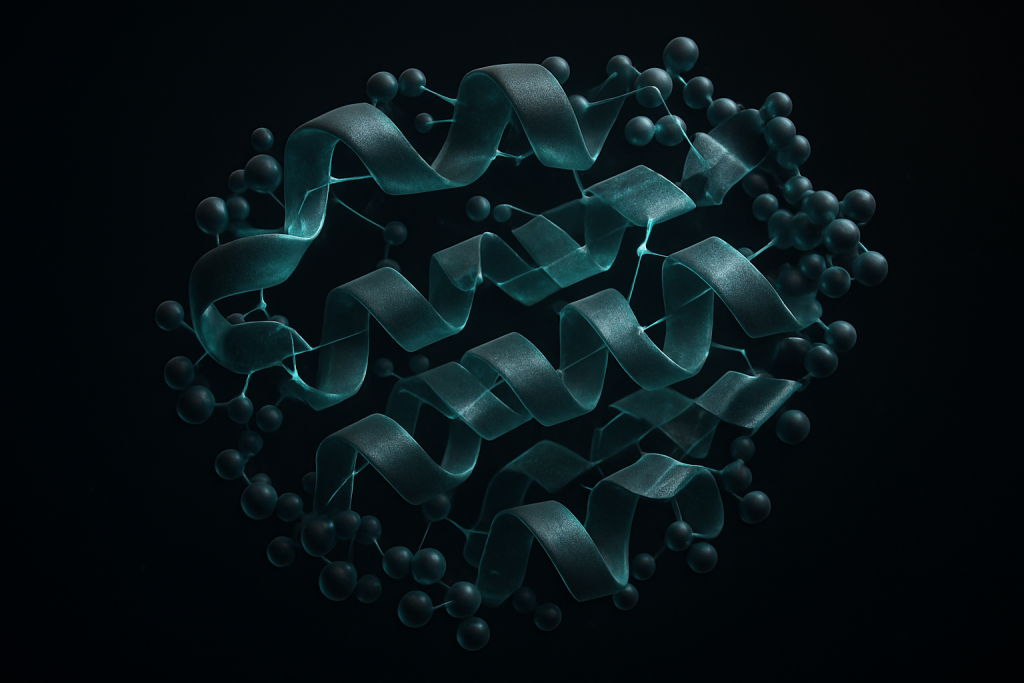
Image generated by AI
Inside every living cell, molecular machines called peptides are folding themselves into precise three-dimensional shapes, each configuration determining whether they heal or harm. These tiny chains of amino acids are responsible for nearly everything your body does—from fighting infections to digesting food to transmitting thoughts across your brain—yet the same forces that allow them to fold correctly can sometimes trap them in toxic forms that accumulate in Alzheimer’s disease, Parkinson’s disease, and dozens of other ailments. Understanding why peptides adopt particular shapes and how those shapes remain stable is one of the central puzzles of modern biology, one that spans from the quantum realm of chemical bonds to the evolutionary timescale of human disease.
In recent years, peptide science has moved from the laboratory margins to the forefront of biotechnology and medicine, with peptide drugs now among the fastest-growing category of pharmaceuticals. From insulin injections that have saved millions of diabetics to cutting-edge cancer immunotherapies that train the immune system to recognize tumor cells, peptides represent a largely untapped frontier of therapeutic possibility. Yet as we harness their power, scientists are racing to solve a fundamental problem: how to make peptides stable enough to survive in the body long enough to work, but flexible enough to maintain their function. This question sits at the intersection of chemistry, biology, and medicine—and the answers could transform how we treat everything from infectious disease to genetic disorders.
What Is Peptide Structure and Stability?
A peptide is a short chain of amino acids—typically fewer than fifty, which distinguishes it from longer protein chains—linked together by chemical bonds called peptide bonds. Think of amino acids as specialized LEGO bricks, each with a unique shape and chemical personality, and peptide bonds as the connectors that snap them together. But unlike rigid plastic blocks, the moment these amino acids are linked, they begin folding and twisting into three-dimensional shapes driven by an intricate dance of chemical forces: hydrogen bonds, ionic attractions, hydrophobic interactions, and disulfide bridges that lock parts of the chain together. The resulting three-dimensional structure is the peptide’s most fundamental property, because in biology, shape is destiny—a peptide’s structure determines whether it can bind to a receptor on a cell surface, whether it can catalyze a chemical reaction, or whether it can trigger an immune response.
Peptide stability refers to how well a peptide maintains this three-dimensional structure over time in the presence of cellular conditions: the hot, wet, chemically reactive environment inside cells and organisms. Stability is measured in various ways—how long the peptide survives before enzymes called proteases cut it apart, how well it resists denaturation from heat or acid, and how long it retains its biological activity. The history of peptide research reveals a century-long struggle with this problem: when chemist Emil Fischer began studying amino acids and peptide bonds in the 1880s and 1890s, earning a Nobel Prize for his work, scientists marveled at the elegant geometry of these molecular structures but had no idea how to keep them stable long enough to study them, much less use them as medicines. It wasn’t until the 1950s, when Frederick Sanger sequenced insulin and showed that peptides had specific, determined sequences, that scientists truly grasped that peptide structure could be predicted and potentially controlled.
How It Works in Nature
In living organisms, peptide folding is orchestrated by the amino acid sequence itself—a principle known as Anfinsen’s dogma, named after Christian Anfinsen’s landmark 1960s experiments showing that protein structure is determined by amino acid sequence alone. When a chain of amino acids is synthesized by the ribosome, it emerges as a linear string, but almost instantaneously it begins collapsing into a specific three-dimensional shape as various chemical forces pull and push different parts of the chain together. Hydrophobic amino acids—those repelled by water—cluster together in the peptide’s core, away from the watery cellular environment, while hydrophilic amino acids orient toward the surface where they can interact with water and other molecules. Simultaneously, the peptide’s backbone—the repeating chain of atoms that forms the “spine” of the molecule—twists into recurring patterns called alpha helices or beta sheets, structures that maximize the stability of hydrogen bonds between different parts of the chain.
Consider the hormone insulin, a 51-amino-acid peptide that regulates blood sugar in humans. When insulin is synthesized, it begins as a longer, inactive precursor called preproinsulin, which folds itself into a specific shape as it travels through the endoplasmic reticulum. Enzymes then cleave off portions of the chain, leaving the mature insulin molecule with its characteristic structure: two separate chains held together by disulfide bonds that act like molecular staples. This structure is so critical that even a single amino acid substitution in the wrong location can cause type 2 diabetes or other metabolic disorders. The peptide’s folded shape allows it to fit precisely into insulin receptors on cell surfaces, triggering a cascade of signals that tell cells to take up glucose from the bloodstream. Without this exact three-dimensional structure, insulin cannot function, no matter how many of its amino acids are present.
Medical and Scientific Relevance
The stability and structure of peptides have become central to modern medicine because peptides offer several advantages over large proteins and small drug molecules: they can be highly specific in their targets, they are generally less toxic than synthetic chemicals, and they can be manufactured reliably through biotechnology. Peptide drugs now represent a multi-billion-dollar industry, with applications ranging from hormone replacement therapy to cancer treatment to autoimmune disease management. The challenge, however, is that peptides are inherently unstable in the body—proteases circulating in the bloodstream and present in every tissue treat peptides as food, eagerly cutting them apart into individual amino acids. Scientists have developed numerous strategies to solve this stability problem: adding chemical modifications that proteases cannot recognize, incorporating non-natural amino acids, wrapping peptides in protective carriers, or administering them directly to tissues where they need to work before proteases can destroy them.
One celebrated example is exenatide, a peptide drug derived from a toxin found in Gila monster venom that mimics the hormone GLP-1, which regulates blood sugar and appetite. Exenatide has become a blockbuster diabetes and weight-loss medication because it triggers the same beneficial biological responses as natural GLP-1 but has been chemically stabilized to survive longer in the bloodstream than the natural hormone would. Another powerful application is in cancer immunotherapy: peptide vaccines, which contain short sequences that match mutations found on a patient’s specific tumor, can train the immune system to recognize and attack cancer cells while leaving healthy cells alone. Alzheimer’s and Parkinson’s research has focused intensely on understanding why certain peptides, particularly amyloid-beta and alpha-synuclein, fail to fold correctly and aggregate into toxic tangles—and how to stabilize the correct form while destabilizing the incorrect form. These medical applications demonstrate that peptide structure and stability are not abstract theoretical concerns but practical keys to treating diseases that affect millions.
Recent Breakthroughs in Peptide Structure and Stability
In 2020 and 2021, the field experienced a revolutionary moment when DeepMind’s AlphaFold system, an artificial intelligence trained on tens of thousands of known protein and peptide structures, achieved unprecedented accuracy in predicting three-dimensional structures from amino acid sequences alone. This breakthrough, which earned the team the Lasker Award for Basic Medical Research, has fundamentally changed how scientists approach peptide design and stability. Rather than relying on time-consuming X-ray crystallography or nuclear magnetic resonance spectroscopy to determine structures experimentally, researchers can now generate accurate structural predictions in seconds, allowing them to rapidly test how amino acid modifications might affect folding and stability. Follow-up work has extended these predictions to peptide-receptor interactions, helping scientists design peptides that bind more tightly and specifically to their targets while remaining stable in physiological conditions.
Simultaneously, advances in synthetic biology have enabled the creation of peptides with entirely new properties that don’t exist in nature. Researchers are now incorporating D-amino acids (the mirror-image form of naturally occurring L-amino acids), cyclic structures that are more resistant to proteolysis, and peptoids—synthetic analogs of peptides with altered backbone geometry—to create therapeutic molecules with unprecedented stability. Current research frontiers include the rational design of peptide nanostructures that can self-assemble into higher-order arrangements, the development of intrinsically disordered peptides that function through shape-shifting rather than fixed structures, and the understanding of how peptides misfold in neurodegenerative diseases and how to reverse that misfolding. One particularly active area involves peptide-based biosensors that change color or fluorescence when they encounter specific molecules, potentially enabling rapid diagnostic tests for infections or biomarkers of disease.
Why Peptide Structure and Stability Matters for the Future
As peptide therapeutics move from niche treatments to mainstream medicine, the importance of understanding and controlling peptide stability will only increase. Climate change and emerging infectious diseases will create urgent demand for new peptide-based vaccines and antimicrobial agents that remain stable across a range of environmental conditions—particularly relevant as we develop treatments that can be deployed in resource-limited settings without refrigeration. The personalized medicine revolution, where treatments are tailored to individual patient genomes, increasingly relies on peptide design: cancer vaccines, rare disease treatments, and genetic disorder therapies will increasingly be custom-designed peptides optimized for each patient’s specific molecular profile. Furthermore, as we develop artificial organs, tissue engineering, and regenerative medicine approaches, peptides will serve as crucial scaffolding molecules and signaling factors that guide cell behavior and tissue growth. The aging population will place enormous demands on treatments for neurodegenerative diseases, most of which involve peptide misfolding, making peptide stability research a matter of profound societal importance.
Yet significant challenges remain. Despite AlphaFold’s successes, predicting how peptides will behave inside living tissues—where they encounter millions of competing molecules, variable pH and temperature, and cellular components that can chemically modify them—remains uncertain. Delivering peptides efficiently to target tissues remains a major obstacle; most peptides work best if they can be injected directly or delivered orally, but the digestive tract and liver rapidly destroy them. Manufacturing peptides at scale while maintaining quality and stability adds significant cost to peptide drugs, making them expensive for many patients and many diseases. Finally, as we create more powerful and specific peptide therapeutics, we must grapple with the potential for misuse, whether through bioterrorism or unauthorized modification of peptide sequences to create harmful agents.
Key Takeaways
- Peptides are short chains of amino acids held together by peptide bonds that fold into precise three-dimensional structures determined by the order of their amino acids.
- Peptide stability—the ability to maintain structure in the body before being broken down by enzymes—is critical for peptide drugs to work effectively, and scientists use chemical modifications and protective carriers to extend peptide lifespan in living tissues.
- Peptide drugs including insulin, GLP-1 agonists for diabetes, and personalized cancer vaccines represent one of the fastest-growing categories of pharmaceuticals, with applications across virtually every disease category.
- Recent breakthroughs in artificial intelligence prediction and synthetic peptide design have accelerated the development pipeline, making it possible to rationally design peptides with desired properties in months rather than years.
- Understanding and controlling peptide structure and stability will be essential for treating neurodegenerative diseases, developing new vaccines, creating personalized medicine, and addressing future pandemics and aging-related health challenges.
Explore TED Talks on Peptide Structure and Stability:
TED content is used under CC BY-NC-ND 4.0. © TED Conferences, LLC.
Frequently Asked Questions
What chemical forces determine how a peptide chain folds into its three-dimensional shape?
Peptide folding is driven by multiple forces including hydrogen bonding between amino acids, hydrophobic interactions that bury nonpolar residues away from water, electrostatic attractions between charged amino acids, and disulfide bonds that covalently link cysteine residues. These forces work together to minimize the peptide's overall energy and create its stable, functional structure.
Why do the same folding mechanisms that create functional peptides sometimes produce toxic accumulations in diseases like Alzheimer's?
Under certain conditions—such as altered pH, temperature changes, or specific genetic mutations—peptides can misfold into alternative three-dimensional configurations that are more stable than their native forms, causing them to aggregate into harmful clumps. These misfolded peptides resist normal cellular degradation pathways, allowing them to accumulate and damage neurons over time.
How do scientists balance peptide stability with the flexibility needed for pharmaceutical function?
Researchers modify peptides through chemical engineering—such as adding stabilizing non-natural amino acids, creating cyclic structures, or incorporating protective modifications—while preserving the specific active sites required for biological activity. This balance is critical because excessive rigidity can prevent peptides from interacting with target molecules, while insufficient stability causes degradation before therapeutic effect.
What makes peptide drugs particularly challenging to keep stable inside the body compared to small-molecule drugs?
Peptides are chains of amino acids vulnerable to enzymatic breakdown by proteases naturally present in blood and tissues, whereas small molecules have fewer chemical bonds susceptible to enzymatic attack. Additionally, peptides must maintain precise three-dimensional structures to function, and this structural integrity is easily disrupted by temperature, pH, and enzymatic degradation during circulation.