Image generated by AI
Every piece of plastic ever made still exists somewhere on Earth. A shopping bag used for fifteen minutes can persist in the environment for 400 years, gradually fragmenting into smaller particles but never truly disappearing. This sobering reality has forced scientists and engineers to confront a fundamental question: what if we could design plastics that break down on demand, their molecular chains unraveling in response to light, heat, or other environmental triggers? The answer lies in understanding plastic degradation—the process by which polymers lose their structural integrity—and harnessing it as a tool rather than accepting it as an inevitable problem.
Plastic degradation is no longer just an environmental concern confined to landfills and ocean gyres. Today, it has become a critical frontier in materials science, driving innovation across packaging, medicine, aerospace, and environmental remediation. Companies are racing to develop “smart” polymers that degrade on schedule, while researchers simultaneously work to create more durable plastics for applications where longevity is essential. This paradox—the simultaneous pursuit of degradability and performance—sits at the heart of modern polymer chemistry and defines one of the most consequential engineering challenges of our time.
What Is Plastic Degradation and Polymer Performance?
Plastic degradation is the process by which polymers—long chains of molecules bonded together—break down into smaller fragments through chemical, physical, or biological mechanisms. Polymer performance, conversely, refers to how well these materials maintain their structural properties under stress, temperature, moisture, and time. These two concepts are intimately linked: a plastic’s degradation profile is inseparable from its performance characteristics. A grocery bag that degrades too quickly is useless; one that never degrades is an environmental catastrophe. The challenge in modern materials science is engineering polymers with precisely calibrated degradation timelines matched to their intended use.
The story of plastic degradation science began in earnest during the 1970s and 1980s, when researchers first recognized that conventional plastics like polyethylene and polypropylene showed unexpected brittleness after years of outdoor exposure. Scientists at Exxon and later at the University of Toronto discovered that ultraviolet light and oxygen could cleave polymer chains, a finding that initially seemed like a defect but eventually became recognized as an opportunity. Pioneering work by researchers like James Gregory and others in the oxo-degradable plastic field demonstrated that intentional chemical modifications could make plastics break down in controlled ways, launching a new field of “engineered degradation.”
The Chemistry Behind It
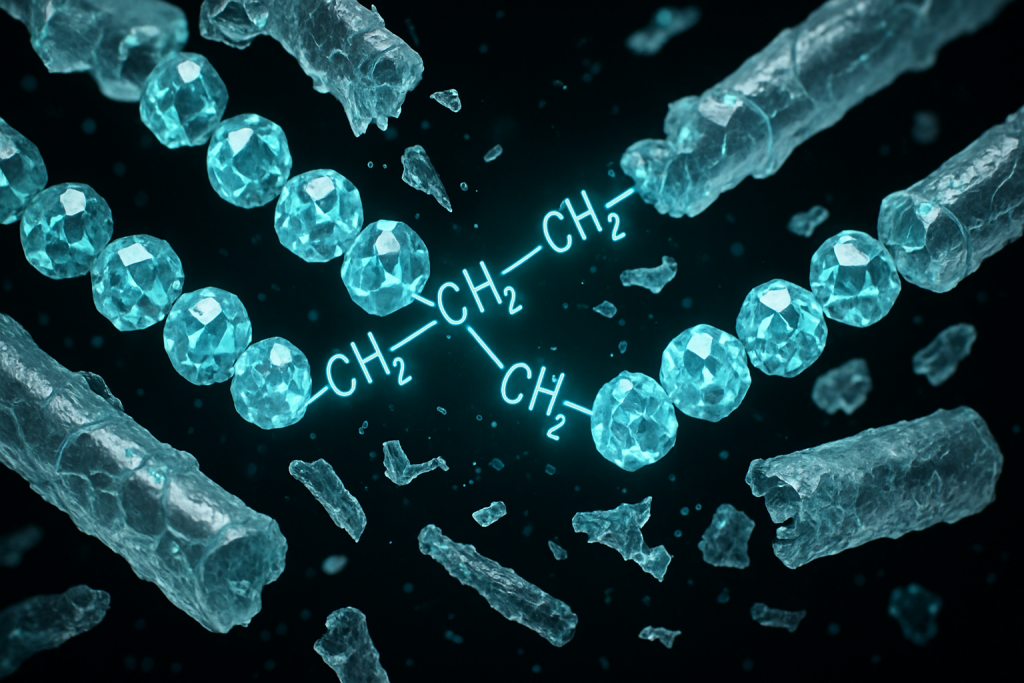
At the molecular level, polymer degradation occurs when the covalent bonds holding the polymer chain together are severed. This cleavage can happen through several mechanisms. Hydrolysis occurs when water molecules insert themselves between polymer links, particularly in polyesters and polyurethanes, causing the chain to snap. Oxidative degradation happens when oxygen attacks the carbon backbone, especially when activated by heat or ultraviolet radiation, breaking the chain into shorter segments. Photodegradation uses light energy to weaken molecular bonds directly. In biological degradation, enzymes secreted by microorganisms and fungi work like molecular scissors, cutting specific bonds that microbes recognize as food sources.
Think of a polymer chain like a long string of beads. Normal environmental stresses might rattle the string, but the beads stay connected. Now imagine the string is made of a special material that becomes brittle when exposed to sunlight, or dissolves when submerged in water, or gets eaten by tiny organisms. The chemical bonds between beads might be weakened by adding metal ions, or the beads themselves might be slightly different chemically, making them attractive targets for enzymes. By adjusting the composition and structure of the polymer chain—inserting different types of bonds, changing the ratio of ingredients, or incorporating specific chemical groups—scientists can make plastics that remain strong for months but crumble within years, or vice versa.
Where It Is Used Today
Plastic degradation science has moved far beyond laboratory curiosity into mainstream industrial applications. Biodegradable packaging materials, made from polymers like polylactic acid (PLA) derived from corn starch, now compete with conventional plastics in food service and consumer goods. Agricultural films designed to break down after a growing season reduce tilling requirements and soil contamination. In medicine, absorbable sutures and drug-delivery implants made from polyesters and polycaprolactone degrade predictably within the body, releasing therapeutic compounds or simply dissolving once they’re no longer needed. These applications represent a fundamental shift: degradation has become a designed feature rather than an unwanted side effect.
Major corporations have begun integrating degradable plastics into their supply chains. Nestlé, PepsiCo, and Unilever have committed to using compostable packaging for certain product lines. The medical device industry has embraced degradable polymers for stents, bone scaffolds, and contraceptive implants, where the material’s useful life matches its intended clinical duration. In agriculture, biodegradable mulch films are reducing plastic waste accumulation in soils across North America and Europe. Researchers are also exploring self-healing polymers—materials that can reverse degradation through chemical bonding—for high-performance applications in aerospace and automotive manufacturing, where weight savings and durability are equally critical.
Recent Breakthroughs in Plastic Degradation and Polymer Performance
The past three years have witnessed remarkable advances in both polymer degradation and durability enhancement. In 2023, researchers at the University of Tokyo and University of Portsmouth announced the discovery of an engineered enzyme, PETase, derived from bacteria found in a plastic-recycling plant, capable of breaking down polyethylene terephthalate (PET) bottles 300 times faster than natural degradation. This discovery has spawned a new field of “enzymatic recycling,” where modified enzymes essentially deconstruct used plastics into their molecular components for remanufacturing. Simultaneously, scientists have developed additives that can be mixed into conventional plastics during production, triggering controlled degradation without sacrificing initial performance. Companies like Footprint and Notpla have commercialized mushroom-based packaging materials that are entirely biodegradable yet surprisingly durable during storage and use.
Current research priorities include extending degradation timelines with precision—creating plastics that last exactly 18 months in soil or 200 years in dry storage—and developing truly compostable alternatives that break down in industrial facilities within 12 weeks. Scientists are investigating how to make degradable plastics perform as well as conventional ones in demanding applications like automotive fuel tanks and structural components. The fundamental open question remains: can we engineer polymers that balance longevity with eventual environmental harmlessness, rather than choosing one or the other?
Why Plastic Degradation and Polymer Performance Matters for the Future
The implications of mastering plastic degradation extend far beyond waste management. As global plastic production accelerates—projected to reach 1.1 billion metric tons annually by 2050—the ability to engineer materials that are simultaneously functional and eventually biodegradable becomes existential. Climate change adds urgency: the energy required to produce virgin plastics generates substantial carbon emissions, while recycling via enzymatic degradation could create closed-loop systems requiring dramatically less energy. In developing nations without sophisticated waste infrastructure, degradable plastics offer a pathway to reduce accumulating pollution without requiring massive investments in sorting and processing facilities. The science also touches on public health: microplastics from fragmenting conventional plastics are increasingly detected in human bloodstreams, organs, and tissues, making the shift toward genuinely biodegradable alternatives a medical necessity.
However, significant challenges remain. Truly biodegradable plastics often cost 20 to 50 percent more than conventional alternatives, creating economic resistance despite environmental benefits. There’s also a “greenwashing” problem: some commercially labeled “biodegradable” plastics only degrade in industrial composting facilities unavailable in most communities, meaning they end up in landfills anyway where they persist for decades. Scientists must also ensure that degradation byproducts don’t create new environmental problems—some polymers degrade into toxic intermediate compounds or persistent breakdown fragments. The race is on to develop polymers that are simultaneously affordable, truly biodegradable in natural environments, non-toxic when broken down, and performant enough for demanding applications.
Key Takeaways
- Plastic degradation is the controlled breakdown of polymer chains through chemical, physical, or biological mechanisms, now engineered as a design feature rather than an environmental liability.
- The chemistry relies on weakening or targeting specific molecular bonds through hydrolysis, oxidation, photodegradation, or enzymatic attack, with degradation timelines ranging from months to centuries depending on polymer composition.
- Biodegradable and degradable plastics are revolutionizing food packaging, medical implants, and agriculture, with enzymatic recycling emerging as a game-changing technology for reclaiming used plastics.
- Recent breakthroughs in engineered enzymes and precision additives have accelerated degradation rates while researchers work to balance durability with environmental responsibility in real-world applications.
- Mastering controlled polymer degradation is essential for addressing the global plastic crisis, reducing carbon emissions from virgin plastic production, and protecting human health from microplastic accumulation.
Explore TED Talks on Plastic degradation and polymer performance:
TED content is used under CC BY-NC-ND 4.0. © TED Conferences, LLC.
Frequently Asked Questions
What is the molecular mechanism by which polymers lose their structural integrity during degradation?
Plastic degradation occurs when environmental triggers such as light, heat, or chemical exposure break the covalent bonds between polymer chains, causing the long-chain molecules to fragment into smaller pieces. This process can be photodegradation (light-induced), thermal degradation (heat-induced), or chemical degradation, each attacking the polymer's backbone at different rates depending on the material's composition.
How do scientists design 'smart' polymers that degrade on demand rather than persisting indefinitely?
Researchers engineer polymers with built-in weak points or trigger-responsive groups in their molecular structure, such as specific chemical bonds that cleave when exposed to designated environmental conditions like UV light, heat, or particular pH levels. By controlling the placement and type of these degradation points, scientists can program plastics to break down within a desired timeframe rather than remaining stable for centuries.
Why is there a paradox between creating degradable plastics and maintaining polymer performance for long-term applications?
Materials designed to degrade easily are inherently unstable and lose structural integrity faster, making them unsuitable for applications requiring durability, while highly stable polymers resist degradation by nature and persist in the environment. This creates a fundamental tension: the same molecular properties that make plastics useful (strength, stability, resistance to breakdown) directly oppose the goal of environmental degradability.
Can plastic fragments that persist as microplastics continue to degrade, or do they remain chemically stable indefinitely?
Even fragmented microplastics can continue to degrade through weathering, photodegradation, and oxidation, but the process is extremely slow and may take centuries depending on the polymer type and environmental conditions. However, they do not completely disappear—they break into progressively smaller particles (nanoplastics) that persist in ecosystems and may never fully return to their original chemical elements.