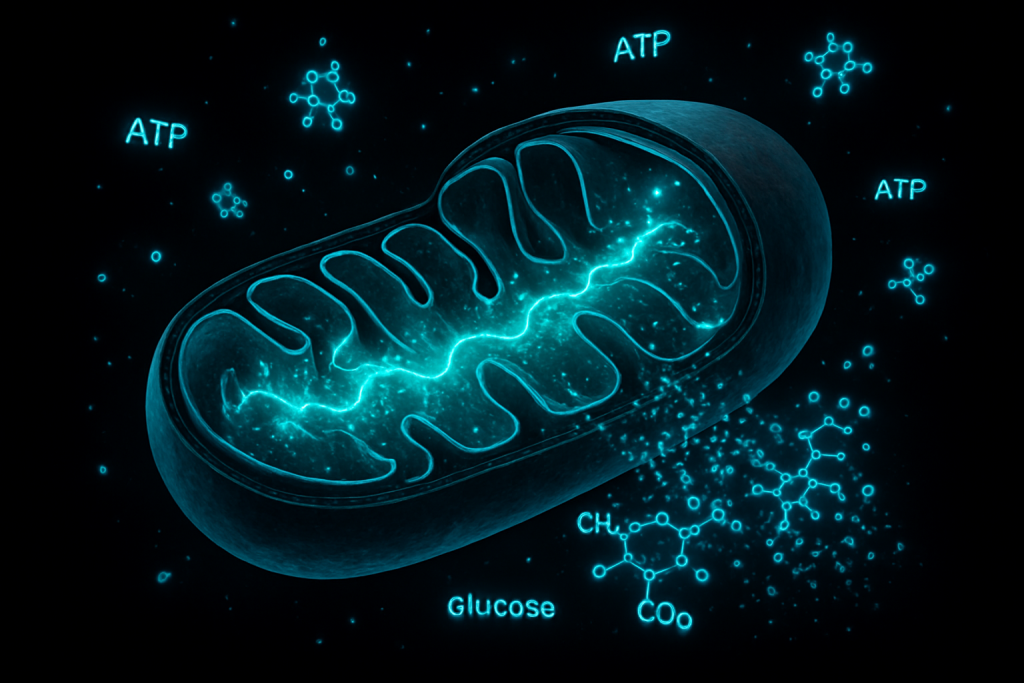
Image generated by AI
Every second of your life, trillions of cells in your body are performing an intricate chemical ballet, converting food into energy with an efficiency that would make any power plant jealous. This process, known as cellular metabolism, is so fundamental to life that without it, you would exhaust your body’s energy reserves in minutes. Yet for most people, the cascade of molecular reactions that transforms a piece of bread into the electrical signals firing through your brain remains invisible—a black box of biology that operates behind the scenes of consciousness. Understanding metabolic pathways and cellular energy is not merely an academic exercise; it is the key to comprehending how life itself works at its most basic level.
In an era of personalized medicine, climate change, and the race to develop new therapies for cancer, diabetes, and aging, metabolic science has become increasingly urgent. Researchers are discovering that metabolic dysfunction lies at the heart of many modern diseases, while simultaneously learning to manipulate metabolic pathways to develop new treatments and biofuels. From pharmaceutical companies designing drugs that reprogram cancer cell metabolism, to bioengineers creating organisms that produce sustainable energy, the practical implications of metabolic research are reshaping medicine and industry. This convergence of basic science and real-world application makes metabolic pathways one of the most consequential frontiers in modern biology.
What Is Metabolic Pathways and Cellular Energy?
Metabolic pathways are sequences of chemical reactions catalyzed by enzymes that transform nutrients from food into usable energy and building blocks for cellular structures. At the heart of this process lies a molecule called adenosine triphosphate, or ATP—often described as the “currency” of cellular energy because it carries energy in the form of chemical bonds that cells can readily break to power almost every biological process imaginable. When you think of metabolism, picture an elaborate assembly line where carbohydrates, fats, and proteins enter at one end, undergo a series of enzymatic transformations, and exit as ATP molecules ready to do work, combined with various molecular byproducts that the cell either recycles or eliminates. This energy conversion process occurs within specialized cellular compartments called mitochondria, earning them the nickname “powerhouses of the cell,” though the initial breakdown of sugars happens in the cell’s cytoplasm through a pathway called glycolysis.
The scientific understanding of metabolic pathways emerged gradually over the past two centuries, beginning with observations about fermentation in the 1800s by scientists like Louis Pasteur. The breakthrough came in the early 20th century when biochemists like Otto Meyerhof and Gustav Embden traced the step-by-step breakdown of glucose, establishing the glycolytic pathway in the 1920s. This foundational work was followed by Hans Krebs’s discovery of the citric acid cycle in 1937—the central metabolic hub where most cellular energy is ultimately extracted—and Peter Mitchell’s elucidation of how ATP is actually synthesized in the mitochondria in the 1960s. These discoveries transformed our understanding from viewing cells as mysterious black boxes to seeing them as chemical factories operating under precise biochemical rules.
How It Works in Nature
The story of cellular energy production unfolds in several acts, each orchestrated with remarkable precision. It begins when you consume food—say, a piece of fruit containing glucose. In the cytoplasm, an enzyme-catalyzed process called glycolysis splits each glucose molecule into two simpler molecules called pyruvate, extracting a small amount of energy in the form of two ATP molecules and high-energy electrons captured by carrier molecules. These pyruvate molecules then enter the mitochondria, where they are converted into acetyl-CoA and fed into the citric acid cycle (also called the Krebs cycle), a whirling carousel of molecular transformations that extracts the high-energy electrons contained within the carbon skeleton of glucose. The crucial insight is that most of the cell’s ATP is not generated directly during these early steps; instead, the high-energy electrons harvested from breaking down glucose are passed along a chain of proteins embedded in the mitochondrial membrane called the electron transport chain, where their energy drives the pumping of protons across the membrane, creating an electrochemical gradient analogous to water backed up behind a dam.
The final step is where the genius of cellular energy conversion becomes apparent: ATP synthase, a protein complex that resembles a molecular turbine, harnesses the flow of protons back across the membrane to phosphorylate ADP molecules, generating ATP. Think of it like a hydroelectric dam: just as gravity pulls water downhill and the force can turn turbines to generate electricity, the electrochemical gradient created by the electron transport chain drives ATP synthase to generate the chemical energy currency that powers virtually every cellular process. One glucose molecule, fully oxidized through this complete pathway, yields approximately thirty to thirty-two ATP molecules—a far more impressive return than the small number generated in glycolysis alone. Different nutrients follow variations of these pathways: fats are broken down into acetyl-CoA and enter the citric acid cycle, while proteins can be converted to intermediates that feed into the pathway at various points, allowing cells to extract energy and building blocks from diverse food sources.
Medical and Scientific Relevance
The medical significance of understanding metabolic pathways has become increasingly apparent as researchers recognize that metabolic dysfunction underlies many modern diseases. Cancer cells, for instance, exhibit a fundamental metabolic shift: they preferentially metabolize glucose through glycolysis even in the presence of oxygen, a phenomenon discovered by Otto Warburg in the 1920s but only recently understood mechanistically. This altered metabolism, known as the Warburg effect, occurs because cancer cells prioritize rapid ATP and molecular building block production over energy efficiency, allowing them to grow and divide rapidly—a finding that has sparked intense interest in developing drugs that target cancer cell metabolism rather than simply trying to kill rapidly dividing cells. Similarly, metabolic dysfunction is central to type 2 diabetes, where cells become “insulin resistant” and fail to efficiently take up glucose, disrupting the normal control of metabolic pathways and leading to dangerously high blood sugar levels. Research has also revealed that aging itself may be fundamentally linked to declining mitochondrial function and metabolic efficiency, suggesting that interventions targeting metabolism could extend healthspan and lifespan.
The pharmaceutical industry has responded by developing an entirely new class of drugs targeting metabolic pathways. GLP-1 receptor agonists like semaglutide have revolutionized diabetes and weight loss treatment by enhancing insulin secretion and altering metabolic preferences. Meanwhile, researchers are exploring SGLT2 inhibitors, which work by preventing glucose reabsorption in the kidneys and forcing cells to metabolize more fat, and are investigating how manipulating the citric acid cycle through drugs targeting specific enzymes might slow cancer progression. Beyond pharmaceuticals, metabolic engineering has enabled scientists to reprogram the metabolic pathways of microorganisms like yeast and bacteria to produce biofuels, plastics, and pharmaceuticals, creating a burgeoning biotechnology industry centered on “precision fermentation.” Athletes and fitness enthusiasts have also embraced insights from metabolic research, with numerous interventions—from high-intensity interval training that forces reliance on anaerobic metabolism, to ketogenic diets that shift fuel sources from carbohydrates to fats—designed to modify metabolic pathways and improve performance or body composition.
Recent Breakthroughs in Metabolic Pathways and Cellular Energy
The past few years have witnessed remarkable advances in our ability to visualize and manipulate metabolic pathways in real time. One significant breakthrough involves the development of genetically encoded fluorescent biosensors that allow researchers to watch ATP levels, ion concentrations, and other metabolic indicators fluctuate within living cells and organisms with unprecedented spatial and temporal resolution. In 2022 and 2023, multiple research teams published studies revealing unexpected heterogeneity in mitochondrial function within single cells, suggesting that traditional notions of uniform cellular metabolism may oversimplify biological reality. Another major advance involves the discovery of “metabolic memory”—the finding that cells exposed to high glucose levels maintain altered metabolic patterns even after glucose levels normalize, providing new insights into why blood sugar control is so important for long-term health. Simultaneously, cryo-electron microscopy has achieved near-atomic resolution of respiratory complexes and ATP synthase, allowing researchers to understand in exquisite detail how these molecular machines harness electron energy to pump protons and synthesize ATP.
Current research frontiers include understanding how metabolic pathways communicate with and regulate gene expression through “metabolic signaling,” the discovery that metabolic byproducts themselves serve as regulatory molecules rather than just waste. Researchers are also intensively studying how different cell types—neurons versus muscle cells, for instance—optimize their metabolic pathways for their specific functional demands, and how this optimization can go awry in disease. The emerging field of “immunometabolism” has revealed that immune cells dramatically shift their metabolism depending on whether they are being activated to fight infection, suggesting that metabolic reprogramming could be harnessed to enhance immune therapy. Meanwhile, synthetic biologists are attempting to construct entirely artificial metabolic pathways by rewiring cellular circuits, raising the intriguing possibility that we might someday design cells that produce energy or useful compounds far more efficiently than evolution ever managed.
Why Metabolic Pathways and Cellular Energy Matters for the Future
The future of medicine, agriculture, and energy production will likely be increasingly shaped by our expanding mastery of metabolic pathways. As the global population ages, the promise of interventions that slow metabolic decline and improve cellular energy production could reduce the burden of age-related diseases that currently consume enormous healthcare resources. Climate change and resource scarcity are driving intense interest in using metabolic engineering to create sustainable alternatives to fossil fuels and petroleum-derived chemicals, with companies already producing bio-based leather, spider silk proteins, and biofuels using engineered microbes. The convergence of metabolic research with artificial intelligence is opening new possibilities: machine learning algorithms trained on massive datasets of metabolic measurements can predict how cells will respond to perturbations and identify novel drug targets far more rapidly than traditional approaches. Furthermore, understanding metabolic pathways is essential for addressing chronic diseases of affluence—obesity, type 2 diabetes, cardiovascular disease, and cancer—which disproportionately affect wealthier populations and might be preventable or treatable through metabolic interventions tailored to individual genetic and lifestyle differences.
However, significant challenges remain before metabolic science can fully realize its potential. The human body’s metabolism is staggeringly complex, involving thousands of enzymatic reactions and intricate regulatory networks that we are only beginning to map comprehensively. Most metabolic research to date has focused on simplified cell cultures or animal models, and translating findings to complex human systems remains difficult and often unsuccessful. There is also a fundamental tension between the reductionist approach that has driven metabolic science—studying individual pathways in isolation—and the holistic reality that metabolic pathways form an interconnected network where changes in one pathway inevitably affect others. Additionally, metabolic interventions that benefit one person may harm another due to genetic variation, highlighting the need for truly personalized approaches that consider individual metabolic differences, a capability we are only now beginning to develop.
Key Takeaways
- Metabolic pathways are sequences of enzymatic reactions that convert nutrients into ATP, the universal energy currency that powers nearly every cellular process, with the most efficient ATP production occurring in mitochondria through the electron transport chain and ATP synthase.
- Cells extract energy from nutrients through glycolysis, the citric acid cycle, and the electron transport chain, with the latter generating the proton gradient that drives ATP synthesis through a mechanism analogous to a hydroelectric dam and turbine.
- Understanding and manipulating metabolic pathways holds promise for treating metabolic diseases like type 2 diabetes and cancer, developing sustainable biofuels, and extending healthy aging through interventions that optimize cellular energy production.
- Recent breakthroughs in biosensors, structural biology, and synthetic biology are revealing previously hidden complexity in cellular metabolism and enabling researchers to reprogram metabolic pathways with increasing precision and sophistication.
- Metabolic science will be increasingly central to addressing major challenges facing humanity, from treating aging-related diseases to combating climate change through sustainable biotechnology, though significant scientific hurdles remain before the field’s full potential is realized.
Explore TED Talks on Metabolic Pathways and Cellular Energy:
TED content is used under CC BY-NC-ND 4.0. © TED Conferences, LLC.
Frequently Asked Questions
How do cells convert food molecules into usable energy through metabolic pathways?
Cells break down food molecules like glucose through a series of enzymatic reactions organized into pathways such as glycolysis and the citric acid cycle, ultimately producing ATP (adenosine triphosphate), which serves as the cell's primary energy currency. These pathways extract chemical energy stored in molecular bonds and transfer it to ATP in a controlled, step-wise manner that minimizes energy loss as heat.
Why is understanding metabolic dysfunction important for treating diseases like cancer and diabetes?
Cancer cells and diabetic cells exhibit altered metabolic pathways that differ from healthy cells, allowing researchers to develop targeted therapies that selectively disrupt cancer cell metabolism or restore normal metabolic function in diabetic tissues. By understanding these metabolic differences, scientists can design drugs that exploit metabolic vulnerabilities unique to diseased cells while sparing healthy tissue.
What is the relationship between metabolic pathways and the development of sustainable biofuels?
Bioengineers manipulate metabolic pathways in microorganisms to redirect their cellular machinery toward producing biofuels like ethanol or biogas instead of their natural products. By reprogramming these pathways, organisms can convert renewable biomass into energy-rich compounds more efficiently than traditional chemical processes.
How efficient is cellular metabolism compared to artificial energy conversion systems?
Cellular metabolism operates at approximately 38-40% efficiency in converting chemical energy from food into usable ATP, which exceeds many artificial power generation systems and reflects millions of years of evolutionary optimization. This high efficiency is achieved through the coordinated action of multiple metabolic pathways and the recycling of energy carriers within cells.