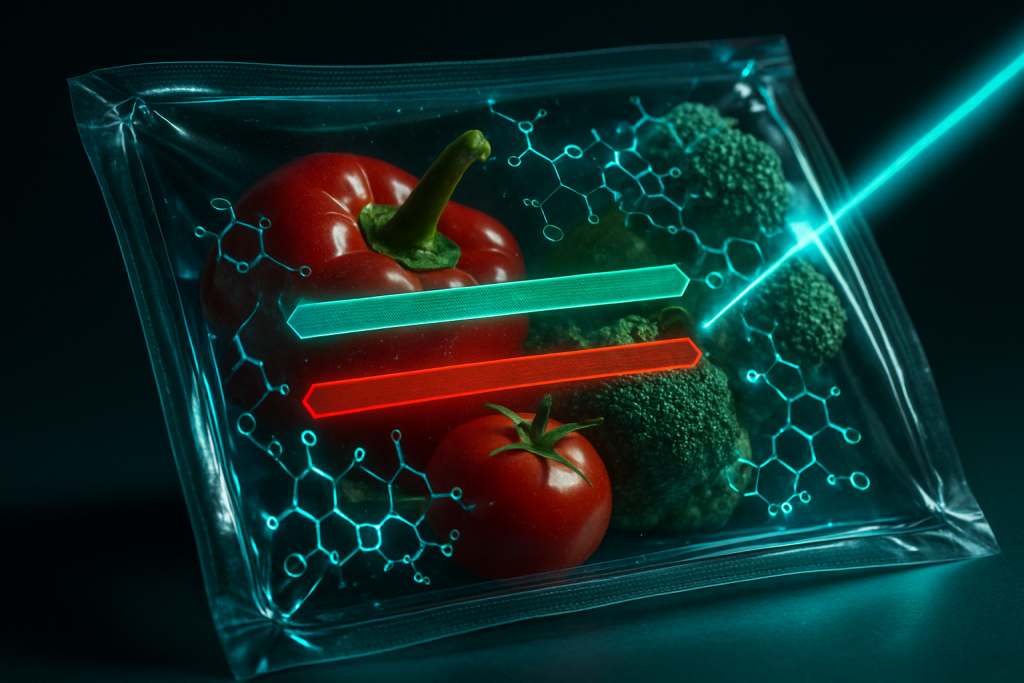
Image generated by AI
Every year, roughly one-third of the food produced globally is wasted, often because consumers and retailers cannot reliably determine whether food is actually spoiled or still safe to eat. Imagine if your yogurt container could tell you, with scientific precision, whether the contents remain fresh—not based on an arbitrary printed date, but on real-time chemical changes occurring inside the package. Smart packaging with integrated freshness indicators represents a paradigm shift in how we approach food safety, combining materials science, chemistry, and consumer behavior to solve one of the most pressing problems in the global food supply chain.
In an era of increasing sustainability concerns and stricter food safety regulations, smart packaging has transitioned from laboratory curiosity to commercial reality. Major food companies, pharmaceutical manufacturers, and retailers are now investing billions in these technologies, recognizing that intelligent packaging can simultaneously reduce waste, prevent foodborne illness, and improve supply chain transparency. The convergence of nanotechnology, biomarker detection, and Internet of Things connectivity means that the humble food package is becoming a sophisticated chemical laboratory, capable of monitoring and communicating product condition in real time.
What Is Smart Packaging and Food Freshness Indicators?
Smart packaging with freshness indicators refers to food and beverage containers that actively monitor or respond to changes in product quality and communicate this information to consumers or supply chain managers. Rather than relying on static printed “best by” dates that represent conservative estimates of shelf life, these intelligent systems employ chemical, biological, or electronic sensors to detect the actual biochemical changes that occur as food degrades. The indicator might change color, emit a signal, display a message, or connect to a mobile app—all triggered by specific chemical markers of spoilage or degradation. This represents a fundamental shift from passive packaging, which merely contains food, to active packaging that participates in food preservation and quality monitoring.
The concept of freshness indicators was first explored systematically in the 1990s, though the foundations were laid earlier in the century with work on oxidation indicators in packaged foods. Researchers at institutions like Purdue University and various food science departments began investigating how chemical reactions could be harnessed to create visible indicators of food quality. The breakthrough came when scientists realized that certain enzymatic reactions or chemical transformations could be designed to occur at precisely the same rate as the food degradation process itself, creating an elegant synchronization between indicator activation and actual spoilage. Over the past two decades, this field has exploded into a multi-billion-dollar industry, with companies like Insignia Systems, Freshpoint, and various startups developing increasingly sophisticated solutions.
The Chemistry Behind It
The chemistry of freshness indicators operates on a deceptively simple principle: engineered chemical systems are designed to undergo visible changes—typically color shifts—that occur at the same rate as the actual degradation of the food product. The most common mechanisms involve enzymatic reactions, oxidation pathways, or pH changes that are naturally correlated with food spoilage. When food deteriorates, microorganisms multiply and produce metabolic byproducts like ammonia, hydrogen sulfide, and various organic acids, which alter the chemical environment inside the package. Smart indicators are calibrated to respond to these specific chemical signatures, creating a direct molecular dialogue between the food’s condition and the consumer’s perception of it.
Consider a typical time-temperature indicator (TTI), one of the most widespread types of freshness indicator currently in use. Imagine the inside of the package as a race track, and the food quality as one runner and the chemical indicator as another. Both start at the same point—the production date—and both run at speeds determined by temperature. The food runner experiences predictable chemical deterioration as microbes multiply and enzymes break down proteins and fats. The indicator runner undergoes a calibrated enzymatic reaction, typically involving a dye precursor and an enzyme such as glucose oxidase or peroxidase. At precisely the moment the food would become unsafe or noticeably degraded, the indicator completes its reaction and changes color—usually from one color to another, like blue to yellow or white to brown. The elegance lies in the calibration: manufacturers adjust enzyme concentrations, substrate quantities, and reaction conditions so that the indicator’s timeline precisely mirrors the food’s actual degradation under various temperature conditions.
Where It Is Used Today
Smart freshness indicators have become increasingly prevalent across diverse food and pharmaceutical industries, transforming quality assurance practices. In the seafood industry, TTI labels are now standard on packages of fish and shellfish, where rapid spoilage and foodborne pathogen proliferation pose serious health risks. Dairy companies embed indicators in yogurt, milk, and cheese packaging to provide consumers with real-time information about product safety. Pharmaceutical companies use sophisticated indicators on vaccine packages and temperature-sensitive medications, where maintaining specific temperature conditions is literally a matter of public health. Airlines, hospitals, and international logistics companies rely heavily on these systems to track whether cold-chain integrity has been maintained during shipping and storage.
The pharmaceutical sector represents perhaps the most safety-critical application of freshness indicators. Vaccines and biologics are extraordinarily sensitive to temperature fluctuations; even brief excursions above safe storage temperatures can render them ineffective without any visible signs of degradation. Companies like Vial monitoring and Temptime have developed sophisticated multi-use TTI labels that provide cumulative temperature exposure data, allowing healthcare workers to instantly assess whether a vaccine is still potent. In fresh produce distribution, companies like Apeel Sciences have pioneered biochemical coatings that slow ripening and microbial growth while incorporating indicators that signal when optimal consumption windows are closing. The meat and poultry industry increasingly uses indicators that respond to gases produced by spoilage microorganisms, creating a chemical feedback loop where the indicator’s color change is directly triggered by the same biological processes that make food unsafe.
Recent Breakthroughs in Smart Packaging and Food Freshness Indicators
The past two to three years have witnessed remarkable advances in miniaturization and connectivity of freshness indicators. Researchers at MIT and Stanford University have developed programmable ink systems based on graphene oxide that can respond to multiple quality markers simultaneously—monitoring not just temperature, but also humidity, oxygen levels, and the presence of specific spoilage compounds. These multi-parameter indicators provide far more granular information than traditional single-parameter systems, capturing the complexity of how foods actually degrade in real-world conditions. Additionally, the integration of near-field communication (NFC) chips and Bluetooth connectivity into packaging has enabled real-time data transmission to smartphones and supply chain management systems, transforming packaging from a passive container into an active node in the Internet of Things. Companies like Insignia have launched systems where consumers simply tap their phone to a package label to receive detailed freshness information and personalized recommendations about consumption timing.
One of the most exciting developments involves biomimetic indicators based on naturally occurring processes. Researchers have engineered bacterial spores that germinate or produce fluorescent proteins in response to specific spoilage markers, creating living indicators that respond only to genuine food degradation rather than temperature alone. Another frontier involves edible indicators made from food-grade materials like chitosan or whey protein films embedded with pH-sensitive anthocyanins derived from plant sources. These indicators literally become part of the food packaging material rather than separate labels, potentially reducing manufacturing complexity and improving consumer acceptance. Current research questions center on achieving the precise calibration needed for diverse food types, reducing manufacturing costs to competitive levels with traditional packaging, and ensuring regulatory approval across different jurisdictions with varying standards for package claims.
Why Smart Packaging and Food Freshness Indicators Matter for the Future
The global implications of smart freshness indicators extend far beyond individual consumer convenience. Food waste represents not just an economic loss of approximately $1 trillion annually, but also an environmental catastrophe—wasted food accounts for roughly 8 percent of global greenhouse gas emissions, consuming scarce resources like water and land while transporting products that ultimately reach landfills. By providing accurate, real-time freshness information, smart packaging could dramatically reduce both consumer and retail waste, allowing products that are perfectly safe and nutritious to be consumed rather than discarded based on conservative printed dates. In developing nations with inadequate cold chain infrastructure, freshness indicators could enable safer food distribution and longer effective shelf lives, directly improving food security for vulnerable populations. Furthermore, as regulatory agencies worldwide increasingly scrutinize food safety practices, intelligent packaging creates auditable records of product condition throughout the supply chain, potentially preventing contamination events and improving public health outcomes.
However, significant challenges remain before smart packaging achieves ubiquitous adoption. Manufacturing costs, while declining, still exceed conventional packaging in many applications, creating economic barriers to implementation, particularly for low-margin commodities. Regulatory frameworks vary dramatically across jurisdictions—what constitutes an acceptable freshness claim in the European Union differs from U.S. FDA standards, complicating multinational distribution. Consumer education represents another critical frontier; even if indicators provide perfect information, consumers must understand what the signals mean and trust the technology. Additionally, the environmental impact of adding electronic components or specialty chemicals to packaging requires careful life cycle assessment to ensure that the sustainability gains from reduced waste aren’t offset by increased manufacturing complexity and material consumption.
Key Takeaways
- Smart packaging with freshness indicators uses engineered chemical systems that change color or emit signals synchronized with actual food degradation, moving beyond arbitrary printed dates to real-time quality monitoring.
- The mechanism typically involves time-temperature indicators (TTIs) containing enzymes and dye precursors that undergo visible reactions at precisely the same rate as the food quality decline they monitor.
- Current applications span seafood, dairy, pharmaceuticals, and fresh produce, with pharmaceutical-grade indicators proving especially critical for temperature-sensitive vaccines and biologics.
- Recent breakthroughs include multi-parameter indicators using graphene-based inks, smartphone connectivity via NFC technology, and biomimetic systems using engineered bacterial spores or plant-based pH indicators.
- Smart freshness indicators could reduce the one-third of global food that is wasted annually while improving food safety and supply chain transparency, though challenges remain in manufacturing costs, regulatory harmonization, and consumer education.
Explore TED Talks on Smart Packaging and Food Freshness Indicators:
TED content is used under CC BY-NC-ND 4.0. © TED Conferences, LLC.
Frequently Asked Questions
How do freshness indicators chemically detect spoilage inside a sealed food package?
Freshness indicators work by monitoring real-time chemical changes in the package headspace, such as pH shifts, gas accumulation (CO₂, ammonia), or volatile organic compounds (VOCs) produced by microbial growth and food degradation. These chemical markers trigger visible color changes in indicator dyes or sensors embedded in the packaging material, directly correlating to actual spoilage rather than arbitrary expiration dates.
What is the role of nanotechnology in making smart packaging more effective?
Nanotechnology enables the creation of highly sensitive nanomaterial-based sensors that can detect minute chemical changes at the molecular level, improving the precision and response time of freshness indicators. Nanoparticles can also be engineered to interact with specific biomarkers of spoilage, such as bacterial metabolites or enzymatic byproducts, providing more accurate and food-specific freshness detection.
Can smart packaging indicators work independently, or do they require external technology to function?
Most freshness indicators function independently without external power or connectivity—they rely on passive chemical reactions within the package that produce visible signals readable by the consumer's eye. However, advanced smart packaging can integrate Internet of Things (IoT) sensors that transmit real-time data to external devices, providing remote monitoring capabilities for supply chain transparency.
Why are printed expiration dates considered less reliable than chemical freshness indicators?
Printed dates are static estimates based on average storage conditions and do not account for variable factors like temperature fluctuations, humidity, or light exposure during transport and storage. Chemical freshness indicators measure the actual degradation occurring in the specific package under real conditions, providing dynamic, condition-responsive assessment of food safety rather than a predetermined timeframe.