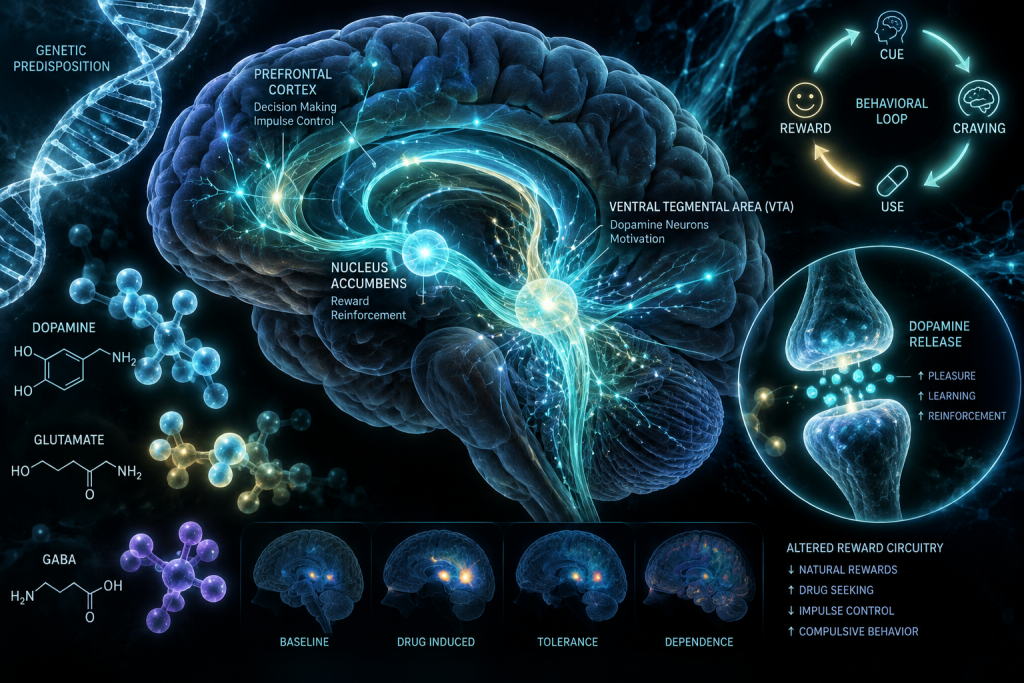
Image generated by AI
Every year, millions of people struggle to break free from behaviors they desperately want to stop—whether it’s checking their phone 150 times a day, returning to an ex-partner, or losing control at a slot machine. What makes these compulsions so powerful that willpower alone seems useless? The answer lies not in moral weakness, but in the fundamental architecture of the human brain, where ancient survival mechanisms have been hijacked by modern stimuli, creating feedback loops so potent they can override conscious intention.
Understanding addiction and behavioral compulsion has become urgent for contemporary society. The opioid crisis, behavioral addictions to social media and gambling, and the perplexing persistence of destructive habits despite severe consequences reveal that we’re living through an epidemic of compulsive behavior. Yet neuroscientists, psychologists, and behavioral economists have made remarkable strides in decoding exactly what happens in the brain during addiction, offering not just theoretical understanding but practical pathways toward treatment and prevention that actually work.
What Is Addiction and Behavioral Compulsion?
Addiction and behavioral compulsion are not synonymous, though they’re closely related. Addiction is a chronic condition characterized by the compulsive pursuit and use of a substance or behavior despite knowing it causes harm, often involving a loss of control and continued engagement even when serious negative consequences follow. Behavioral compulsion, more broadly, refers to repetitive actions driven by an irresistible urge, where the person feels caught between the desire to perform the behavior and the desire to resist it. Both involve a disconnect between what the prefrontal cortex knows is good for us and what the limbic system desperately craves, creating an internal civil war that most willpower frameworks fail to address.
The modern understanding of addiction as a brain disorder, rather than a moral failing, began in earnest during the 1970s and 1980s when neuroscientists discovered the reward pathway—a circuit of neurons that releases dopamine, the neurotransmitter of desire and motivation. Researchers like Roy Wise and Wolfram Schultz mapped how cocaine and heroin hijacked this system with unnatural intensity. By the 1990s, neuroimaging studies revealed that addiction actually changes the physical structure of the brain, shrinking certain regions and strengthening others. This paradigm shift transformed addiction from a character issue into a neuroscience problem, fundamentally reshaping how medicine approaches treatment and how society understands those struggling with compulsive behaviors.
What the Science Says
At the neurobiological core of addiction lies the dopamine system, but in a way that’s more subtle and consequential than popular accounts suggest. Dopamine isn’t simply “the pleasure chemical”—it’s the “wanting” chemical, the motivational currency that drives us toward rewards. When we encounter something rewarding, dopamine neurons fire, but here’s the critical twist: with repeated exposure, the brain adapts. The dopamine system becomes less responsive to the actual reward itself, but increasingly sensitized to cues that predict the reward. This creates a powerful phenomenon called “incentive salience,” where environmental triggers—a particular street corner, a song, a time of day—can trigger overwhelming craving even when the original reward no longer feels as pleasurable. The person continues pursuing the behavior not because it feels good anymore, but because their brain has been neurologically trained to want it.
Imagine your brain’s reward system as a sophisticated prediction machine constantly asking, “What’s the probability that this action will lead to a reward?” Initially, when you try alcohol, drugs, gambling, or even social media, the reward hits hard—dopamine floods your nucleus accumbens, a region deep in the brain critical for motivation. But with repetition, your brain’s tolerance increases; you need more of the substance or more extreme behavior to achieve the same dopamine release. Simultaneously, your brain strengthens associations between environmental cues and the reward. A former cocaine addict might experience overwhelming cravings just from seeing the neighborhood where they used to buy drugs, even years later. This explains why relapse rates remain stubbornly high even after extended abstinence—the brain’s wiring persists, waiting to be reactivated by the right trigger.
How This Affects Everyday Life
The compulsive mechanisms underlying addiction aren’t confined to dramatic cases of substance abuse; they operate across a spectrum of everyday behaviors that millions of people wrestle with daily. Behavioral addictions to smartphones, social media, gambling, shopping, pornography, and even exercise follow the same neurobiological playbook as chemical addictions. Recent studies show that compulsive social media use activates the same reward pathways as cocaine, with users experiencing genuine withdrawal symptoms when separated from their devices. The mechanism is identical: the variable reward schedule (you never know which post will get likes or which notification will bring exciting news) proves especially addictive, exploiting a principle discovered by B.F. Skinner that demonstrates organisms will work harder for unpredictable rewards than predictable ones.
In clinical practice, psychiatrists now recognize “Internet Gaming Disorder” and “Gambling Disorder” as legitimate mental health conditions with real neurobiological substrates. Tech companies have inadvertently—or in some cases deliberately—engineered their products using the same principles that make slot machines irresistible. Streaming services employ algorithms designed to keep you watching “just one more episode.” Dating apps feature swipe mechanics that leverage the dopamine system’s vulnerability to variable rewards. Even fitness enthusiasts can develop genuine addictions to exercise, where the endorphin rush and social reinforcement create a compulsion loop that damages their bodies but feels impossible to interrupt.
Recent Breakthroughs in Addiction and Behavioral Compulsion
In 2022 and 2023, researchers made several pivotal discoveries that are reshaping addiction treatment. A landmark study published in Nature Neuroscience identified a specific neural circuit in the prefrontal cortex that becomes dysfunctional during addiction, losing the ability to regulate the motivation system. More importantly, researchers found they could partially reverse this dysfunction using targeted interventions, suggesting that addiction-related brain changes aren’t permanent. Another breakthrough involved understanding how the cerebellum—traditionally viewed as controlling only movement—actually plays a crucial role in habit formation and compulsion. This expanded understanding opens new therapeutic targets. Simultaneously, research on psychedelic-assisted therapy, particularly with psilocybin and MDMA, has shown remarkable promise in treating addiction by literally reorganizing neural networks and reducing the salience of drug-related cues.
Current research frontiers include mapping the distinction between goal-directed behavior and habitual behavior at the neural level—understanding why some behaviors feel chosen while others feel automatic and uncontrollable. Scientists are investigating whether cognitive interventions that reduce the perceived value of the addictive stimulus might work better than willpower-based approaches. There’s also growing interest in how individual differences in brain connectivity, genetic factors, and early-life experiences make some people more vulnerable to addiction while others remain resilient. One unresolved question persists: can we develop interventions that enhance the brain’s natural capacity to override compulsive urges without creating new problems through pharmacological side effects?
Why Addiction and Behavioral Compulsion Matters for the Future
As our environment becomes increasingly engineered to exploit our psychological vulnerabilities, understanding addiction becomes not merely a medical concern but a civilizational imperative. The opioid epidemic has killed over 100,000 Americans annually, making it a greater mortality threat than car accidents. Yet behavioral addictions to technology spread faster and affect younger populations than any previous epidemic. The average teenager now spends nearly 8 hours daily consuming media, often in ways specifically designed by engineers versed in behavioral psychology to maximize engagement and minimize friction for continued use. Without deeper scientific understanding of why humans develop compulsions, and without societal implementation of that knowledge, we’ll continue treating symptoms while the disease spreads.
The challenge ahead is translating neuroscientific insights into effective prevention and treatment at scale. Most addiction interventions still rely on 12-step programs developed before we understood dopamine systems, and while these have value, they fail for the majority of people who attempt them. We need treatment approaches that address the neurobiological reality of addiction while respecting individual agency. This requires developing better medications that target specific neural circuits, refining behavioral therapies informed by neuroscience, and fundamentally redesigning the technologies and environments that fuel behavioral compulsions. Perhaps most ambitiously, we need to shift societal understanding of addiction from moral weakness to recognized brain dysfunction, which remains stunningly incomplete even among educated populations.
Key Takeaways
- Addiction is a brain disorder involving dopamine dysregulation, not a moral failing—the brain’s reward prediction system becomes sensitized to cues and desensitized to actual rewards.
- Behavioral compulsion operates through the same neurobiological mechanisms as substance addiction, explaining why social media, gambling, and shopping can become genuinely addictive with real withdrawal symptoms.
- Recent discoveries in neuroscience reveal that addiction-related brain changes are partially reversible, and psychedelic-assisted therapy shows unprecedented promise in treating severe addiction.
- Current research is focused on distinguishing goal-directed from habitual behavior, identifying individual vulnerability factors, and developing targeted interventions that address specific neural circuits involved in compulsion.
- As technologies become increasingly designed to exploit reward systems, understanding and treating addiction will become central to public health, mental health, and technological ethics in coming decades.
Explore TED Talks on Addiction and Behavioral Compulsion:
TED content is used under CC BY-NC-ND 4.0. © TED Conferences, LLC.
Frequently Asked Questions
What is the neurological difference between addiction and behavioral compulsion?
Addiction is a chronic condition involving compulsive pursuit of a substance or behavior despite known harm, while behavioral compulsion refers to repetitive actions driven by psychological mechanisms. The article suggests both involve hijacked brain reward systems, though addiction typically involves more severe physiological dependence and withdrawal symptoms.
How do ancient survival mechanisms in the brain contribute to modern addiction?
The human brain's primitive reward and survival systems evolved to reinforce beneficial behaviors like eating and reproduction, but these mechanisms can be exploited by modern stimuli like drugs, gambling, and social media. This hijacking of ancient neural pathways creates abnormally potent feedback loops that override conscious decision-making.
Why does willpower alone fail to break addiction and compulsive behaviors?
Addiction and behavioral compulsion involve fundamental changes to brain architecture and reward processing that operate largely outside conscious control, making willpower insufficient as a standalone solution. The feedback loops created are neurologically powerful enough to override intentional efforts to stop the behavior.
What do neuroscientific findings reveal about effective treatment pathways for addiction?
The article indicates that neuroscientists, psychologists, and behavioral economists have decoded specific brain mechanisms during addiction, enabling the development of treatment approaches that address the underlying neurological processes rather than relying solely on willpower. This scientific understanding has led to practical, evidence-based interventions with better success rates than traditional approaches.