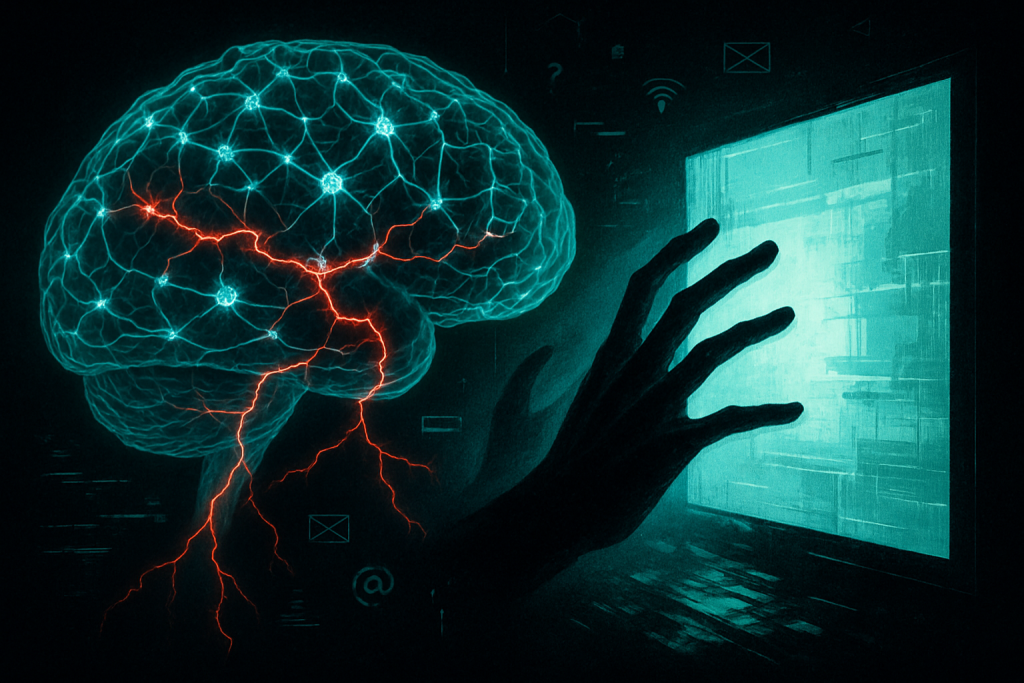
Image generated by AI
In 2023, a teenager in Ohio received over 300 hateful messages in a single day after posting a photo online. Yet the striking part wasn’t the volume—it was that many of the bullies were classmates she had previously considered friends. What transforms ordinary people into digital aggressors? The answer lies not in some fundamental evil lurking in human nature, but in the peculiar architecture of the internet itself, which amplifies and distorts psychological vulnerabilities we all possess.
Cyberbullying has become one of the most pervasive mental health crises of our time. According to the Cyberbullying Research Center, approximately 59 percent of U.S. teens have experienced some form of cyberbullying, including offensive name-calling, rumors, and explicit image sharing. Yet despite its prevalence, we often treat online aggression as a straightforward moral failure rather than what it actually is: a complex psychological phenomenon shaped by neurological, social, and technological forces. Understanding the science behind why humans behave this way online is not about excusing the behavior—it’s about recognizing the mechanisms at play so we can better prevent, intervene in, and recover from digital aggression.
What Is Cyberbullying and Aggressive Behavior Online?
Cyberbullying refers to deliberate, repeated harm inflicted through digital platforms—texts, social media, gaming environments, and messaging apps. Unlike traditional bullying, which requires physical presence, online aggression can follow victims everywhere, persist indefinitely through screenshots and reposts, and reach audiences of thousands. Psychologists define it as intentional aggressive behavior by a group or individual using electronic forms of contact against a victim who cannot easily defend themselves. The behavior spans a spectrum: from cruel comments and spreading rumors to coordinated harassment campaigns, doxing (publicly revealing private information), and the distribution of intimate images without consent. What distinguishes cyberbullying from mere rudeness is the intentionality, repetition, and power imbalance inherent in the act.
The formal study of cyberbullying emerged in the early 2000s as internet adoption accelerated globally. Researchers like Vivek Borges and Robin Kowalski began documenting this phenomenon around 2004-2005, recognizing it as distinct from offline bullying. Early studies were conducted primarily in Scandinavia and North America, where internet penetration was highest. By 2007, the American Psychological Association formally acknowledged cyberbullying as a significant concern, launching research initiatives to understand its unique features. Since then, the field has exploded, with thousands of studies examining everything from the prevalence of online aggression to its neurobiological underpinnings and long-term psychological consequences.
What the Science Says
The psychology of cyberbullying operates through several interlocking mechanisms, each rooted in well-established principles of human behavior. The first is what researchers call the “online disinhibition effect,” a phenomenon first described by psychologist John Suler in 2004. When interacting through screens rather than face-to-face, people experience reduced self-awareness and decreased concern for social evaluation. Their sense of personal accountability diminishes because the target feels psychologically distant, there’s an anonymity buffer (whether real or perceived), and there are no immediate social repercussions visible in their environment. The brain’s prefrontal cortex—responsible for impulse control and empathy—becomes less engaged when we’re online, particularly among adolescents whose prefrontal cortexes are still developing until their mid-twenties. Simultaneously, the amygdala, which processes emotional reactions and threat detection, becomes hyperactive in the polarizing environment of social media algorithms designed to maximize engagement through emotional arousal.
Consider the experience of sending a harsh text message versus saying the same words in person. When you see someone’s face crumple with hurt, mirror neurons in your brain fire in response—you literally simulate their pain. This automatic empathic response is dampened significantly online. A 2021 study published in the journal PNAS found that when people delivered criticism through email rather than in person, they were 40 percent more aggressive and showed measurably lower empathic responses, as measured through facial expressions and self-report. The digital medium creates what psychologists call “psychological distance,” making the target feel abstract rather than real. Add to this the phenomenon of “deindividuation”—the tendency for people in groups to lose their individual sense of responsibility and engage in behaviors they would never undertake alone—and you have a recipe for aggression. Online spaces naturally create the conditions for deindividuation: anonymity (or perceived anonymity), diffusion of responsibility across many perpetrators, and lack of surveillance.
How This Affects Everyday Life
The consequences of cyberbullying ripple through victims’ lives in profound ways. Research from the Journal of Adolescent Health demonstrates that targets of cyberbullying show elevated rates of anxiety, depression, and suicidal ideation—in some studies, rates two to nine times higher than peers not experiencing online aggression. The impacts extend to academic performance, sleep quality, and physical health markers like cortisol dysregulation. One particularly concerning finding comes from a longitudinal study at the University of Wisconsin-Madison: adolescents who experience cyberbullying show altered neural patterns in regions associated with emotional processing even months after the bullying has ceased. The brain appears to develop a kind of chronic hypervigilance, remaining on high alert for social threat. Beyond individuals, schools and workplaces now routinely experience productivity losses, damaged institutional reputation, and in extreme cases, legal liability when cyberbullying incidents occur on their platforms or among their members.
Contemporary applications of this research are extensive. Educational institutions have begun implementing AI-powered monitoring systems that detect hostile language in student communications and alert counselors before situations escalate. Mental health apps like Youper and Woebot use machine learning trained on cyberbullying psychology to provide real-time support and coping strategies to affected adolescents. Social media platforms including Instagram, TikTok, and Twitter have invested billions in machine learning systems trained to identify aggressive content and limit its distribution—though these systems remain imperfect. Corporate environments are increasingly adopting cyberbullying prevention protocols, particularly as workplace harassment has migrated to platforms like Slack and Microsoft Teams. Research institutions are also developing “digital resilience” interventions grounded in cognitive-behavioral therapy principles, helping vulnerable individuals build psychological defenses against online aggression.
Recent Breakthroughs in Cyberbullying and Aggressive Behavior Online
Over the past two to three years, neuroscience has begun revealing what happens in perpetrators’ brains during online aggression. A groundbreaking 2022 study from Stanford University used functional MRI to scan adolescents while they engaged in simulated cyberbullying. Researchers found that activation patterns in the ventromedial prefrontal cortex—a region crucial for evaluating social consequences—showed significantly reduced activity when participants sent aggressive messages through a screen, compared to face-to-face interactions. Even more striking, when researchers provided real-time feedback showing the emotional impact of the aggressive messages (through photos of distressed faces), this activity partially recovered, suggesting that restoring perspective on harm can reactivate empathic neural circuits. Simultaneously, research published in Cyberpsychology, Behavior, and Social Networking in 2023 has identified distinct psychological profiles among online aggressors: some are reactive (responding to perceived provocation), others are proactive (seeking status or entertainment), and still others appear to be displaced aggressors (transferring offline frustrations to digital targets). This typology is proving crucial for tailoring intervention strategies.
Researchers are now investigating novel prevention approaches grounded in these insights. One emerging area involves “moral disengagement reversal”—interventions designed to reactivate people’s sense of personal responsibility and connection to targets. Another focuses on algorithm transparency: examining how social media recommendation systems that prioritize emotionally engaging (often hostile) content may inadvertently reinforce aggressive posting patterns. Scientists are also exploring whether brief interventions—like prompting people to consider a target’s perspective before posting, or showing them neural imaging data about their own reduced empathy online—can meaningfully reduce cyberbullying behavior. Open questions remain: Why do some individuals engage in cyberbullying repeatedly while others never do, despite similar opportunities? How do protective factors like strong offline social connections buffer against perpetrating online aggression? And can we design digital environments that naturally promote prosocial behavior rather than requiring constant monitoring?
Why Cyberbullying and Aggressive Behavior Online Matters for the Future
As digital interaction becomes increasingly central to human connection—particularly following the COVID-19 pandemic’s acceleration of remote work, learning, and socialization—understanding and preventing cyberbullying becomes imperative for population mental health. The issue intersects with fundamental questions about human nature itself: Are we fundamentally prone to aggression when given anonymity, or is online hostility primarily a product of poorly designed social systems? The answer appears to be both, which means solutions must operate at multiple levels simultaneously. We need better individual psychological interventions, institutional policies, platform design changes, and potentially even regulatory frameworks that hold digital spaces accountable for their role in amplifying human aggression. The stakes are particularly high for younger generations who have never known a world without social media—their developing brains are being shaped by digital environments optimized for engagement rather than wellbeing.
Significant challenges remain unresolved. Free speech considerations complicate content moderation, creating genuine tension between protecting vulnerable people and preserving open discourse. The global nature of the internet means that cyberbullying prevention strategies effective in one cultural context may fail in another. Socioeconomic disparities in digital access create unequal exposure to both cyberbullying risk and digital literacy programs designed to prevent it. Perhaps most fundamentally, we lack consensus on whether the problem is the internet itself—requiring wholesale changes to digital architecture—or specific implementations that could be reformed through targeted interventions. Current research suggests it’s the latter, but proving this conclusively will require large-scale experimental studies manipulating platform features and measuring population-level mental health outcomes, work that remains ethically and practically complex.
Key Takeaways
- Cyberbullying occurs because the internet’s architecture—anonymity, psychological distance, and reduced visibility of social consequences—systematically weakens the empathic and inhibitory brain systems that normally prevent aggressive behavior in face-to-face contexts.
- The “online disinhibition effect” and deindividuation operate through well-understood neural mechanisms: reduced prefrontal cortex engagement and heightened amygdala activation create conditions where ordinary people behave more aggressively online than they would in physical presence.
- Real-time perspective-taking interventions and platform design changes that restore awareness of targets’ humanity show promise in reducing online aggression, suggesting prevention is feasible without requiring fundamental changes to human nature.
- Current research has identified distinct perpetrator profiles and is mapping the neurobiology of online aggression with increasing precision, moving the field from description toward mechanistic explanation and targeted intervention.
- As digital interaction becomes humanity’s primary social medium, understanding cyberbullying psychology is essential for building digital spaces that support rather than undermine mental health and social cohesion.
Explore TED Talks on Cyberbullying and Aggressive Behavior Online:
TED content is used under CC BY-NC-ND 4.0. © TED Conferences, LLC.
Frequently Asked Questions
What neurological and psychological mechanisms explain why people become more aggressive online than they would face-to-face?
The article identifies the internet's unique architecture as amplifying psychological vulnerabilities through digital disinhibition, where anonymity and reduced social cues lower inhibitions against aggression. This occurs because the brain's regions responsible for empathy and social consequences are less activated when interactions lack immediate physical feedback and accountability.
Why do previously friendly peers sometimes transform into cyberbullies toward the same person online?
The phenomenon reflects how digital platforms distort normal social psychology—factors like anonymity, lack of direct confrontation, and mob dynamics create conditions where ordinary people behave in ways they wouldn't in face-to-face interactions. The absence of visual cues showing the victim's emotional pain reduces the bully's ability to empathize in real-time.
What do the statistics tell us about the prevalence of cyberbullying as a mental health concern?
According to the Cyberbullying Research Center cited in the article, 59 percent of U.S. teens experience some form of cyberbullying, making it a widespread mental health crisis rather than an isolated problem. This high prevalence indicates cyberbullying is a systemic psychological and social issue affecting a clear majority of adolescents.
How does understanding cyberbullying as a psychological phenomenon rather than a moral failing change intervention approaches?
Recognizing the neurological, social, and technological mechanisms underlying cyberbullying enables evidence-based prevention and intervention strategies targeting the root causes rather than simply punishing perpetrators. This scientific approach helps identify which environmental and psychological factors can be modified to reduce aggressive behavior online.