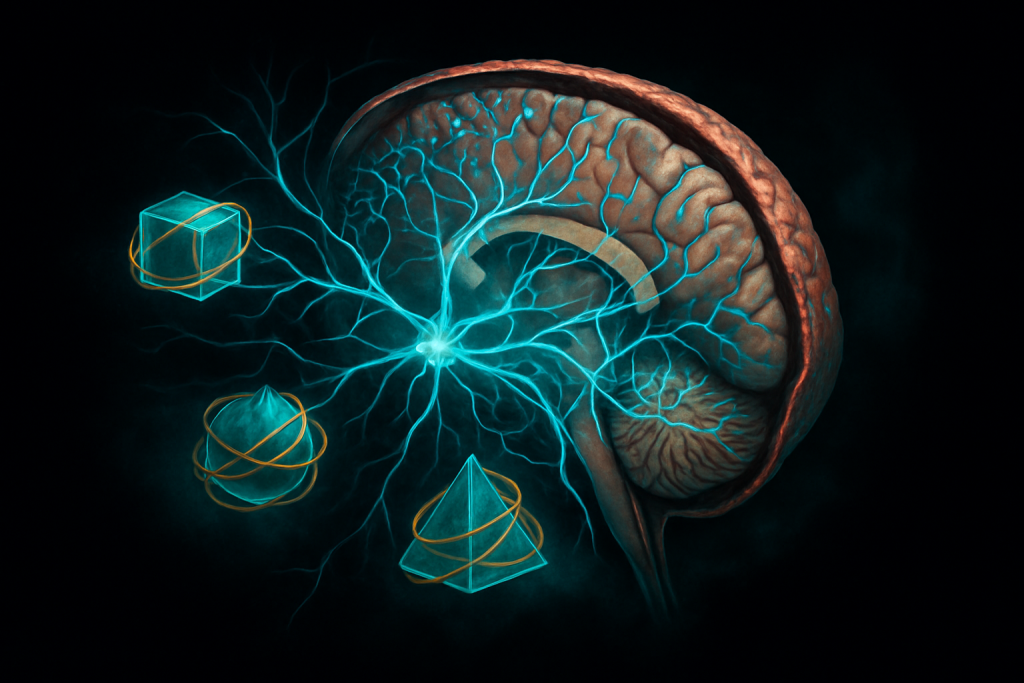
Image generated by AI
When you sketch a design, write a paragraph, or solve a stubborn problem, something remarkable happens in your mind: the idea becomes yours in a way that feels almost tangible. Yet you didn’t manufacture it from nothing—you drew on existing knowledge, borrowed techniques, and recombined familiar elements. So why does the creative act trigger such a powerful sense of possession, even when the raw materials were always available to anyone? This phenomenon, known as psychological ownership, reveals something profound about how the human mind binds itself to its creations, transforming abstract work into extensions of the self.
Understanding psychological ownership and creative agency has become urgent in our age of artificial intelligence, open-source collaboration, and rapid idea sharing. As algorithms generate text and images, as teams span continents and work asynchronously, and as the boundary between creator and consumer blurs, the question of who owns what—and more importantly, how ownership shapes motivation, well-being, and innovation—has moved from the margins of psychology into the spotlight. Companies, educators, and policymakers increasingly recognize that when people feel they own their work and exercise genuine agency over its direction, they perform better, persist longer through obstacles, and contribute more creatively to collective endeavors.
What Is Psychological Ownership and Creative Agency?
Psychological ownership is the sense that something is “mine” even without formal legal title. It’s the feeling a parent has toward a child they’re raising, a gardener toward their plot of vegetables, or a software developer toward code they’ve written. This ownership isn’t about possession in the legal sense—you can feel psychological ownership toward something you don’t legally own, and conversely, you can legally own something without feeling any psychological attachment to it. The phenomenon operates at the cognitive and emotional level, shaping how we invest energy, experience satisfaction, and relate to objects and ideas. Creative agency, the complementary concept, refers to the sense that you have meaningful control over your creative work—that your choices matter, that you can influence outcomes, and that the final product reflects your intentions and values.
The modern scientific study of psychological ownership emerged in the 1980s and 1990s, pioneered by researcher James Pierce and his colleagues at Washington State University. They initially investigated why people felt attachment to material possessions and organizational roles, publishing foundational work that distinguished psychological ownership from actual ownership. Around the same time, psychologist Albert Bandura was developing his influential theory of self-efficacy and agency, establishing that people’s belief in their capacity to influence events profoundly affects their motivation and performance. These parallel research streams converged to illuminate how psychological ownership and creative agency interact: when people feel they own their creative work and have genuine agency over it, their engagement and innovation flourish.
What the Science Says
At the neurological level, psychological ownership activates regions associated with self-referential processing and emotional reward. When you create something, your brain literally treats it as an extension of your self-concept. Functional MRI studies show that considering something “yours” activates the medial prefrontal cortex, the same area that lights up when you think about your own personality traits or memories. Simultaneously, the reward circuitry—particularly the ventromedial prefrontal cortex and ventral striatum—releases dopamine, the neurochemical underlying motivation and pleasure. This dual activation explains why ownership feels good and why it compels continued engagement. The creative act strengthens these neural patterns: the more effort you invest in shaping something, the more intensely your brain encodes it as part of your identity, creating a feedback loop that deepens psychological ownership.
Consider the “endowment effect,” a well-documented phenomenon where people value something more highly simply because they own it. In classic experiments, researchers give participants a coffee mug and then ask them how much they’d sell it for. Strikingly, people demand roughly double the price they’d pay to buy an identical mug—even though they received it moments earlier. The same effect applies to creative work. A designer who has spent weeks refining a logo perceives its value differently than an outsider viewing the same design for the first time. This isn’t mere rationalization; it reflects genuine shifts in how the brain processes and evaluates the work. The investment of time, effort, and emotional energy literally transforms the object’s neural representation in your mind.
How This Affects Everyday Life
In educational settings, psychological ownership profoundly influences learning outcomes and student motivation. When students feel genuine agency in choosing research topics, designing projects, or determining how to demonstrate mastery, their engagement and retention improve dramatically compared to standard curricula where assignments are predetermined. Researchers have found that students who feel ownership over their learning pursue deeper understanding rather than surface-level memorization, exhibit greater persistence when facing difficulties, and report higher intrinsic motivation. The impact extends beyond grades: students who experience creative agency develop more robust self-concepts as learners and are more likely to pursue further education or creative careers. Similarly, in workplace settings, employees who feel they own their projects and have voice in decision-making show higher productivity, lower burnout, and greater innovation.
These principles now inform organizational practices across industries. Tech companies like Google and 3M have long encouraged employees to spend time on self-directed projects, recognizing that ownership drives innovation. Design firms use co-creation methods where clients participate actively, fostering joint ownership that leads to better outcomes and higher satisfaction. In healthcare, when patients feel agency in their treatment decisions—choosing which therapies to pursue, setting health goals—they demonstrate better adherence and health outcomes. Educational platforms increasingly incorporate choice architecture, allowing learners to customize their learning paths. Even in creative industries like music production and game design, the most engaging work often emerges when team members feel they genuinely own their contributions rather than simply executing instructions.
Recent Breakthroughs in Psychological Ownership and Creative Agency
Recent research has illuminated how digital environments reshape psychological ownership in unexpected ways. A 2022 study from Stanford University examining remote work discovered that workers who collaborated digitally showed similar patterns of psychological ownership to their in-person counterparts, challenging assumptions that ownership requires physical proximity or synchronous interaction. However, the research also revealed nuanced differences: asynchronous collaboration required explicit scaffolding—clear authorship attribution, regular feedback, and transparent decision-making processes—to maintain ownership feelings. Meanwhile, neuroscientists at MIT have begun mapping how the “sense of ownership” extends beyond objects to ideas and abstract concepts. Using advanced brain imaging, they’ve shown that when people generate ideas themselves, versus merely receiving them, a distinct neural signature emerges involving the default mode network and regions associated with autobiographical memory, literally treating the idea as part of one’s life story.
Artificial intelligence presents a frontier challenge for psychological ownership research. As algorithms increasingly assist or co-create with humans, questions arise: does using AI assistance diminish the creator’s sense of ownership? A growing body of preliminary research suggests the answer is nuanced. When people perceive AI as a tool they actively control and direct, ownership remains robust. When AI operates as an autonomous agent, people report reduced ownership and satisfaction even if the AI-generated output is objectively superior. This finding has implications for how we design creative software and collaborative AI systems. Researchers are also investigating how psychological ownership affects collaboration across cultures, examining whether the phenomenon is universal or shaped by cultural values around individualism and communal property.
Why Psychological Ownership and Creative Agency Matters for the Future
As artificial intelligence and automation reshape work, psychological ownership becomes a crucial determinant of human flourishing in the economy. If machines handle routine tasks, humans increasingly occupy roles requiring creativity, complex judgment, and innovation—domains where psychological ownership and agency are essential to performance. Organizations and institutions that successfully foster ownership and agency will attract talent, generate better ideas, and adapt more effectively to change. Conversely, settings that treat humans as interchangeable executors of predetermined tasks risk losing both talent and innovative capacity. The implications extend to social cohesion: research suggests that people who experience agency and ownership in their productive lives report higher well-being, stronger community engagement, and greater life satisfaction.
However, significant challenges remain. Economic pressures often incentivize efficiency and standardization over the scaffolding that fosters ownership—clear feedback, meaningful choice, genuine influence over outcomes. Educational systems, despite growing awareness of agency’s importance, struggle to implement student-centered approaches at scale. The gig economy’s fragmentation makes sustained psychological ownership difficult when workers move rapidly between projects and organizations. Additionally, inequalities in access to ownership opportunities risk exacerbating existing disparities: privileged groups may enjoy rich opportunities for creative agency while others experience only instrumental, alienated labor. Future research must examine how to extend psychological ownership opportunities more equitably and how to design systems—organizational, educational, technological—that foster genuine agency even within constraints.
Key Takeaways
- Psychological ownership—the sense that something is “mine” without formal legal title—activates the brain’s self-referential and reward systems, explaining why our creations feel like extensions of ourselves.
- Creative agency, the belief that you meaningfully control and influence your creative work, reinforces psychological ownership through a feedback loop: effort invested deepens identity-binding, which increases motivation for further effort.
- The most promising real-world application is organizational and educational design that structures meaningful choice and transparent decision-making, which consistently increases engagement, innovation, and well-being across domains.
- Current research is examining how digital collaboration, artificial intelligence assistance, and cross-cultural differences shape psychological ownership, with implications for remote work, creative software design, and global teams.
- As automation reshapes the economy, fostering psychological ownership and genuine creative agency will determine not only individual motivation and innovation but also social cohesion and human well-being in future work environments.
Explore TED Talks on Psychological Ownership and Creative Agency:
TED content is used under CC BY-NC-ND 4.0. © TED Conferences, LLC.
Frequently Asked Questions
What psychological mechanism causes people to feel ownership over creative work they've made from existing materials and knowledge?
Psychological ownership arises when individuals mentally bind themselves to their creations through the act of transformation and investment of effort, even when using pre-existing elements. This sense of possession reflects how the mind treats creative output as an extension of the self rather than merely a recombination of external resources.
How does psychological ownership influence motivation and performance in creative tasks?
When people experience psychological ownership over their work, they demonstrate increased motivation, longer persistence through challenges, and higher-quality creative contributions. This sense of possession directly enhances performance because individuals are invested in outcomes they perceive as extensions of themselves.
Why has studying psychological ownership become more important in the context of artificial intelligence and collaborative work environments?
As AI generates creative content and teams collaborate across distributed settings, the traditional boundaries between creator, creation, and ownership become blurred, making it critical to understand how psychological ownership affects innovation and well-being. Researchers and organizations now recognize that clarifying ownership and agency is essential for maintaining motivation and creativity in these emerging work contexts.
Can psychological ownership affect creative agency, and if so, how are these two concepts related?
Yes—psychological ownership and creative agency are interconnected, with genuine agency (the ability to direct and control one's creative work) being a key factor that strengthens feelings of ownership. When individuals exercise real control over their creative process and outcomes, they develop stronger psychological ownership, which in turn reinforces their sense of agency.