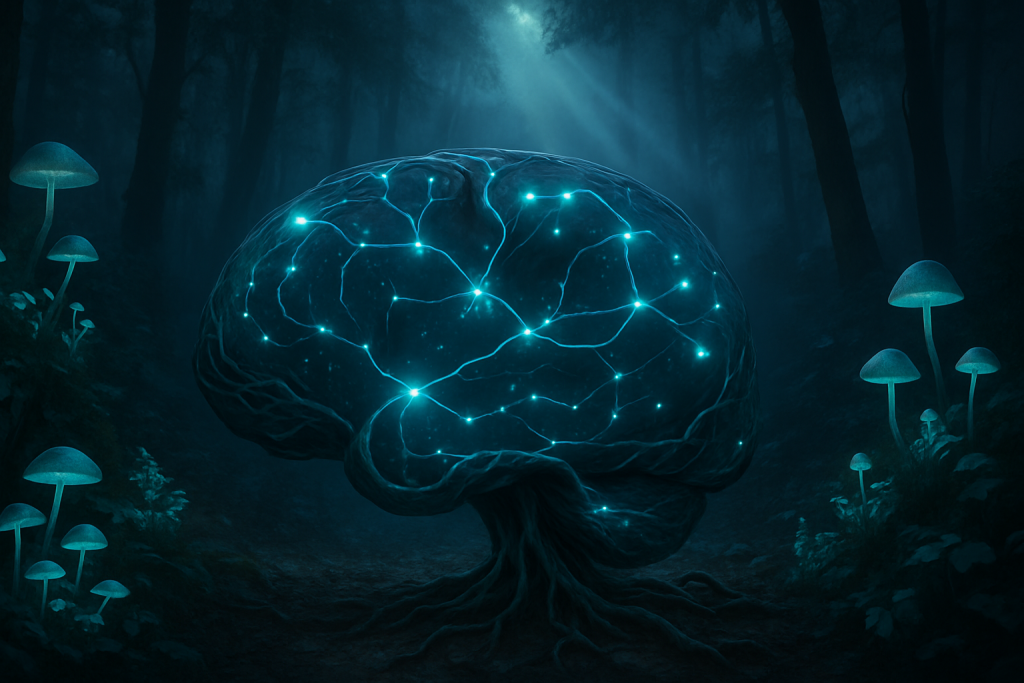
Image generated by AI
Imagine standing in a dense forest, sunlight filtering through leaves, the sound of birdsong filling the air. Within minutes, your stress levels drop, your attention sharpens, and a sense of calm washes over you. Yet most of us spend our days in cities and climate-controlled offices, staring at screens, rarely experiencing this feeling. Why, then, does nature exert such a powerful pull on the human mind? And more intriguingly, what happens neurologically when we reconnect with the natural world?
The question of why humans are drawn to nature is no longer merely philosophical—it has become a rigorous scientific inquiry. In an era where over 55% of the global population now lives in urban environments, and depression and anxiety disorders affect hundreds of millions of people worldwide, understanding our innate need for nature has never been more urgent. Environmental psychologists are uncovering evidence that nature connection isn’t a luxury or aesthetic preference, but rather a fundamental human need with profound implications for mental health, creativity, and even our capacity to solve the planet’s greatest challenges.
What Is Nature Connection and Environmental Psychology?
Nature connection refers to the psychological relationship between individuals and the natural environment—the degree to which people feel emotionally bonded to, aware of, and engaged with natural systems. This can manifest in various ways: a person might feel connected through direct experiences like hiking or gardening, or through more subtle forms of engagement such as noticing seasonal changes or caring about wildlife conservation. Environmental psychology, the broader field of study, examines how human behavior, cognition, and emotion are shaped by our physical and natural surroundings, and conversely, how human actions impact the environment. Together, these concepts explore a bidirectional relationship: not only does nature affect us, but our psychological state also influences how we interact with and protect natural spaces.
The formal study of environmental psychology began in the 1960s and 1970s, though the philosophical roots run deeper. Pioneering researchers like Roger Ulrich and Rachel and Stephen Kaplan developed foundational theories in the 1980s and 1990s that would revolutionize how we understand nature’s psychological benefits. Ulrich’s seminal 1984 study, which showed that hospital patients with windows overlooking trees recovered faster than those facing brick walls, provided some of the earliest empirical evidence that nature exposure produces measurable physiological and psychological effects. Since then, thousands of studies have built upon this foundation, creating a robust scientific consensus that nature connection is a cornerstone of human wellbeing.
What the Science Says
The mechanisms underlying nature connection operate across multiple biological systems simultaneously. When we spend time in natural environments, the sympathetic nervous system—responsible for the “fight or flight” response—downregulates, while the parasympathetic nervous system—associated with rest and recovery—activates. This neurological shift reduces cortisol levels, lowers blood pressure, and decreases heart rate variability. Simultaneously, nature exposure enhances activity in brain regions associated with attention, emotional regulation, and reward processing. Brain imaging studies using fMRI have demonstrated that walking through natural environments produces different neural signatures than walking through urban areas, with nature activating regions associated with introspection and social processing while reducing activity in areas linked to rumination and anxiety.
Consider the effect like tuning a radio: when you’re in an urban environment, your brain is constantly scanning for threats—vehicles, crowds, social evaluation, competing stimuli. This perpetual vigilance exhausts the prefrontal cortex, the brain region responsible for focused attention and executive function. Natural environments, by contrast, engage what researchers call “soft fascination”—trees, water, and wildlife capture attention gently and effortlessly, allowing the prefrontal cortex to recover. This recovery mechanism, formalized in Attention Restoration Theory by the Kaplans, explains why a forest walk can leave you feeling mentally refreshed rather than drained, even if it requires physical exertion.
How This Affects Everyday Life
The practical implications of nature connection research are reshaping how we design cities, workplaces, and healthcare facilities. Studies consistently show that workers with access to natural views report higher job satisfaction and productivity, while students in classrooms with windows overlooking green spaces demonstrate improved academic performance and reduced behavioral problems. Mental health outcomes have proven particularly compelling: people with higher nature connection scores exhibit lower rates of depression, anxiety, and stress-related disorders. The COVID-19 pandemic inadvertently became a massive natural experiment in this domain, with researchers noting that individuals who maintained nature access during lockdowns reported significantly better mental health outcomes than those confined to concrete environments without green space access.
Urban planners are now incorporating “biophilic design”—architecture that integrates natural elements—into buildings and public spaces. Companies like Google and Microsoft have invested heavily in office green walls and indoor gardens, not merely for aesthetics but because research demonstrates tangible productivity gains. Healthcare institutions are increasingly adopting nature-based therapies, with some hospitals now offering “nature prescriptions” alongside pharmaceutical interventions for anxiety and depression. Therapeutic horticultural programs have become standard in psychiatric facilities, while wilderness therapy has emerged as an evidence-based treatment for adolescent behavioral and emotional disorders. Some innovative municipalities are even mandating that new developments preserve or create green corridors, based on environmental psychology research demonstrating that neighborhood nature access is a public health imperative.
Recent Breakthroughs in Nature Connection and Environmental Psychology
Recent research has begun to unpack the mechanisms of nature connection with unprecedented precision. A 2023 study published in Frontiers in Psychology revealed that even brief exposures to nature—as short as 20 minutes—produce measurable improvements in stress biomarkers, suggesting that frequent micro-doses of nature throughout the day might provide cumulative mental health benefits. Researchers at the University of Exeter’s European Centre for Environment and Human Health have been investigating what they call the “30-minute rule”: exposure to natural environments for at least 30 minutes per week is associated with good health and high wellbeing. Additionally, emerging research using wearable biosensors has allowed scientists to track real-time physiological responses to nature exposure, revealing that individual differences in baseline stress reactivity predict who benefits most dramatically from nature interaction.
Current investigations are exploring more nuanced questions: Does the type of nature matter? Are forests superior to urban parks? Does virtual nature provide comparable benefits to physical immersion? Early findings suggest that wildness matters—more biodiverse and less manicured environments appear to provide greater psychological benefits—though even small urban green spaces confer meaningful advantages. Researchers are also investigating whether nature connection can be cultivated or trained, with preliminary evidence suggesting that mindfulness practices in natural settings amplify both the psychological and physiological benefits. The role of social connection during nature exposure is another frontier, with studies suggesting that shared nature experiences may strengthen both environmental motivation and social bonds.
Why Nature Connection and Environmental Psychology Matters for the Future
The implications of nature connection research extend far beyond individual mental health, touching upon humanity’s most pressing global challenges. If nature connection predicts environmental concern and conservation behavior—and mounting evidence suggests it does—then fostering this connection becomes a critical strategy for addressing climate change, biodiversity loss, and ecosystem degradation. People who feel emotionally connected to natural systems are significantly more likely to support environmental policies, modify their consumption patterns, and advocate for conservation. This creates a virtuous cycle: as people develop stronger nature connections, they become more motivated to protect and preserve natural spaces, which in turn provides greater nature access and stronger connection for future generations. Furthermore, if nature exposure enhances creativity, focus, and cognitive flexibility—capacities essential for innovation—then ensuring widespread access to nature becomes an investment in our collective problem-solving capacity.
However, significant challenges remain in translating this knowledge into equitable, scalable solutions. Access to nature is profoundly unequal: residents of low-income communities and communities of color have historically had less access to green space, a disparity sometimes termed “environmental injustice.” The mechanisms underlying nature connection—why certain individuals respond more intensely, whether cultural background influences connection patterns, and how to foster connection in those with limited outdoor access—remain incompletely understood. Additionally, some researchers caution against oversimplifying nature connection into a purely individualistic wellness tool, warning that focusing on nature therapy risks depoliticizing environmental destruction and obscuring systemic inequities in environmental access.
Key Takeaways
- Nature connection—the psychological bond between humans and natural environments—is not merely aesthetic but fundamentally shapes brain function, stress physiology, and mental health.
- When we spend time in nature, the parasympathetic nervous system activates while stress-related activity decreases, and the prefrontal cortex recovers from the exhaustion of sustained urban attention.
- Even brief nature exposures of 20-30 minutes produce measurable improvements in stress biomarkers, productivity, and emotional regulation, making nature access a practical mental health intervention.
- Current research is investigating the nuances of nature connection: whether different environments confer different benefits, whether virtual nature suffices, and how connection can be cultivated across diverse populations.
- As urbanization accelerates and environmental crises intensify, fostering nature connection becomes both a mental health imperative and a strategy for cultivating the environmental motivation necessary to address ecological collapse.
Explore TED Talks on Nature Connection and Environmental Psychology:
TED content is used under CC BY-NC-ND 4.0. © TED Conferences, LLC.
Frequently Asked Questions
What neurological changes occur in the brain when humans experience nature connection?
The article indicates that nature exposure produces measurable physiological changes including reduced stress levels and sharpened attention, suggesting activation of parasympathetic nervous system responses and enhanced cognitive function. These neurological shifts occur within minutes of nature exposure and reflect the brain's adaptive response to natural environments.
Why do environmental psychologists consider nature connection a fundamental human need rather than merely a preference?
Environmental psychologists recognize nature connection as fundamental because it has demonstrable impacts on mental health outcomes, creativity, and psychological well-being—effects that align with how basic human needs function. The widespread prevalence of depression and anxiety in urbanized populations lacking nature access suggests that nature connection serves essential psychological functions similar to other fundamental needs.
How does the urban environment specifically affect the human capacity for nature connection?
With over 55% of the global population living in urban settings with climate-controlled spaces and screen-based activities, most humans have reduced frequency and quality of nature exposure. This environmental constraint limits opportunities for the restorative neurological and psychological effects that nature connection provides.
What is the relationship between nature connection and human problem-solving capacity according to environmental psychology?
The article suggests that nature connection enhances cognitive functions including attention and mental clarity, which are essential capacities for addressing complex challenges. Environmental psychologists propose that reconnection with natural systems may improve our capacity to solve large-scale environmental and societal problems by restoring these critical cognitive resources.