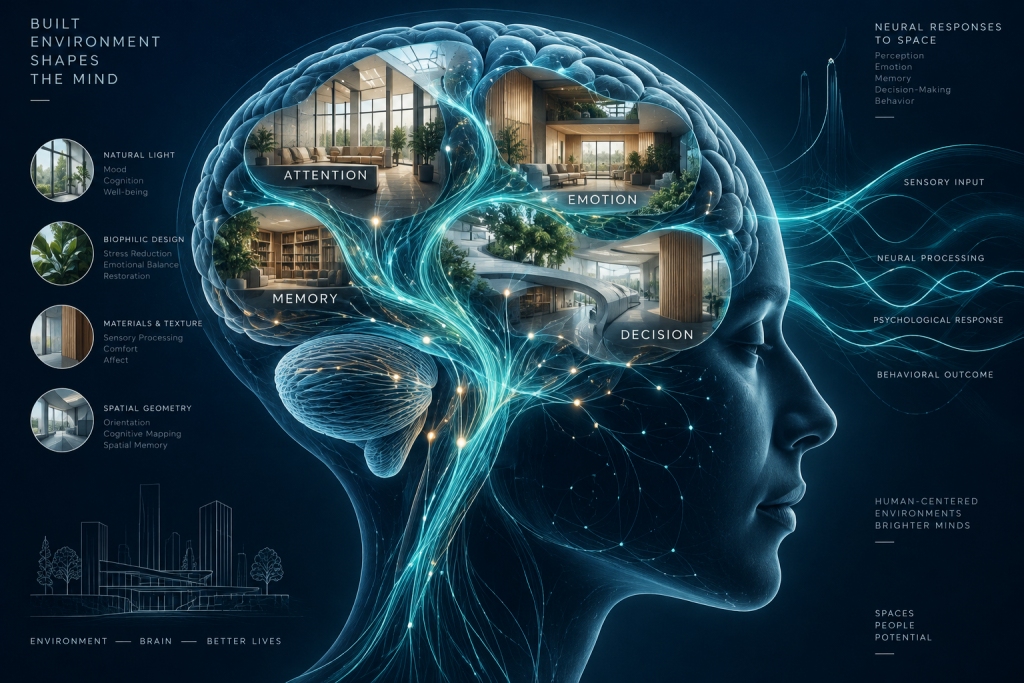
Image generated by AI
When you walk into a hospital corridor painted hospital-grey with flickering fluorescent lights, your cortisol levels spike. When you step into a sunlit room with plants and curved furniture, your stress hormone drops. The architecture surrounding us isn’t neutral—it’s a silent architect of our emotions, cognition, and behavior. Yet most of us move through designed spaces without questioning why a particular room makes us anxious while another feels welcoming, or why some offices drain our creativity while others seem to spark it.
Environmental psychology has emerged as one of the most consequential fields bridging neuroscience, architecture, and behavioral design. In an era where we spend over 90 percent of our lives indoors, understanding how our surroundings shape our minds isn’t merely academic—it’s essential. From hospital recovery rates to workplace productivity, from classroom learning outcomes to mental health in urban environments, the spaces we inhabit wield surprising power over our wellbeing and performance.
What Is Environmental Design and Psychological Impact?
Environmental design psychology refers to the complex relationship between the physical characteristics of spaces—their layout, lighting, color, materials, sound, temperature, and spatial organization—and human cognition, emotion, and behavior. It’s the study of how our brains and bodies respond to architectural and design choices, often in ways we don’t consciously perceive. The field asks a fundamental question: how do inanimate objects and spatial arrangements influence the animate human mind?
The modern investigation of this relationship began in earnest during the 1960s and 1970s, when researchers like Roger Ulrich and Rachel Kaplan started systematically studying how nature and designed spaces affected stress recovery, attention, and mood. Ulrich’s landmark 1984 study found that patients recovering from surgery who had windows overlooking trees required fewer pain medications and left the hospital earlier than those facing brick walls. This wasn’t anecdotal—it was quantifiable, reproducible evidence that design mattered biologically. Since then, the field has exploded into a sophisticated science combining environmental psychology, neuroscience, architecture, and behavioral economics.
What the Science Says
The mechanism linking environment to psychology operates through multiple biological channels simultaneously. Our sensory systems constantly gather information about our surroundings—light wavelengths, acoustic frequencies, spatial proportions, color information—and send this data to the brain’s sensory cortex. From there, signals travel to the limbic system, particularly the amygdala and insula, which process emotional significance and threat assessment. The prefrontal cortex then moderates these responses, but this regulation requires cognitive resources. When an environment triggers threat responses (harsh lighting, cramped spaces, excessive noise), the brain dedicates resources to managing stress rather than higher-order thinking. Conversely, spaces that feel safe and aesthetically coherent allow the prefrontal cortex to remain engaged in creative work, learning, and social connection.
Consider how this plays out with natural light. Circadian rhythms—our 24-hour biological clock—depend fundamentally on light exposure. When we lack natural light, particularly in the morning, our melatonin and cortisol cycles become desynchronized. This isn’t a minor inconvenience; it disrupts sleep quality, immune function, mood regulation, and cognitive performance. A person working in a windowless office doesn’t simply feel worse—their brain chemistry actually shifts toward a state less conducive to focus and wellbeing. Conversely, access to natural light strengthens circadian alignment, improving everything from memory consolidation to emotional regulation.
How This Affects Everyday Life
Environmental psychology has transitioned from academic curiosity to practical application in healthcare, workplace design, education, and urban planning. Hospitals now routinely incorporate design principles based on decades of research: artwork that depicts nature, window access when possible, soft indirect lighting, and warm color palettes have demonstrably reduced patient anxiety and accelerated recovery. Corporate campuses increasingly feature open, plant-filled spaces not as aesthetic luxuries but as evidence-based interventions for employee wellbeing and productivity. Schools are redesigning classrooms with attention to spatial acoustics, natural light, and flexible furniture arrangements—changes that research shows improve student engagement and learning outcomes, particularly for children with attention difficulties.
The tech industry has become perhaps the most aggressive adopter of environmental design principles. Companies like Google and Apple engineer their workspaces based on psychological research: varied thermal environments, adjustable lighting, access to nature, and diverse spatial types supporting different cognitive modes. Educational institutions have similarly transformed, with universities like MIT and Stanford deliberately creating spaces that encourage serendipitous encounters and collaborative breakthroughs. Mental health clinics increasingly design waiting rooms to be calming environments—reducing harsh lighting, incorporating nature imagery, and creating acoustic privacy—because research shows that even waiting room design influences therapeutic outcomes.
Recent Breakthroughs in Environmental Design and Psychological Impact
Over the past two to three years, neuroimaging studies have provided unprecedented insight into how environments activate specific brain networks. Research using fMRI technology has shown that viewing natural environments activates the default mode network—associated with reflective thinking and creativity—while viewing chaotic or poorly designed spaces activates threat-detection systems. A 2022 study published in the Proceedings of the National Academy of Sciences found that fractal patterns commonly found in nature (think leaf veins, tree branches) activate the visual cortex in uniquely harmonious ways, reducing cognitive load and promoting aesthetic pleasure. This suggests that biomimetic design—architecture that incorporates natural patterns and forms—isn’t just visually pleasing but genuinely easier for our brains to process.
Researchers are now investigating biophilic design more rigorously, with studies examining not just whether nature access helps—we’ve known that for decades—but which specific elements of nature matter most and why. Current investigations focus on sensory richness, temporal variation (how spaces change throughout the day), and the neurochemical responses to specific design interventions. Questions remain: Can a high-quality digital representation of nature provide psychological benefits similar to physical nature? How much exposure to nature-based design is needed for measurable effects? Do the benefits plateau, or do they remain scalable with increased environmental richness?
Why Environmental Design and Psychological Impact Matters for the Future
As urbanization intensifies—nearly 70 percent of humanity will live in cities by 2050—the psychological impact of environmental design becomes increasingly consequential for public health. Cities designed without attention to psychological principles create concentrated mental health crises: higher rates of depression, anxiety, and stress-related illness than rural or well-designed urban areas. The future of sustainable cities isn’t just about carbon footprints and renewable energy; it’s about designing urban environments that support human flourishing at scale. This means prioritizing green spaces, walkability, mixed-use neighborhoods, and architectural forms that feel psychologically coherent rather than alienating.
However, significant challenges remain in scaling this knowledge. Corporate and institutional adoption of environmental psychology has outpaced public policy and affordable housing design. Low-income communities often inhabit environments engineered for minimum cost rather than human wellbeing: harsh lighting, limited access to nature, poor acoustic design, and spatial configurations that increase social friction. There’s also the challenge of individual variation—what design elements optimize wellbeing for an introvert may differ from those for an extrovert, and cultural contexts shape environmental preferences profoundly. Future research must grapple with these inequities and variations rather than assuming universal design principles apply uniformly across populations.
Key Takeaways
- Environmental design—the physical characteristics of spaces including light, color, layout, and materials—measurably influences human psychological states, stress levels, cognitive performance, and emotional wellbeing through neural pathways connecting sensory input to the limbic system and prefrontal cortex.
- The mechanism operates through multiple biological channels: circadian rhythm disruption from inadequate natural light, threat-detection activation in chaotic spaces, cognitive resource depletion when environments feel unsafe, and enhanced creativity and social connection in coherently designed, nature-integrated spaces.
- The most promising applications are in healthcare, education, and workplace design, where evidence-based environmental interventions have demonstrably improved patient recovery times, student learning outcomes, and employee wellbeing and productivity.
- Recent neuroscience research using fMRI and other imaging technologies has identified specific brain networks and neurochemical responses to environmental characteristics, with particular promise in understanding biophilic design and fractal pattern recognition.
- As global urbanization accelerates, understanding and implementing psychological environmental design principles becomes essential for public health and social equity, though significant challenges remain in scaling these principles across diverse populations and socioeconomic contexts.
Explore TED Talks on Environmental Design and Psychological Impact:
TED content is used under CC BY-NC-ND 4.0. © TED Conferences, LLC.
Frequently Asked Questions
How do environmental design elements like lighting and color physically affect cortisol levels in the human body?
Specific wavelengths of light (particularly blue light from natural sunlight) regulate circadian rhythms and suppress melatonin, which directly influences cortisol secretion through the hypothalamic-pituitary-adrenal (HPA) axis. Color perception in the brain activates different neural pathways; for instance, cool colors and natural greens engage parasympathetic nervous system responses that lower stress hormone production, while harsh artificial lighting and grey tones can trigger sustained sympathetic activation.
What is the neurobiological mechanism by which curved versus angular furniture shapes emotional and cognitive responses?
Angular shapes activate the brain's threat-detection systems in the amygdala, triggering mild stress responses, while curved forms engage approach-related neural circuits associated with safety and comfort. This occurs through visual processing in the prefrontal cortex, which interprets geometric properties as environmental cues for either threat or refuge based on evolutionary survival patterns.
Can environmental design factors like spatial layout and temperature measurably impact workplace productivity and cognitive performance?
Yes; studies show that temperature regulation (68-72°F optimal), natural light exposure, and open-yet-partitioned spatial layouts enhance executive function, attention span, and creative problem-solving by optimizing prefrontal cortex activity and reducing cognitive load from discomfort. Conversely, poor environmental conditions elevate mental fatigue and reduce task performance by 10-25% in controlled studies.
How do plants and natural materials in indoor spaces affect psychological outcomes differently than synthetic environments?
Natural elements trigger biophilic responses—inherent neural pathways that promote parasympathetic activation and reduce rumination through sensory engagement with living systems, visible growth patterns, and organic textures. This is measurable through decreased cortisol, lower blood pressure, and improved mood scores compared to synthetic environments that lack these biological pattern-recognition cues.