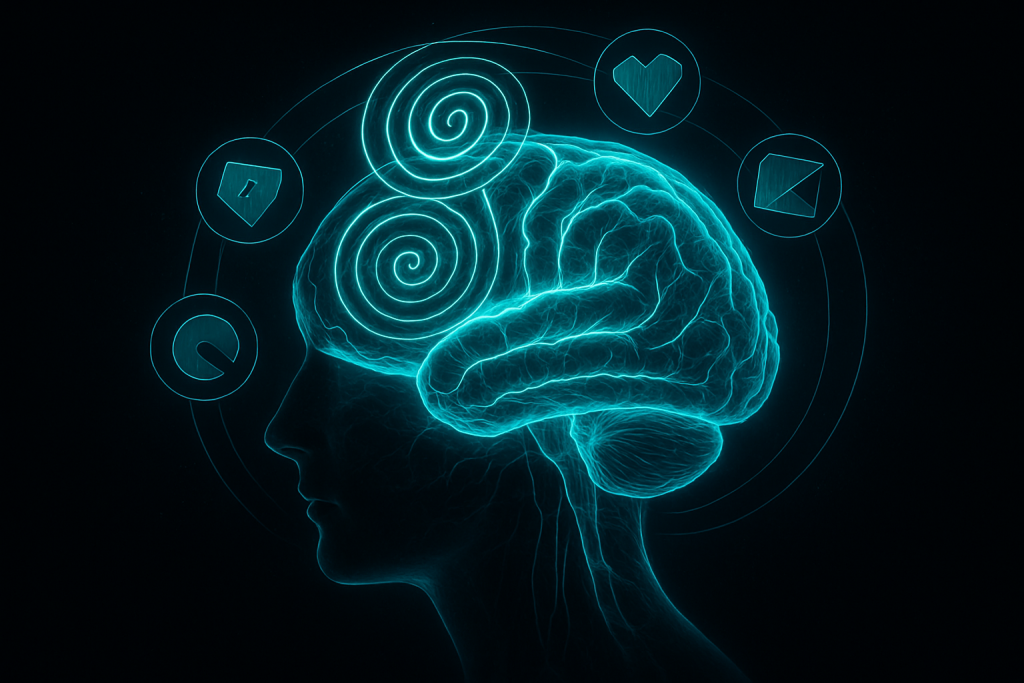
Image generated by AI
You replay an awkward conversation from three years ago while lying in bed at night. You obsess over a critical email from your boss, imagining different ways you could have worded your response. You find yourself stuck in a loop of “what-ifs” about a relationship that ended badly. These moments feel involuntary, as if your mind has developed a life of its own—and indeed, neuroscience suggests this isn’t simply a character flaw or sign of weakness, but rather a fundamental aspect of how human brains process emotional experiences.
Rumination—the tendency to repetitively think about past events, focusing especially on negative emotions and their causes—is one of the most common psychological phenomena, yet one of the least understood. Research suggests that up to 75 percent of people engage in some form of rumination regularly, and it exists on a spectrum from adaptive reflection to a maladaptive pattern linked to depression, anxiety, and diminished well-being. Understanding why our minds default to this behavior, how it works at a neurological level, and when it becomes problematic has become a central concern in contemporary psychology and neuroscience.
What Is Rumination and Emotional Processing?
Rumination is the cognitive process of repeatedly thinking about the same thoughts, often negative or distressing ones, without moving toward resolution or action. It differs from problem-solving or constructive reflection in that it tends to be circular and self-perpetuating—you turn the same concerns over and over in your mind without making progress toward understanding or change. Emotional processing, by contrast, refers to the broader psychological mechanism by which we integrate emotional experiences into our sense of self and long-term memory. These two concepts are intimately connected: rumination is often an unsuccessful attempt at emotional processing, where the mind keeps cycling through an experience because something about it hasn’t been adequately resolved or integrated.
The scientific study of rumination traces back to the 1990s, when clinical psychologist Susan Nolen-Hoeksema at Stanford University observed that depressed women were more likely than depressed men to engage in repetitive, self-focused thinking about their depression. Her groundbreaking work led to the “Response Styles Theory,” which posits that people facing distress either engage in “ruminative responses” (turning inward and focusing on symptoms) or “distracting responses” (redirecting attention outward). This framework revolutionized how psychologists understood not only why some people get stuck in depressive episodes, but also why identical stressful events lead to vastly different psychological outcomes across individuals. Since then, research has expanded to show that rumination is relevant to anxiety disorders, post-traumatic stress, insomnia, and even physical health outcomes.
What the Science Says
At its core, rumination appears to emerge from a mismatch between emotional experience and cognitive understanding. When something emotionally significant happens—a betrayal, a failure, an unexpected loss—the brain registers it as important and potentially threatening. Normally, the emotional response fades as we process the event, extract lessons, and move forward. But in rumination, this natural resolution process gets stuck. Neuroimaging studies using functional MRI have revealed that people who ruminate show heightened activity in the default mode network, a collection of brain regions active during self-referential thinking, combined with reduced engagement of the prefrontal cortex, which is crucial for cognitive control and flexible thinking. This neural signature suggests that ruminators are caught in an intense loop of self-focused attention with limited access to the brain’s executive resources that might help redirect or resolve the thought pattern.
Think of rumination like a scratched record that keeps replaying the same groove. The needle lands in the same spot repeatedly, producing the same sound each time, even though playing it over and over doesn’t deepen your understanding of the song—it just reinforces the same frustrating loop. Similarly, when you ruminate about an embarrassing moment, your brain rehearses the memory and its emotional valence without genuinely integrating new information. Each repetition strengthens the neural pathways associated with the memory and the emotional sting, making the thought more automatic and harder to dismiss. The brain seems to be treating rumination as problem-solving—”If I just think about this enough, maybe I’ll understand it or fix it”—but this strategy backfires because emotional understanding requires more than repetition; it requires perspective, narrative integration, and a sense of closure or acceptance.
How This Affects Everyday Life
The impact of rumination extends far beyond momentary discomfort. Longitudinal studies have shown that chronic rumination is a significant risk factor for developing major depression, particularly in people who experience stressful life events. A landmark 2011 meta-analysis found that ruminators were approximately five to seven times more likely to develop depressive episodes compared to non-ruminators. Beyond depression, rumination is implicated in generalized anxiety disorder, where people ruminate about future threats, and in post-traumatic stress disorder, where rumination about traumatic memories perpetuates symptoms. The cascade effects are profound: rumination disrupts sleep, impairs decision-making, reduces cognitive capacity for other tasks, and can even affect physical health through chronic stress activation. People who ruminate tend to withdraw from social activities, creating a negative feedback loop where isolation reduces the social correction and perspective that might interrupt ruminative patterns.
In clinical settings, therapists increasingly screen for ruminative patterns because they’re so predictive of treatment outcomes. Cognitive-behavioral therapy (CBT) for depression and anxiety explicitly targets rumination by teaching patients to recognize the thought pattern and interrupt it through behavioral activation, mindfulness, and cognitive restructuring. Workplace mental health programs now incorporate rumination-reduction strategies, recognizing that persistent rumination reduces productivity and increases burnout risk. Some organizations have begun teaching “meta-awareness”—the ability to notice that you’re ruminating—as a foundational skill. Digital mental health applications track rumination through symptom reporting and smartphone usage patterns, offering just-in-time interventions when rumination is detected, and preliminary evidence suggests these tools can reduce rumination frequency by 20 to 40 percent in at-risk populations.
Recent Breakthroughs in Rumination and Emotional Processing
In the past few years, researchers have made significant progress in identifying the specific neural mechanisms that distinguish adaptive emotional processing from maladaptive rumination. A 2022 study published in Nature Neuroscience used machine learning to analyze brain imaging data and found that people who successfully process emotional experiences show distinct patterns of connectivity between the prefrontal cortex and the amygdala—the brain’s emotional center. Specifically, adaptive processors showed stronger top-down regulation from prefrontal regions, allowing them to modulate emotional intensity while maintaining engagement with the emotional content. In contrast, chronic ruminators showed either weak prefrontal control or paradoxically strong connectivity that felt forced and effortful, suggesting their emotional regulation required constant mental effort. This distinction has profound implications: it suggests that rumination isn’t simply “too much thinking” but rather inefficient emotional regulation architecture that exhausts the brain’s resources.
Another exciting development is the growing recognition of “adaptive rumination” or constructive reflection—a form of repetitive thinking that actually supports emotional growth and problem-solving. Researchers like Ethan Kross at the University of Michigan have shown that the way you talk to yourself about emotional experiences dramatically shapes outcomes. People who achieve emotional distance, perhaps by referring to themselves in the third person or by focusing on what they’ve learned, show better emotional regulation and lower depressive symptoms even when they engage in considerable reflection. This suggests that rumination becomes problematic not because people think about their experiences, but because of the quality and direction of that thinking. Current research is exploring whether training people in “structured reflection”—setting aside specific times to think deeply about emotional experiences within a problem-solving framework—could channel the brain’s natural tendency toward rumination into more adaptive pathways. Preliminary data from intervention studies suggests this approach holds promise, particularly for anxiety disorders.
Why Rumination and Emotional Processing Matters for the Future
As our understanding of rumination advances, its implications ripple across multiple domains. The mental health crisis affecting millions globally—characterized by rising rates of depression, anxiety, and burnout—is partly rooted in maladaptive rumination patterns amplified by modern life. Social media platforms, with their endless feeds of self-focused content and opportunities for social comparison, may inadvertently create environments that reinforce ruminative thinking. Understanding how to support healthier emotional processing at scale could address mental health challenges before they crystallize into diagnosable disorders. Similarly, as artificial intelligence systems become more integrated into mental health care, research on rumination provides crucial insights into how algorithms might detect early warning signs and deliver timely interventions. In education and organizational psychology, insight into rumination informs approaches to stress management, resilience-building, and creating work environments that support psychological flexibility rather than anxiety amplification.
Despite these advances, significant challenges remain. We still lack precise biomarkers that can reliably distinguish rumination from other forms of repetitive thinking, limiting our ability to develop targeted interventions. The neurobiological mechanisms linking rumination to physical health outcomes—through inflammation, immune suppression, and cardiovascular disease—remain incompletely understood. Additionally, cultural differences in rumination patterns and their meaning have received insufficient attention; some research suggests that the cognitive styles valued in certain cultures may inadvertently encourage the very patterns associated with rumination in Western psychological literature. Future research must integrate neuroscience, clinical psychology, cultural studies, and digital behavioral tracking to develop a more nuanced understanding of how rumination emerges, why some people are more vulnerable, and how to intervene effectively across diverse populations.
Key Takeaways
- Rumination is the circular, repetitive thinking about emotional experiences without reaching resolution, distinct from helpful reflection because it lacks progress toward understanding or change.
- Neurobiologically, rumination involves hyperactive default mode network activity combined with weakened prefrontal control, creating a self-reinforcing loop of self-focused thinking that exhausts cognitive resources.
- The most promising intervention approach involves teaching structured reflection and metacognitive awareness—helping people notice rumination and deliberately shift toward adaptive emotional processing rather than simply avoiding the thought pattern.
- Current research is advancing toward identifying reliable biomarkers for rumination and exploring how the quality and framing of repetitive thinking determines whether it leads to emotional growth or psychological distress.
- As rumination contributes significantly to depression, anxiety, and burnout across populations, understanding and reducing maladaptive rumination patterns represents a critical frontier in preventative mental health and well-being science.
Explore TED Talks on Rumination and Emotional Processing:
TED content is used under CC BY-NC-ND 4.0. © TED Conferences, LLC.
Frequently Asked Questions
What is the difference between rumination and problem-solving in emotional processing?
Rumination involves repetitively thinking about negative or distressing thoughts without moving toward resolution or action, whereas problem-solving is goal-directed cognitive activity aimed at addressing the issue. The article notes that rumination differs fundamentally from productive reflection by its lack of forward movement or actionable outcomes.
Why do neuroscientists consider rumination an involuntary brain process rather than a character flaw?
Neuroscience research indicates that rumination is a fundamental aspect of how human brains process emotional experiences, suggesting it operates through automatic neural mechanisms rather than conscious choice or personal weakness. This finding reframes rumination as a built-in cognitive function that exists across up to 75 percent of the population.
How does rumination exist on a spectrum between adaptive and maladaptive patterns?
Rumination ranges from adaptive reflection—which may aid emotional processing—to maladaptive rumination linked to depression, anxiety, and diminished well-being. The severity and outcome depend on factors that determine whether the repetitive thinking leads to insight or instead perpetuates emotional distress.
What are the primary negative psychological outcomes associated with excessive rumination?
Excessive rumination is linked to depression, anxiety, and diminished overall well-being according to research cited in the article. These outcomes suggest that when rumination becomes maladaptive, it actively impairs mental health rather than facilitating emotional resolution.