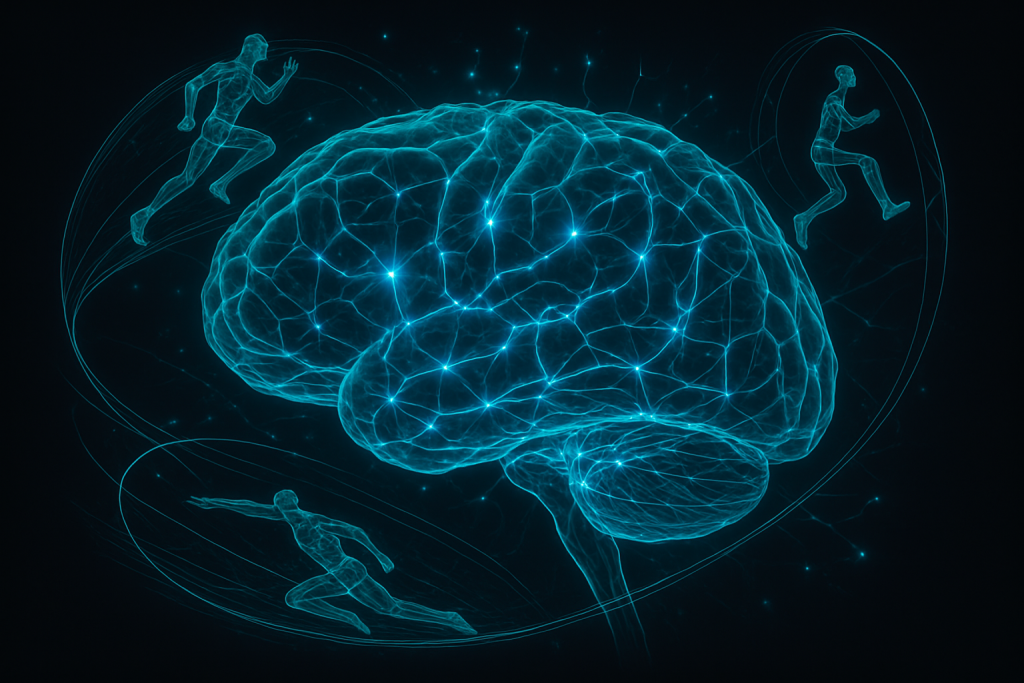
Image generated by AI
When Serena Williams stood at the baseline before serving at match point, she wasn’t just relying on years of physical conditioning—she was activating a mental choreography refined through visualization and psychological rehearsal. Yet this isn’t some mystical phenomenon exclusive to elite athletes. The science of mental training reveals something profound: our brains don’t fundamentally distinguish between vividly imagined experiences and real ones, a discovery that has revolutionized how we understand the connection between thought and action. This neural equivalence suggests that mental practice isn’t merely a supplement to physical training—it’s a legitimate form of motor learning that activates the same neural networks as actual performance.
In an era where athletic competition has been optimized to its physical limits, the psychological dimension has become the new frontier for competitive advantage. From professional sports organizations investing millions in sports psychologists to amateur athletes using smartphone apps for guided visualization, mental training has transitioned from fringe territory to mainstream practice. This shift reflects a deeper scientific understanding: performance under pressure, resilience after setbacks, and the ability to execute complex skills in high-stakes situations are not accidents of personality—they are trainable cognitive skills governed by predictable psychological principles that researchers have begun to map with precision.
What Is Athletic Performance and Mental Training?
Athletic performance encompasses the complex interplay of physical ability, technical skill, and psychological state during competitive or training situations. Mental training, also called psychological skills training or sports psychology intervention, refers to systematic practice of cognitive and emotional techniques designed to optimize performance. These techniques include visualization or mental imagery, self-talk, attention control, goal-setting, arousal regulation, and confidence building. Unlike physical training that targets muscle strength and cardiovascular capacity, mental training targets the neurological systems governing attention, motivation, emotional regulation, and motor planning. The fundamental premise is that since the nervous system orchestrates both thought and action, training the mind can enhance the execution of physical skills and sustain performance under psychological pressure.
The scientific study of mental training in athletics emerged in earnest during the Cold War, when Soviet sports scientists—particularly researcher Vladimir Rotenberg and his colleagues—systematically investigated visualization and mental rehearsal. During the 1980s, American and European researchers like Jean Côté and Jean-Philippe Côté began documenting that elite athletes across diverse sports devoted significant training time to mental techniques, often unconsciously. This observation sparked rigorous investigation into why these practices were so universal and what mechanisms explained their effectiveness. By the 1990s and 2000s, advances in neuroimaging allowed scientists to directly observe what happens in the brain during mental training, transforming mental techniques from anecdotal practice into an evidence-based discipline grounded in neuroscience and cognitive psychology.
What the Science Says
The mechanism underlying mental training operates through a principle called neural equivalence: when you vividly imagine performing a physical skill, your brain activates many of the same neural circuits as during actual performance, though with reduced intensity and output. Brain imaging studies using functional magnetic resonance imaging (fMRI) have demonstrated that visualization of motor tasks activates the premotor cortex, supplementary motor area, and cerebellum—regions critical for movement planning and coordination—in patterns remarkably similar to actual motor execution. This neural activation strengthens the synaptic connections within motor networks through a process called long-term potentiation, meaning that mental practice literally rewires neural pathways governing motor execution. Additionally, mental training activates the prefrontal cortex, which is crucial for attention control, decision-making, and emotional regulation—capacities essential for performing under pressure. Over repeated sessions, these neural pathways become more efficient and more readily accessible during actual performance, resulting in improved execution, faster skill acquisition, and greater resilience when competing.
Consider the analogy of a musician learning a difficult concerto. Physical practice—actually playing the instrument—develops both the motor skills and the neural circuits for execution. Yet accomplished musicians also spend considerable time mentally rehearsing passages without touching their instrument, imagining the feel of their fingers, the sound production, and the emotional contours of the music. During these mental rehearsal sessions, their motor cortex activates in response to imagined finger movements, their auditory cortex processes imagined sounds, and their emotional centers engage with the imagined emotional content. This mental practice strengthens the same neural networks that will be recruited during performance, and research shows it produces measurable improvements in execution speed and accuracy comparable to some physical practice sessions. The key distinction is that mental practice appears particularly effective for refining already-learned skills, encoding complex spatial sequences, and managing the psychological aspects of performance under pressure—aspects where physical repetition alone provides limited benefit.
How This Affects Everyday Life
While elite athletes represent the most visible application of mental training science, the principles extend far beyond professional sports, affecting performance across domains requiring complex skill execution under pressure. Surgeons use visualization to mentally rehearse complex procedures before operating, a technique that has been shown to reduce complications and improve outcomes; a 2017 study in the Journal of Surgical Education found that surgeons who engaged in pre-operative mental rehearsal made fewer errors during actual surgery. Military personnel use similar techniques to prepare for high-stress scenarios, improving decision-making and emotional regulation in combat situations. Musicians, dancers, public speakers, and performers of all kinds have integrated mental training into their preparation routines. Even in non-performance contexts, mental training principles apply to everyday challenges: students studying for exams show improved retention when they mentally rehearse retrieval scenarios; people facing anxiety-provoking situations benefit from mental preparation and visualization; and individuals pursuing fitness goals show greater adherence and success when they combine physical training with mental imagery of themselves executing exercises and achieving their goals.
Contemporary applications span multiple industries and medical contexts. Clinical psychology uses imagery-based techniques and attention control training to treat anxiety disorders, PTSD, and phobias—treating these conditions as disturbances in how the mind regulates attention and emotional response. Rehabilitation medicine employs mental motor imagery in stroke recovery, where patients who cannot move affected limbs can still activate motor circuits through visualization, potentially facilitating neuroplastic reorganization and recovery of function. Corporate performance coaching and executive training programs increasingly incorporate mental training techniques to enhance decision-making under pressure and leadership effectiveness. The proliferation of digital applications—from guided visualization apps to biofeedback devices that monitor attention state during mental practice—has democratized access to these techniques beyond elite athletic contexts. These technologies reflect a broader recognition that mental training is not a luxury performance enhancer but a fundamental tool for optimizing human performance across virtually all domains involving skilled execution and psychological pressure.
Recent Breakthroughs in Athletic Performance and Mental Training
Recent research has revealed surprising specificity in how mental training effects vary depending on the exact nature of the imagined experience. A 2022 meta-analysis published in Psychology of Sport and Exercise examining over 100 studies found that internal imagery—imagining from the first-person perspective, feeling the movements in your body—produces stronger performance improvements than external imagery, where you imagine watching yourself perform like viewing a video. Moreover, research has demonstrated that kinesthetic imagery, which specifically engages the sensation of movement and proprioceptive feedback, produces more robust neural activation than purely visual imagery. This finding has transformed how sports psychologists design interventions, with practitioners now emphasizing the importance of emotionally engaging, multisensory mental rehearsal rather than passive visualization. Additionally, recent studies employing transcranial magnetic stimulation (TMS) have shown that mental practice produces measurable changes in corticospinal excitability—the efficiency of neural transmission from motor cortex to muscles—comparable to effects from physical practice, providing unprecedented physiological evidence for mental training’s efficacy.
Current research frontiers explore how mental training interacts with other performance-enhancing systems and under what conditions it remains effective. Investigators are examining whether specific personality traits, attention capacities, or cognitive styles predict who benefits most from mental training, moving beyond the assumption that it works equally for all athletes. Another active area investigates how mental training interacts with pressure and anxiety: some evidence suggests that mentally rehearsing performance under simulated pressure (including imagining competition anxiety and practicing emotional regulation during mental rehearsal) produces superior transfer to actual competitive contexts compared to mentally practicing in relaxed conditions. Researchers are also exploring the potential dark side: whether excessive or inappropriate mental training might contribute to anxiety, perfectionism, or performance decrements in certain populations. These questions reflect a maturation of the field from simple documentation of efficacy toward nuanced understanding of mechanism, individual differences, and optimization strategies.
Why Athletic Performance and Mental Training Matters for the Future
As our understanding of mental training advances, it carries profound implications for how we conceptualize learning, skill development, and human potential more broadly. The evidence that imagination can produce genuine neural and physiological changes challenges traditional distinctions between mental and physical processes, suggesting these represent different expressions of unified brain function. For education, this implies that mental rehearsal techniques could enhance learning across academic disciplines, with students mentally practicing problem-solving, public speaking, or test-taking in addition to conventional study methods. For medicine and rehabilitation, refined mental training approaches could unlock recovery pathways for patients with motor deficits or neurological injuries. The recognition that psychological skills are trainable also democratizes excellence: if performance under pressure relies on learnable psychological techniques rather than innate talent alone, then systematic psychological training could expand the population capable of high-level performance. Furthermore, as artificial intelligence and automation increasingly replace routine physical labor, distinctly human capacities like performing complex skills under pressure—precisely what mental training optimizes—become increasingly valuable economically and socially.
Significant challenges remain before we fully harness mental training’s potential. Research has concentrated on relatively small, often homogeneous populations—predominantly elite athletes in individual sports—limiting our ability to generalize findings across different athletic contexts, age groups, and cultures. The mechanisms underlying individual differences in mental training responsiveness remain poorly understood; we cannot yet reliably predict who will benefit most from which interventions. Additionally, the field struggles with standardization: interventions vary widely in duration, intensity, content, and delivery, making comparison across studies difficult and complicating efforts to distill evidence-based best practices. The interaction between mental training and other performance factors—genetics, physical conditioning, technical coaching, nutrition, sleep—remains inadequately understood. There also exists a risk of overselling mental training as a panacea, potentially leading athletes and performers to neglect fundamental physical preparation or to use it as justification for inappropriate pressure on young athletes. These limitations underscore that while mental training represents a genuine performance tool, it remains most effective as part of comprehensive, balanced training approaches.
Key Takeaways
- Mental training leverages neural equivalence—the brain activates similar neural circuits during vivid mental rehearsal as during actual performance—allowing athletes to strengthen motor networks, improve skill execution, and develop psychological resilience through visualization and cognitive practice.
- The mechanism operates through long-term potentiation at the synaptic level: repeated mental practice strengthens connections within motor networks while also recruiting prefrontal systems governing attention, decision-making, and emotional regulation, improving performance under competitive pressure.
- The most promising real-world applications extend beyond elite sports to surgical training, military preparation, rehabilitation medicine, and general skill development, with guided mental imagery, attention control training, and psychological skills systematically improving outcomes across diverse domains.
- Current research emphasizes that internal, kinesthetic, emotionally-engaging imagery produces stronger effects than passive visualization, and that training under simulated pressure conditions enhances transfer to actual competitive contexts, while individual differences in mental training responsiveness remain incompletely understood.
- As excellence increasingly depends on performing complex skills under psychological pressure rather than routine physical tasks, scientifically-grounded mental training becomes essential for human development, with implications for education, medicine, rehabilitation, and our understanding of learning and human potential.
Explore TED Talks on Athletic Performance and Mental Training:
TED content is used under CC BY-NC-ND 4.0. © TED Conferences, LLC.
Frequently Asked Questions
How does the brain's neural equivalence between imagined and real experiences improve motor learning in athletes?
When athletes vividly imagine performing a skill, their brains activate the same neural networks used during actual physical performance, allowing the central nervous system to strengthen motor pathways without physical execution. This neural activation creates legitimate learning effects comparable to physical practice, making visualization a scientifically valid form of motor skill refinement.
What specific cognitive mechanisms allow mental training to enhance performance under pressure?
Mental training strengthens the prefrontal cortex's ability to regulate stress responses and maintain focus during high-stakes situations by repeatedly rehearsing psychological strategies in safe, controlled mental contexts. This neural conditioning builds executive function resilience that transfers to actual competitive scenarios where performance execution is critical.
Can mental training alone produce the same athletic performance improvements as physical training?
Mental training cannot replace physical practice for developing muscle memory and physiological adaptations, but it significantly enhances skill execution and performance consistency when combined with physical training. The science shows mental training is most effective as a complementary tool that optimizes the neural patterns underlying already-developed physical capabilities.
Is there measurable neurological evidence that mental training changes how athletes' brains respond to competitive stress?
Yes, neuroimaging studies demonstrate that mental training protocols alter activity in brain regions associated with emotion regulation, decision-making, and attention control, resulting in measurable changes in how athletes process competitive pressure. These neural adaptations correlate with improved performance metrics and reduced performance anxiety in high-pressure situations.