AI Insight
A total solar eclipse observed from Spain on August 12, 2026 displayed an unusually golden corona instead of the typical pearly white appearance. The golden coloration resulted from two atmospheric filtering effects: the Sun's low position near the horizon during totality caused atmospheric scattering of blue light, and smoke from nearby forest fires provided additional blue light filtering. A hydrogen prominence visible at the Sun's edge retained its characteristic bright pink color despite the atmospheric effects.
Why it matters
This observation demonstrates how atmospheric conditions can dramatically alter the visual appearance of astronomical phenomena, providing insights into light scattering and atmospheric optics. The event also illustrates how local environmental factors like wildfire smoke can create unique observational conditions during rare celestial events.
Understand the Science
APOD
Astronomy Picture of the Day
Discover the cosmos! Each day a different image or photograph of our fascinating universe is featured, along with a brief explanation written by a professional astronomer.
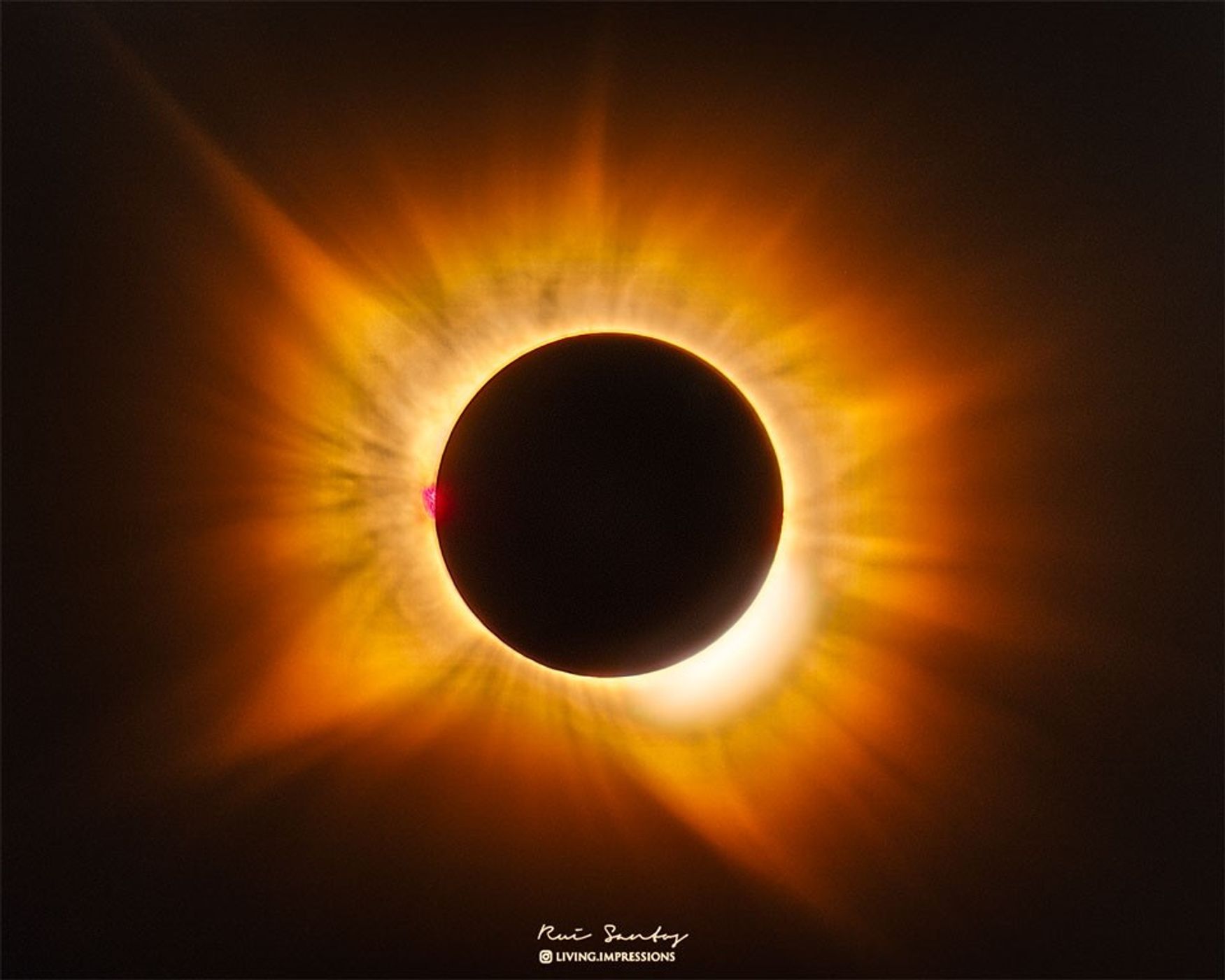
A Golden Corona Eclipse
Explanation: This total solar eclipse appeared not only poetically beautiful but scientifically interesting. Usually the solar corona appears white, and to some observers the corona of last week’s total solar eclipse did appear this pearly color. But this time, totality observers in Spain saw a corona that appeared unusually golden. For one reason, from Spain, the totality occurred when the setting Sun was near the horizon. That low, sunlight travels through a large amount of air which scatters out blue light. An unusual amount of smoke in the air from nearby forest fires acted as a second filter, further scattering the remaining blue tones and deepening the already gold-dominated light. The HDR-processed, multiple-exposure featured image was captured from Benavente, Spain last week. One thing that did not appear golden was a hydrogen-glowing prominence that hovered over the Sun‘s left edge — its original bright pink color survived.

Gallery: Solar Eclipse of 2026 August 12
Tomorrow’s picture: fast meteors
| Date: | August 17, 2026 |
|---|---|
| Credit & Copyright: | Rui Santos (Living Impressions) |
| Authors & editors: | Robert Nemiroff, Jerry Bonnell, Cecilia Chirenti, Keighley Rockcliffe |
| A service of: |
ASD at NASA / GSFC, NASA Science Activation & Michigan Tech. U. |