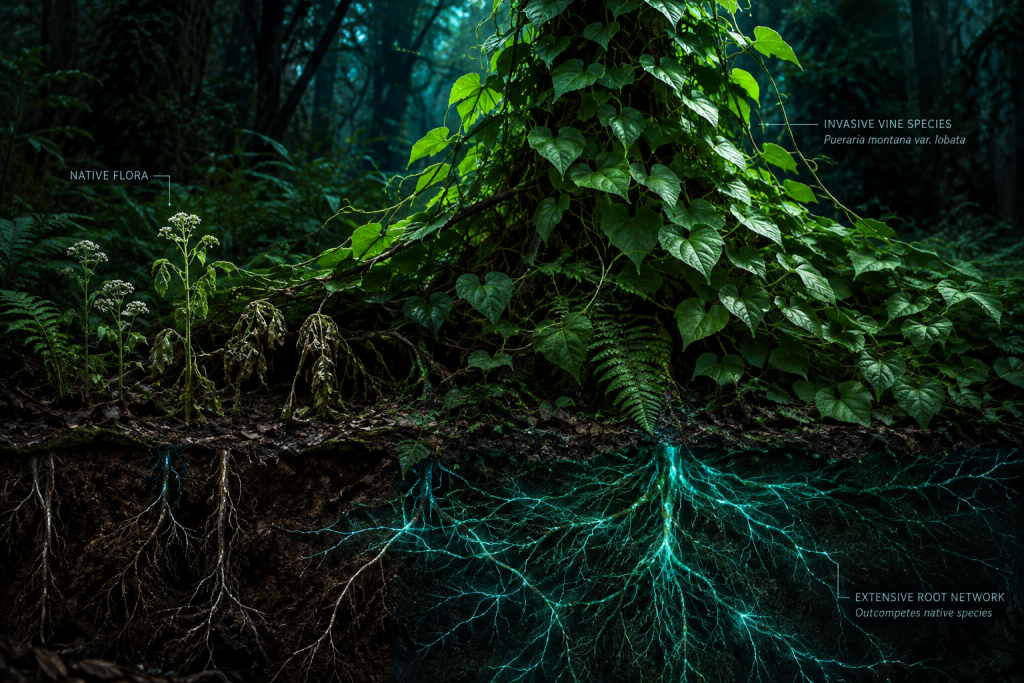
Image generated by AI
Every year, a carp with golden scales slips through a lock system in the Mississippi River, a zebra mussel clogs a water intake pipe, and a kudzu vine strangles another forest canopy. These aren’t isolated incidents—they’re symptoms of a global biological upheaval that costs the world economy an estimated $423 billion annually. Invasive species, organisms that establish themselves in ecosystems where they don’t naturally belong, have become one of the most potent drivers of ecological change on Earth, reshaping food webs, destabilizing economies, and altering the very structure of landscapes we thought we understood.
What makes invasive species so consequential isn’t simply their presence, but the speed and scale at which they transform entire ecosystems. Unlike the gradual evolution that shaped native species over millions of years, invasive species arrive with no natural predators, no evolved competitors, and no pathogens to keep them in check. The science of invasive species ecology examines these dynamics—how organisms succeed in new environments, why some ecosystems are more vulnerable than others, and what cascading effects ripple through food webs when the rules of nature are suddenly rewritten. Understanding these processes has become essential not just for conservation biologists, but for public health officials, agricultural economists, and urban planners grappling with an accelerating crisis.
What Is Invasive Species Ecology and Impact?
Invasive species ecology is the scientific study of how non-native organisms establish, spread, and alter ecosystems they colonize, along with the cascading biological, economic, and social consequences that follow. Unlike the broader field of invasion biology, which examines the general principles of how species invade, invasive species ecology focuses specifically on the ecological mechanisms that make invasions succeed or fail, the structural changes they trigger in food webs and nutrient cycles, and the predictable patterns that repeat across different continents and climate zones. An invasive species isn’t simply any organism found outside its native range—it must actively spread, outcompete native species, and cause measurable harm to ecosystems, human health, or economic interests. This distinction matters because millions of introduced species never become invasive; they either fail to establish populations or remain confined and benign.
The scientific framework for understanding invasive species took shape gradually over the 20th century, accelerating after the 1958 publication of Charles Elton’s landmark work “The Ecology of Invasions by Animals and Plants,” which recognized invasions as a fundamental ecological problem. Elton observed that simplified ecosystems—islands, agricultural monocultures, and degraded habitats—were far more vulnerable to invasion than complex, biodiverse systems. The field matured significantly in the 1990s and 2000s, when researchers like James Brown and Peter Kareiva developed mathematical models showing how life history traits, dispersal mechanisms, and environmental resistance shaped invasion success. Today, invasive species ecology integrates evolutionary biology, community ecology, network theory, and systems thinking to predict which species will become problematic, where they’re most likely to establish, and how to manage them once they’ve arrived.
How It Works in Nature
The ecological success of invasive species follows a predictable sequence that ecologists call the “invasion process.” When a species arrives in a new territory, it must first overcome a series of barriers: it must find suitable habitat with appropriate climate, food, and physical conditions; it must encounter enough individuals to establish a viable breeding population; and it must avoid immediate predation or disease. Once these obstacles are cleared, invasive species often experience what ecologists call “release from enemy resistance”—without the natural predators, parasites, and competitors that evolved alongside them over millions of years, they can reproduce and spread far more rapidly than they ever could in their native range. This isn’t because they’re inherently superior organisms; it’s because the ecological rules they’ve suddenly entered are fundamentally different. A hypothetical parallel: imagine moving a chess player to a game where their opponent’s pieces have been blindfolded and their castle walls dismantled. The invading species doesn’t need to be better at the game; they just need to operate in an ecosystem unprepared to resist them.
The mechanisms through which invasive species destabilize ecosystems vary depending on their position in food webs and their interaction with physical environments. Predatory invaders like lionfish in the Caribbean or Burmese pythons in the Everglades cause what ecologists call “top-down control,” decimating native prey populations that evolved no behavioral defenses against them. Herbivorous invaders like rabbits in Australia or feral pigs across continents reshape entire plant communities, fundamentally altering soil composition and nutrient cycling. Some invasive species, particularly plants like purple loosestrife in North American wetlands, produce dense monocultures that exclude native competitors and reduce structural complexity that native animals depend on for shelter and nesting. Still others, like nitrogen-fixing trees introduced to Hawaii, actually change the chemical properties of soil itself, making it impossible for native plant communities to re-establish even if the invasive species is removed. These ecological engineer invaders are particularly devastating because their impacts persist long after the invader itself is eliminated.
Medical and Scientific Relevance
While invasive species are most often discussed as an ecological problem, they pose direct threats to human health and food security that are only now being fully recognized. Mosquitoes carrying dengue, Zika, and other pathogens have invaded new regions as shipping and climate change open corridors for their spread, transforming the epidemiology of infectious disease globally. Similarly, invasive freshwater snails in Africa carry parasites that cause schistosomiasis, infecting millions; these snails have spread far beyond their native range through water systems and agricultural irrigation schemes. Invasive species also trigger cascading effects on human nutrition and economic stability—when lionfish invaded the Atlantic, they consumed juvenile fish that humans depend on for protein, while invasive cassava brown streak virus in East Africa devastated a critical crop for subsistence farmers. Understanding the invasion ecology of disease vectors and agricultural pests has become as important to epidemiologists and food security experts as it is to conservation biologists.
Public health agencies now monitor invasive species as part of their disease surveillance and pandemic preparedness. The emergence of West Nile Virus in North America, spread by invasive Culex mosquito species, prompted the creation of integrated vector management programs that combine ecological knowledge with targeted interventions. Agricultural biotechnology companies deploy ecological understanding to predict which invasive plant species will threaten crop yields in specific regions, enabling preemptive deployment of biocontrols. Climate modeling combined with invasion ecology now helps researchers forecast how species ranges will shift as temperatures warm, allowing resource managers to prepare for invasions that may occur decades in the future. This predictive capacity has become crucial in an era when global trade and climate change are accelerating the rate at which species encounter novel environments.
Recent Breakthroughs in Invasive Species Ecology and Impact
In the past three years, several major research programs have substantially advanced our ability to predict and manage invasive species. A 2022 meta-analysis published in Nature Ecology & Evolution integrated data from over 500 invasion events across multiple continents and found that early detection paired with rapid response protocols could reduce invasion severity by up to 70 percent, but only if interventions began within the first few years of establishment. Simultaneously, machine learning algorithms trained on historical invasion data have begun showing surprising accuracy in predicting which species will become invasive before they actually establish—by analyzing traits like reproductive rate, dispersal capacity, and climate tolerance, researchers can now flag high-risk species with better than 80 percent accuracy. Genomic studies have also revealed that many successful invaders undergo rapid genetic changes in their new environments, evolving novel traits that make them even more formidable competitors; the invasive populations are, in a real sense, not the same species as their ancestors.
The frontier of invasive species research now involves understanding why some ecosystems prove nearly impervious to invasion while others collapse under the pressure of a single non-native species. Recent work on network ecology suggests that ecosystems with high structural redundancy—multiple species performing similar ecological functions—can “absorb” invasive species without wholesale reorganization, while systems with low redundancy can tip into entirely new states. Researchers are also investigating the role of multiple stressors: ecosystems weakened by pollution, habitat fragmentation, or climate change appear far more vulnerable to invasion. The emerging consensus is that invasive species don’t invade truly healthy, resilient ecosystems as readily; instead, they’re often opportunistic symptoms of ecosystems already in distress. This reframes invasion management from solely focusing on removing the invader to addressing the underlying vulnerabilities that allowed invasion to succeed in the first place.
Why Invasive Species Ecology and Impact Matters for the Future
The acceleration of invasive species invasions is inextricably linked to globalization, and that acceleration shows no signs of slowing. Climate change is creating novel combinations of temperature and precipitation that suddenly favor invasive species that previously couldn’t establish in temperate regions—pythons are now surviving in Florida’s winter climate when they would have frozen to death a decade ago, and tropical insect pests are expanding their ranges poleward at an average rate of 2.7 kilometers per year. International trade continues to move billions of organisms across borders each year in shipping containers, ballast water, and ornamental plant markets; a single cargo ship can carry thousands of species in its ballast tanks, creating a biological lottery where winners become invasive and reshape entire oceanic ecosystems. The COVID-19 pandemic demonstrated how a single invasive pathogen can convulse global society; as climate zones shift and trade intensifies, the probability of future invasions by disease vectors, agricultural pests, and ecosystem engineers only increases.
Managing invasive species in a warming, interconnected world requires moving beyond reactive removal efforts toward predictive, preventive strategies that seem almost impossible at current scales. We lack global monitoring systems capable of detecting early invasion stages before species become established—most invasive species are only recognized as problems after they’ve already transformed large areas. Regulatory frameworks for trade and travel remain fragmented and often toothless, with incentives favoring speed over biosecurity. Perhaps most challenging, the ecological knowledge required to manage invasions effectively—understanding local food webs, predicting species interactions, identifying keystones—demands expertise that developing nations most threatened by invasions often lack resources to build. As invasive species continue to reshape the biosphere, the discipline of invasive species ecology will likely become as central to conservation as genetics has become to medicine—not a specialized sideline, but a foundational framework for understanding and managing a changing world.
Key Takeaways
- Invasive species are non-native organisms that establish, spread, and cause measurable harm to ecosystems, with annual global economic costs exceeding $423 billion.
- Invasive species succeed through “release from enemy resistance”—they encounter no evolved predators, competitors, or parasites in their new environments, allowing explosive population growth.
- Some invasive species function as “ecological engineers,” permanently altering soil chemistry, nutrient cycling, or physical habitat structure in ways that persist even after the invader is removed.
- Recent breakthroughs in machine learning and genomic analysis enable scientists to predict invasion success with over 80 percent accuracy and reveal that invasive populations rapidly evolve new traits in their adopted homes.
- Climate change and globalization are accelerating invasions at unprecedented rates, making understanding invasive species ecology essential for predicting and managing future threats to food security, human health, and biodiversity.
Explore TED Talks on Invasive Species Ecology and Impact:
TED content is used under CC BY-NC-ND 4.0. © TED Conferences, LLC.
Frequently Asked Questions
Why do invasive species succeed in new ecosystems where native species struggle to establish?
Invasive species often lack natural predators, evolved competitors, and pathogens in their introduced ecosystems that would normally control their populations in their native range. This absence of ecological resistance allows them to proliferate rapidly and outcompete native species for resources.
How do invasive species alter food webs and what are the cascading ecological effects?
Invasive species can occupy new trophic levels, outcompete native species for food, or become novel prey that native predators aren't adapted to consume, fundamentally restructuring energy flow through ecosystems. These disruptions cascade through food webs, affecting species at multiple trophic levels and destabilizing entire ecological communities.
What characteristics make certain ecosystems more vulnerable to invasive species colonization?
Ecosystems with low native species diversity, disturbed habitats, high resource availability, and weak biotic resistance from native competitors and predators are typically more vulnerable to invasion. Islands and isolated freshwater systems are particularly susceptible due to their limited species pools and reduced evolutionary pressure against novel invaders.
Can invasive species cause permanent changes to ecosystem structure, or can native communities recover if the invader is removed?
Invasive species can cause lasting ecosystem changes through habitat modification, soil alteration, and species extinctions that persist even after invader removal. However, some ecosystems show partial recovery when invasives are eliminated, depending on the degree of structural damage and availability of native species for recolonization.