AI Insight
NASA's Nancy Grace Roman Space Telescope successfully separated from its SpaceX Falcon Heavy rocket approximately 31 minutes after launch on August 30, 2026, from Kennedy Space Center in Florida. The image captures the telescope floating independently in space with its solar arrays still folded, showing its High Gain Antenna that will enable communication with ground control. The telescope is now traveling to sun-Earth Lagrange Point 2 (L2) for a 90-day commissioning period before beginning its scientific mission.
Why it matters
The $4 billion Roman Space Telescope, delivered ahead of schedule and under budget, represents two decades of development work and will investigate fundamental cosmic mysteries including dark matter and dark energy, while also searching for exoplanets around distant stars. Its deployment marks a significant milestone in next-generation space astronomy capabilities.
Understand the Science
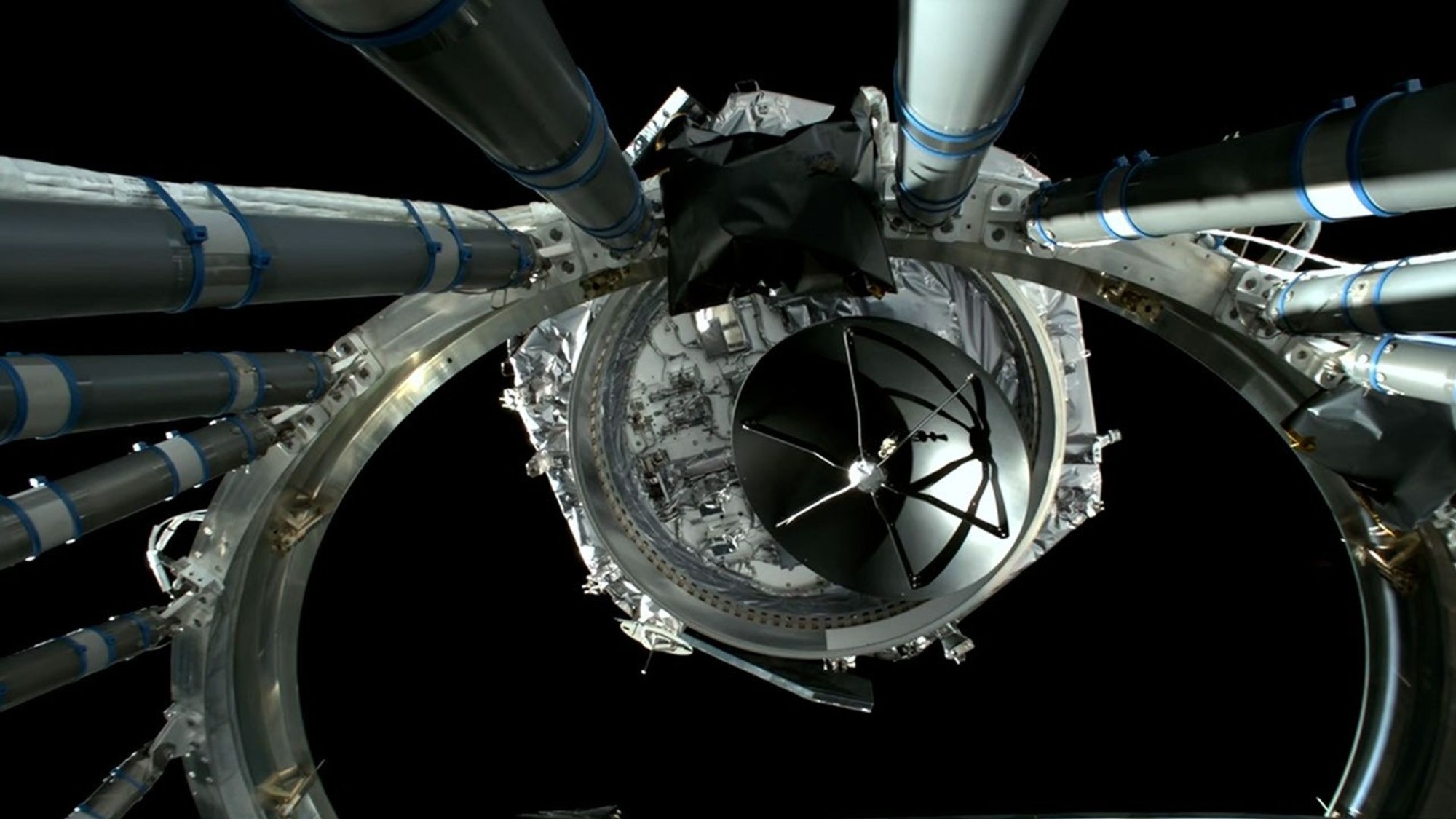
NASA caught a breathtaking image of its next-generation Nancy Grace Roman Space Telescope deploying into space shortly after launch.
What is it?
This image was captured just some 31 minutes after the Roman telescope took off atop a SpaceX Falcon Heavy rocket from NASA’s Kennedy Space Center in Florida on Sunday (Aug. 30).
The photo shows the Nancy Grace Roman Space Telescope (or Roman) flying on its own for the first time, shortly after separating from the upper stage of the SpaceX Falcon Heavy rocket that sent it to orbit. In the foreground, the telescope’s payload adapter can be seen, while just behind, the orbital observatory floats into the blackness of space with its solar arrays still folded for launch.
This view reveals the back of the telescope, upon which its High Gain Antenna (HGA) radiofrequency dish can be seen. This is the dish the telescope will use to communicate with mission controllers on the ground and beam its groundbreaking science back to Earth.
Now well into its mission, the Roman Space Telescope will begin a 90-day commissioning period while traveling to sun-Earth Lagrange Point 2, or L2, a gravitationally stable parking spot in space between our planet and its star.
Why is it incredible?
It’s always incredible seeing views like this one from space. Getting to witness a spacecraft deploy into orbit offers a rare glimpse at the conditions they experience in the vacuum of space.
But more than that, this photograph depicts the culmination of two decades of work from NASA and its contractors who helped develop and build the $4 billion Nancy Grace Roman Space Telescope — ahead of schedule and under budget, a rarity in the spaceflight world.
Once at L2 and fully commissioned, the telescope will begin probing the universe for clues that might help unravel the mysteries of dark matter and dark energy, as well as hunting for exoplanets around distant stars.
Source: Roman telescope leaves its rocket behind | Space photo of the day for Aug. 31, 2026