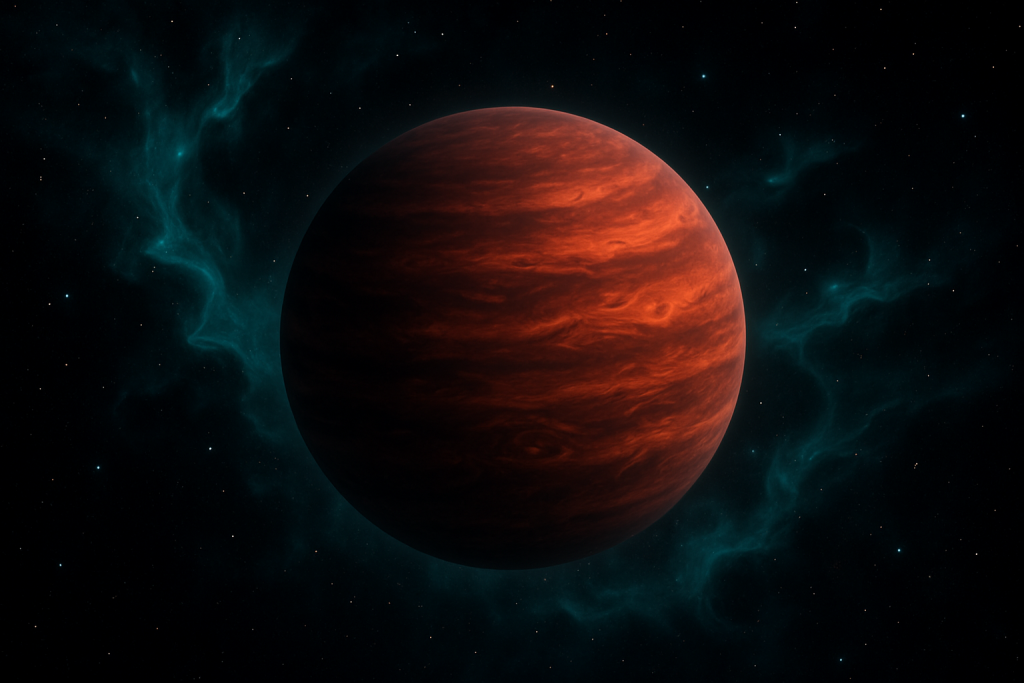
Image generated by AI
Imagine a cosmic object caught in an identity crisis—too massive to be a planet, yet too small to ignite the nuclear fusion that defines a star. This is the peculiar realm of brown dwarfs, mysterious substellar objects that have upended our understanding of how the universe populates itself between the planet and star categories. For decades, astronomers theorized their existence, but brown dwarfs remained frustratingly elusive until their first confirmed discovery in 1995, launching a revolution in how we map the stellar neighborhood and search for distant worlds.
Today, brown dwarfs have become crucial laboratories for understanding atmospheric chemistry, testing the boundaries of stellar formation, and refining our search for potentially habitable exoplanets. With new space telescopes and ground-based surveys discovering hundreds of these objects, brown dwarfs are reshaping our census of the galaxy and revealing unexpected pathways for how planetary systems assemble themselves. Understanding these substellar wanderers matters not just for astronomy—it reshapes our perspective on planetary habitability, stellar physics, and the very definition of what it means to be a “star.”
What Is Brown Dwarfs: Properties, Atmospheres, and Substellar Classification?
A brown dwarf is a substellar object with a mass roughly between 13 and 80 times that of Jupiter—large enough to generate some internal heat through gravitational contraction, yet too small to sustain the hydrogen-fusing reactions that power true stars. Unlike planets, which form within protoplanetary disks around stars, brown dwarfs are thought to form directly from collapsing clouds of gas and dust, much like stars do. However, they lack sufficient mass to reach the critical temperature and pressure needed at their cores to ignite hydrogen fusion, the process that transforms a brown dwarf into a main-sequence star. This fundamental distinction makes brown dwarfs neither true stars nor planets, but rather an entirely separate category of celestial object that occupies the mysterious gap between worlds.
The theoretical concept of brown dwarfs emerged in the 1960s, when astrophysicists realized that the minimum mass required for hydrogen fusion—approximately 75 to 80 Jupiter masses—might represent a natural boundary in stellar formation. However, these objects remained theoretical curiosities for three decades until advances in infrared astronomy made detecting their faint glow possible. In 1995, a team led by David Charbonneau and colleagues announced the discovery of Gliese 229B, a brown dwarf orbiting a nearby red dwarf star, using the Hubble Space Telescope. This landmark confirmation sparked an intensive search that has since uncovered hundreds of brown dwarfs within a few hundred light-years of Earth, fundamentally changing our view of stellar neighborhoods and the frequency of substellar objects in the universe.
What We Know So Far
Brown dwarfs exist along a continuous spectrum of properties determined primarily by their mass and age, creating a dynamic classification system that astronomers use to organize these objects. The most widely adopted system divides brown dwarfs into spectral classes—L, T, and Y types—which reflect progressive cooling and changes in atmospheric composition as these objects age. L dwarfs, the warmest brown dwarfs with effective surface temperatures between 1,200 and 2,000 Kelvin, display prominent absorption features from metal hydrides and alkali atoms in their spectra. T dwarfs, cooling to between 700 and 1,400 Kelvin, develop strong methane absorption bands that fundamentally alter their appearance and mark a dramatic transition in atmospheric chemistry. The most recently discovered Y dwarfs, the coldest brown dwarfs with temperatures below 700 Kelvin, remain so dim that only the most sensitive infrared telescopes can detect them.
To understand this spectral progression, consider how a cooling campfire transforms in character: a hot L dwarf glows visibly orange-red like fresh flames, while a cooler T dwarf shifts toward infrared like dying embers, and a Y dwarf becomes nearly invisible like cold ash, detectable only through sensitive thermal imaging. This analogy captures how brown dwarfs’ appearances fundamentally change as they cool over billions of years. The chemical transitions occurring within their atmospheres—particularly the formation of methane clouds and the depletion of metal oxides—produce these dramatic spectral shifts that allow astronomers to classify and understand these distant objects without ever seeing them directly.
The atmospheric composition of brown dwarfs reveals tantalizing complexity that rivals Earth’s own air in chemical sophistication. L dwarfs possess atmospheres dominated by hydrogen gas, with clouds of dust and condensed salts creating their reddish appearance, while iron and silicate dust scatter blue light effectively, making them appear unusually dim at optical wavelengths. T dwarfs experience a pivotal atmospheric transition where methane becomes abundant, absorbing red light and causing these objects to appear surprisingly blue-shifted despite their cool temperatures—a counterintuitive phenomenon that initially confused astronomers. As brown dwarfs cool into the T and Y dwarf regimes, water ice and ammonia ice clouds become increasingly dominant, while clouds of sulfide minerals and crystalline materials settle into distinct atmospheric layers.
Recent spectroscopic observations using the James Webb Space Telescope have revealed unprecedented details in brown dwarf atmospheres, including evidence for exotic mineral clouds, temperature variations across latitudes, and weather patterns that rival those of Jupiter. The detection of carbon monoxide, water vapor, and hydrogen sulfide in various brown dwarf atmospheres has allowed scientists to construct increasingly sophisticated models of atmospheric circulation and cloud formation. These observations suggest that brown dwarf atmospheres operate under physical principles that bridge planetary meteorology and stellar physics, offering a unique window into how atmospheres behave under extreme but not fully stellar conditions.
The Future of Exploration
Brown dwarfs have emerged as invaluable tools for exoplanet research and the search for potentially habitable worlds beyond our solar system. Because brown dwarfs are cool and relatively nearby, planets orbiting within their habitable zones—where liquid water could potentially exist on a planetary surface—are much easier to detect and characterize than those around distant, luminous stars. The James Webb Space Telescope and next-generation ground-based facilities like the Extremely Large Telescope are now routinely discovering planetary companions around brown dwarfs, revealing a population of worlds that might never have been detected around more distant stars. Moreover, studying the atmospheres of young brown dwarfs helps astronomers understand how planetary atmospheres form and evolve, providing crucial insights for assessing the habitability of exoplanets across the galaxy.
Current research programs are leveraging brown dwarfs as natural laboratories for atmospheric chemistry and cloud physics that cannot be easily replicated in terrestrial labs. NASA’s Brown Dwarf Spectroscopic Survey and the Transiting Exoplanet Community Early Release Science program have prioritized brown dwarf observations, using JWST’s infrared capabilities to detect molecular absorption features that reveal atmospheric structure and composition with unprecedented precision. These surveys are specifically searching for biosignatures in brown dwarf atmospheres and mapping the chemical diversity of substellar worlds, laying groundwork for future detection strategies targeting genuinely habitable exoplanetary atmospheres. Additionally, brown dwarfs serve as essential calibration points for understanding the physics of ultracool objects, helping researchers construct accurate models of stellar evolution at its extreme low-mass boundary.
Recent Breakthroughs in Brown Dwarfs: Properties, Atmospheres, and Substellar Classification
The past three years have witnessed transformative discoveries in brown dwarf science enabled by JWST’s unprecedented infrared sensitivity and spectral resolution. In 2023 and 2024, researchers discovered a new population of ultra-cool brown dwarfs with temperatures as low as 260 Kelvin—colder than Earth’s winter nights—expanding the Y dwarf class and pushing the lower mass boundary of substellar objects. The detection of complex organic molecules and potential prebiotic chemistry in some brown dwarf atmospheres has surprised the astronomical community, suggesting that chemical richness previously thought to require stellar radiation might emerge spontaneously under certain substellar conditions. Remarkably, several brown dwarfs have revealed atmospheric signatures consistent with large-scale weather patterns and jet streams, indicating dynamic meteorological systems far more sophisticated than initially anticipated.
Current frontier research is focusing on detecting planets in habitable zones around nearby brown dwarfs, with several candidates now under intensive observation for signs of atmospheric composition anomalies that might indicate biological activity. Astronomers are also investigating the mass function of brown dwarfs—the distribution of how many exist at various masses—to understand whether brown dwarfs form through a fundamentally different mechanism than stars or represent the natural low-mass tail of star formation. The discovery of binary and multiple brown dwarf systems is providing crucial data about their formation pathways and helping distinguish between competing theoretical models of substellar object assembly in protostellar environments.
Why Brown Dwarfs: Properties, Atmospheres, and Substellar Classification Matters for the Future
Brown dwarfs occupy a unique position in astronomy that bridges planetary science, stellar astrophysics, and the search for extraterrestrial life. By studying brown dwarfs, astronomers are essentially learning to read the atmospheric chemistry of planets that orbit them—a crucial skill for interpreting signals from potentially habitable exoplanets when more distant observations become possible. The atmospheric circulation patterns observed in brown dwarfs help validate computer models used to simulate planetary climates and habitability, improving our ability to assess which distant worlds might harbor life. Furthermore, nearby brown dwarfs serve as accessible analogs for understanding the earliest stages of planetary system formation, as the debris disks and planetary companions around young brown dwarfs directly reveal how worlds assemble themselves from cosmic dust and gas.
The implications extend beyond astronomy into fundamental physics and the nature of matter itself. Brown dwarfs represent the extreme low-mass boundary where quantum degeneracy pressure—a quantum mechanical effect—begins to compete with gravity as the primary force supporting an object against its own weight. Understanding this transition illuminates the physics of neutron stars and white dwarfs at the opposite mass extreme, helping physicists construct unified theories of stellar and compact object behavior across an enormous range of masses. However, significant challenges remain, including the incomplete understanding of brown dwarf magnetic fields, the origin of unexpected atmospheric activity in some objects, and the difficulty of measuring precise masses and ages for isolated brown dwarfs without binary companions to provide calibration data.
Key Takeaways
- Brown dwarfs are substellar objects with masses between roughly 13 and 80 Jupiter masses—too small to sustain hydrogen fusion but large enough to generate internal heat, occupying a unique category between planets and stars.
- Brown dwarfs are classified into spectral types (L, T, and Y) based on temperature and atmospheric composition, with progressively cooler objects displaying increasingly exotic chemistry including methane clouds, water ice, and sulfide minerals.
- The James Webb Space Telescope has revolutionized brown dwarf science by revealing unprecedented atmospheric details, including complex organic chemistry and dynamic weather patterns with implications for understanding exoplanetary atmospheres.
- Brown dwarfs serve as essential tools for finding potentially habitable planets and understanding planetary formation, since their cool temperatures make planets in their habitable zones much easier to detect than around distant stars.
- Understanding brown dwarfs reshapes our census of the galaxy, refines theories of star formation, and provides crucial insights into the boundary between stellar and planetary physics that will inform the search for life beyond Earth for decades to come.
Explore TED Talks on Brown Dwarfs: Properties, Atmospheres, and Substellar Classification:
TED content is used under CC BY-NC-ND 4.0. © TED Conferences, LLC.
Frequently Asked Questions
Why can't brown dwarfs ignite nuclear fusion like stars do?
Brown dwarfs lack sufficient mass to generate the extreme core temperatures and pressures needed to sustain hydrogen fusion, the defining characteristic of stars. With masses between 13 and 80 Jupiter masses, they fall below the ~65 Jupiter-mass threshold required for sustained deuterium fusion.
What makes brown dwarf atmospheres scientifically important for studying exoplanet habitability?
Brown dwarf atmospheres serve as natural laboratories for understanding atmospheric chemistry and processes that directly apply to distant planetary systems. By studying their compositions and chemical reactions, astronomers can better predict conditions on potentially habitable exoplanets and refine models for planetary atmosphere evolution.
How did the discovery of brown dwarfs in 1995 change our understanding of stellar and planetary formation?
The confirmed detection of brown dwarfs revealed an unexpected population of objects between planets and stars, demonstrating that stellar formation pathways were more complex than previously theorized. This discovery has since shown that planetary systems can assemble through mechanisms that don't always produce clear-cut planetary or stellar categories.
Are brown dwarfs useful for refining the classification boundaries between planets and stars?
Yes, brown dwarfs are essential for defining the mass thresholds and physical properties that distinguish stellar from substellar objects. Their properties—particularly the 13 Jupiter-mass lower limit and lack of hydrogen fusion—help establish clear scientific criteria for stellar classification systems.