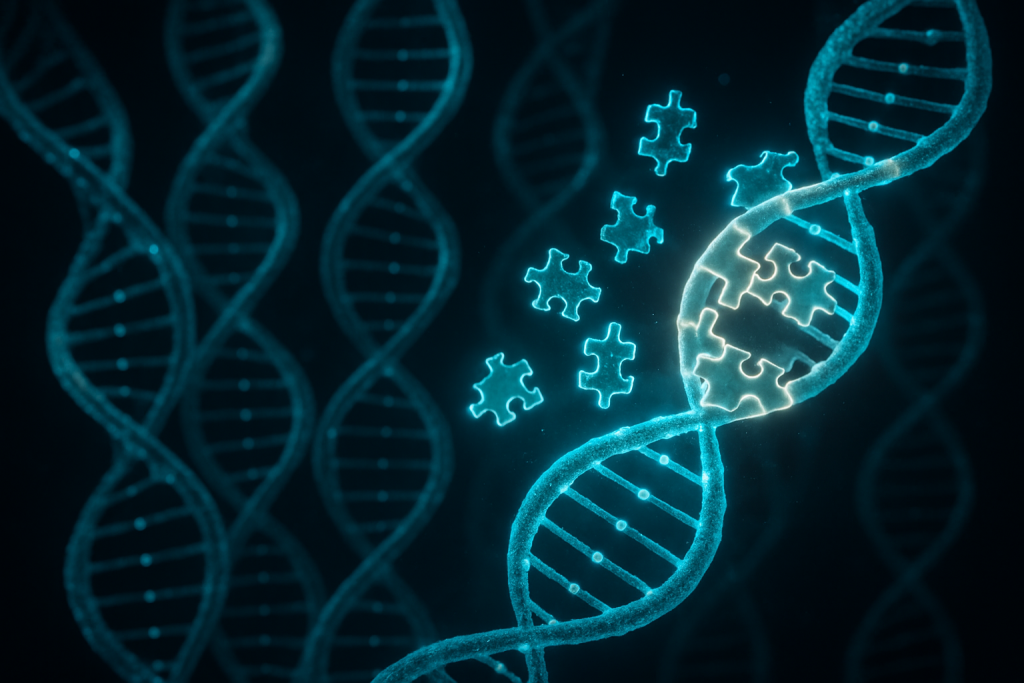
Image generated by AI
Imagine a three-billion-piece puzzle with no picture on the box—and pieces from multiple puzzles mixed in. This is what scientists face when they sequence a genome: millions of tiny DNA fragments that must be reassembled into a coherent whole. Genome assembly, the process of stitching these fragments back together, is one of the most consequential challenges in modern biology. Yet for decades, even with the best technology available, scientists could only approximate the complete picture, leaving gaps and uncertainties that obscured crucial details about our genetic architecture.
Today, genome assembly has become far more sophisticated, and when paired with comparative genomics—the art of reading genetic differences across species—it unlocks a profound understanding of how life evolves, what makes us human, and why some people fall ill while others stay well. The implications extend from personalized medicine to conservation biology, from understanding pandemic diseases to reimagining agriculture.
What Is Genome Assembly and Comparative Genomics?
Genome assembly is the computational and experimental process of reconstructing a complete genetic sequence from short DNA fragments generated during sequencing. When a scientist sequences an organism’s genome, machines break the DNA into millions of overlapping snippets, typically ranging from hundreds to tens of thousands of base pairs. The assembly process uses sophisticated algorithms to find overlaps between these fragments, determining their correct order and orientation, much like assembling a jigsaw puzzle by matching edge patterns. The result is a contiguous sequence—called a contig—that represents the original genome as faithfully as possible. In practice, most genome assemblies still contain gaps where sequence information is missing or ambiguous, though recent technological advances have dramatically reduced these gaps.
Comparative genomics takes this assembled information further by analyzing similarities and differences across multiple genomes. By aligning genetic sequences from humans, chimpanzees, mice, fruit flies, and bacteria, researchers identify which genes are conserved across evolutionary time, which are unique to specific lineages, and how sequences have changed. These patterns reveal evolutionary relationships, uncover the functions of mysterious genes, and highlight genetic variations associated with disease susceptibility, drug metabolism, and adaptive traits. Comparative genomics transforms raw sequence data into a narrative of evolutionary history and biological function.
The field emerged from a surprising place: the late 1990s and early 2000s saw the completion of genome sequences for organisms from bacteria to humans, driven largely by advances in DNA sequencing technology and the vision of researchers like Craig Venter and Francis Collins who led the Human Genome Project. But simply reading the letters of DNA—the A’s, T’s, G’s, and C’s—wasn’t enough. Scientists needed methods to organize these letters into meaningful chunks (genes), understand what those chunks did, and compare across species. This realization catalyzed the birth of modern genomics as a discipline centered on assembly and comparison rather than sequencing alone.
How It Works in Nature
Genome assembly begins with raw sequencing data—millions of reads, each representing a small segment of DNA. Modern sequencing machines like Illumina systems or Oxford Nanopore devices produce reads with different characteristics: short reads (typically 100-300 base pairs) are highly accurate but generate more fragments to assemble; long reads (10,000 to 100,000 base pairs or more) are less accurate per base but contain much more contextual information about where fragments belong. The computational challenge is to identify which reads overlap, determine their correct ordering, and resolve ambiguities where multiple arrangements seem plausible. Assembly algorithms build a graph—called a de Bruijn graph or overlap graph—where nodes represent DNA sequences and edges represent overlaps. The algorithm then finds a path through this graph that visits every read exactly once, reconstructing the original genome sequence.
Think of assembly like reconstructing a novel from a pile of torn pages, each with only a few words, but each page’s ending words overlap with the beginning words of the next page. A reader could physically overlap these pages, match the text, and reassemble the book in correct order. Computer algorithms do something analogous, but at enormous scale: finding millions of overlaps simultaneously and resolving conflicts when multiple orderings seem equally valid. When regions of the genome contain repetitive sequences—long stretches of identical or near-identical DNA—assembly becomes treacherous: the algorithm may not know whether to place a fragment in the first repeat or the third repeat, leaving the structure ambiguous.
Comparative genomics uses alignment algorithms to line up sequences across species, base pair by base pair. A sequence from a human might be compared to the same region in a chimpanzee, and the algorithm notes where they match exactly, where they differ by a single letter (a substitution), and where one sequence has insertions or deletions relative to the other. These differences accumulate over evolutionary time: closely related species show few differences, while distantly related species show many. By analyzing the pattern and type of differences across many genes and many species, researchers infer evolutionary relationships, identify genes under strong natural selection (because they change very slowly across species), and spot genes unique to particular lineages that may confer special abilities or vulnerabilities.
Medical and Scientific Relevance
Genome assembly and comparative genomics have revolutionized our understanding of human disease. By comparing genomes of healthy people and disease patients, researchers identify genetic variants—tiny changes in DNA sequence—that increase disease risk. This approach has identified thousands of genetic risk factors for conditions ranging from diabetes and heart disease to depression and Alzheimer’s disease. Comparative genomics also illuminates why certain diseases are more common in some populations: genetic variations that are rare in Europeans may be common in Africans or Asians, reflecting different evolutionary pressures and migration histories. Understanding these patterns is crucial for developing equitable medicine that works across diverse populations, not just in the European ancestry groups that have been overrepresented in genetic research.
In cancer research, genome assembly and comparative genomics enable clinicians to sequence a patient’s tumor cells and their healthy cells side-by-side, identifying the specific mutations driving that tumor. This information guides targeted therapy selection: a patient with a tumor harboring a specific genetic mutation might benefit from a drug that exploits that exact mutation. In infectious disease, comparative genomics tracks how viruses and bacteria evolve, how they acquire antibiotic resistance, and how they jump between species. During the COVID-19 pandemic, comparative genomics of SARS-CoV-2 genomes from thousands of patients revealed how the virus was spreading globally and evolving in real time, informing public health responses. Pharmaceutical development also relies on comparative genomics: understanding genes in model organisms like mice or flies through comparison to humans helps researchers identify drug targets and predict side effects.
Recent Breakthroughs in Genome Assembly and Comparative Genomics
In March 2022, an international consortium announced the complete telomere-to-telomere assembly of the human genome—the first truly gapless human sequence. This breakthrough, led by the T2T (Telomere-to-Telomere) Consortium, filled in previously inaccessible regions near chromosome ends and in highly repetitive regions at chromosome centers, revealing hidden genes and regulatory sequences that had been missed in the earlier 2003 Human Genome Project reference sequence. Simultaneously, long-read sequencing technologies from companies like PacBio and Oxford Nanopore matured dramatically, making it feasible and affordable to generate high-quality genome assemblies for thousands of organisms. These advances democratized genomics: whereas only the wealthiest research institutions could assemble genomes a decade ago, today’s costs and computational requirements are within reach of many labs worldwide.
Researchers are now using these superior assemblies to tackle long-standing questions in evolutionary and medical genomics. The Vertebrate Genomes Project and Earth BioGenome Project aim to sequence and assemble genomes for hundreds of thousands of species, creating a comprehensive map of genetic diversity. Within human genomics, large projects like the Human Pangenome Project are assembling genomes from diverse human populations to capture the full spectrum of human genetic variation. Open questions that researchers are pursuing include: How much genetic variation exists within our species that we’ve never cataloged? What genes have been subject to strong positive selection in human evolution, and what do they tell us about our unique traits? How do complex regulatory regions—switches that control gene expression—differ across individuals and species, and how do these differences contribute to disease risk and phenotypic variation?
Why Genome Assembly and Comparative Genomics Matters for the Future
As climate change accelerates species extinction, genome assembly and comparative genomics become tools for conservation. By sequencing the genomes of endangered species and comparing them to their relatives, scientists can identify genetic diversity, assess population health, and even contemplate genetic rescue strategies where alleles from closely related species might be introduced to increase genetic diversity in small populations. In agriculture, comparative genomics between crop varieties and their wild relatives identifies genetic variants controlling drought tolerance, pest resistance, and nutritional content. Plant breeders use this information to develop crop varieties adapted to changing environmental conditions. Perhaps most profoundly, as artificial intelligence advances, comparative genomics will likely reveal principles of how genetic variation generates the remarkable diversity of life forms, from neurons to hearts to cognitive abilities, potentially unlocking new frontiers in developmental biology and even synthetic biology.
Yet significant challenges remain. Most genome assemblies still contain errors and ambiguities, particularly in regions with complex repeats. Computational costs for assembling and comparing thousands of genomes are substantial. Ethical questions loom: As we catalog human genetic variation, how do we prevent the misuse of genomic data to resurrect false racial categories or justify discrimination? How do we ensure that the benefits of personalized genomic medicine reach all populations, not just the wealthy? How do we balance scientific openness—sharing genomic data freely to accelerate discovery—with individual privacy and indigenous rights to genetic data? These questions will define the field’s trajectory as much as its technological capabilities.
Key Takeaways
- Genome assembly is the computational process of reconstructing complete DNA sequences from millions of overlapping short fragments generated during sequencing, analogous to assembling a vast jigsaw puzzle.
- Comparative genomics reveals evolutionary relationships and biological function by analyzing similarities and differences in DNA sequences across multiple species and individuals.
- Medical applications include identifying disease-causing genetic variants, guiding cancer treatment selection, and tracking infectious disease evolution in real time.
- Recent breakthroughs like the complete telomere-to-telomere human genome assembly and improved long-read sequencing technologies have transformed the accessibility and quality of genome information.
- The field will shape personalized medicine, conservation biology, agriculture, and our fundamental understanding of how genetic variation generates biological diversity, though significant ethical and technical challenges remain.
Explore TED Talks on Genome Assembly and Comparative Genomics:
TED content is used under CC BY-NC-ND 4.0. © TED Conferences, LLC.
Frequently Asked Questions
How do scientists reassemble millions of DNA fragments into a complete genome sequence?
Scientists use computational algorithms to identify overlapping regions among the millions of short DNA fragments generated during sequencing, then stitch these fragments together based on their sequence similarities. The overlaps act like puzzle pieces that naturally fit together, allowing researchers to reconstruct the original continuous DNA sequence.
Why is genome assembly considered more difficult than simply reading DNA sequences?
Genome assembly is challenging because sequencing machines produce only short, fragmented pieces of DNA, and the computational task of ordering billions of these fragments correctly—especially when dealing with repetitive sequences and contamination from other organisms—requires sophisticated algorithms and significant computational power. Additionally, gaps and uncertainties in assembly can obscure important genetic information.
What can scientists learn by comparing genomes across different species?
Comparative genomics reveals genetic differences and similarities among species, allowing scientists to understand evolutionary relationships, identify genes responsible for species-specific traits, and discover conserved sequences that indicate functionally important regions. This approach helps explain how life evolves and can identify disease-causing mutations by comparing healthy and diseased organisms.
How does improved genome assembly directly impact personalized medicine?
More complete and accurate genome assemblies enable scientists to identify genetic variations in individual patients that cause disease susceptibility or affect drug responses. With a better genomic blueprint, clinicians can develop targeted treatments tailored to a person's specific genetic makeup rather than using one-size-fits-all approaches.