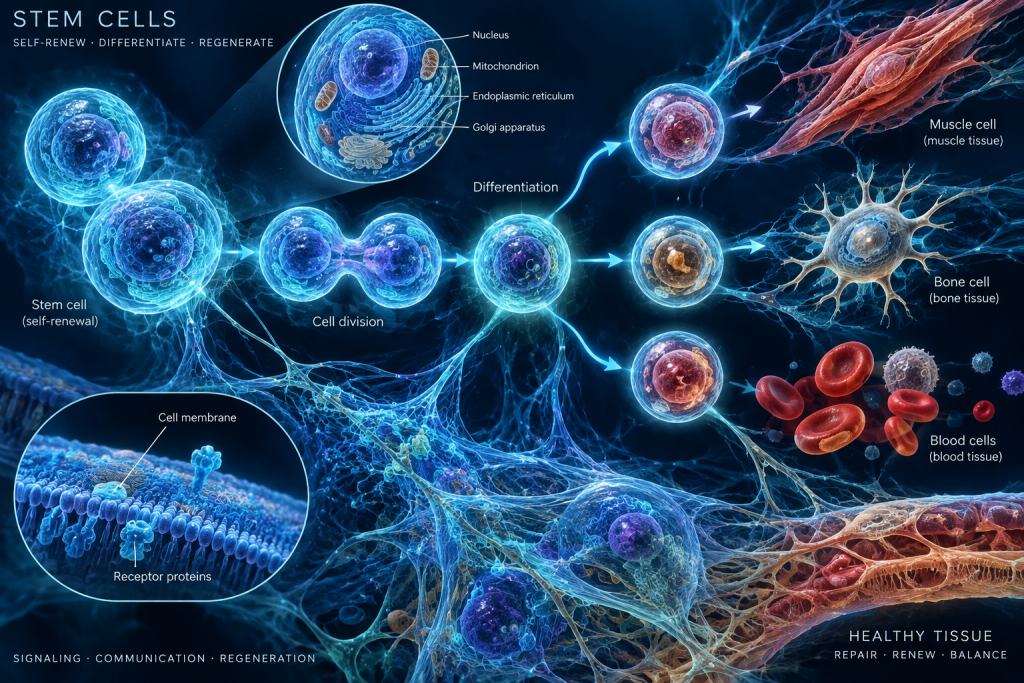
Image generated by AI
Every second of your life, roughly two million of your cells die. Your body replaces them with new ones in a carefully orchestrated biological dance that has played out for billions of years—yet we are only beginning to understand its deeper logic. This renewal process, driven by stem cells maintaining the balance of our tissues, represents one of biology’s most fundamental puzzles: how does an organism preserve itself while constantly replacing its parts? The answer lies in a elegant system of cellular decision-making that keeps us alive from conception through old age.
Stem cell biology and tissue homeostasis have moved from the margins of medical science to its absolute center. As aging populations face epidemics of degenerative diseases, and as researchers unlock new ways to reprogram and regenerate tissues, the field has become essential to understanding longevity, disease, and the future of medicine. Understanding how stem cells maintain our tissues could unlock treatments for Parkinson’s disease, heart failure, diabetes, and spinal cord injuries—conditions that currently have no cure.
What Is Stem Cell Biology and Tissue Homeostasis?
Stem cells are biological cells with two remarkable properties: they can divide to make copies of themselves, and they can differentiate—transform into specialized cell types that perform specific functions. Tissue homeostasis refers to the dynamic equilibrium that tissues maintain: a balance between cell birth, death, and function that keeps organs working properly over decades. Together, stem cell biology and tissue homeostasis describe how our bodies use self-renewing populations of undifferentiated cells to maintain, repair, and regenerate the tissues and organs we depend on. This is not a static process but rather a perpetual interplay between cellular proliferation and differentiation, shaped by signals from the surrounding environment and the tissue’s needs. Without this balance, tissues either accumulate damage or exhaust their capacity to renew, leading to disease and aging.
The scientific study of stem cells began in earnest in the 1960s, when Canadian researchers Ernest McCulloch and James Till discovered that single cells from bone marrow could give rise to colonies of blood cells—the first experimental proof that stem cells existed. Their work laid the groundwork for decades of investigation into the bone marrow’s blood-forming system, which remains one of the best-understood tissue homeostasis systems in the body. In 1981, researchers in Britain and America independently isolated embryonic stem cells from mice, creating laboratory models that could divide indefinitely. The field reached a cultural inflection point in 1998 when James Thomson successfully isolated human embryonic stem cells, sparking both scientific excitement and profound ethical debates that continue today.
How It Works in Nature
Consider your bone marrow, a spongy tissue inside your bones where blood cells are born. Within this organ sit hematopoietic stem cells—rare, highly protected cells that divide to produce both new stem cells (self-renewal) and the millions of blood cells you need each day. Each hematopoietic stem cell divides roughly once every 24 to 48 hours, giving rise to daughter cells that either retain stem cell potential or commit to becoming a specific blood cell type: a red blood cell, platelet, or immune cell. This decision is not random but determined by molecular signals from neighboring cells and the tissue’s demand. The stem cell niche—the microenvironment surrounding the stem cell—acts like a biological thermostat, releasing signals that tell the stem cell when to divide, when to rest, and when to differentiate. This same principle repeats throughout the body: in skin, gut, hair follicles, and brain, where stem cell populations quietly maintain the tissues we rely on.
Think of stem cells as master librarians in a biological archive. Each time a page (a cell) wears out, a librarian (stem cell) makes a copy: one copy stays in the archive to continue copying when needed, while the other leaves to perform work in the library. The genius of this system is its sustainability. Unlike a library of finite books, a library of stem cells can theoretically continue copying indefinitely, provided the stem cells themselves don’t become exhausted or damaged. Yet this system has constraints: stem cells are precious resources, sequestered in specialized niches and carefully rationed. Some tissues, like blood, maintain robust stem cell populations that renew throughout life. Others, like the heart, have lost most of their stem cell capacity over evolutionary time, which is why heart attacks cause permanent damage.
Medical and Scientific Relevance
Understanding tissue homeostasis has direct implications for treating diseases where tissues fail to renew or renew incorrectly. In type 1 diabetes, the insulin-producing beta cells in the pancreas die, and the body’s capacity to regenerate them is insufficient—understanding stem cell exhaustion in this context could enable therapies that restore beta cell populations. In Parkinson’s disease, dopamine-producing neurons in the brain gradually die; researchers are exploring whether dopamine-secreting cells derived from stem cells could replace them. Leukemia and lymphoma represent a dark inversion of tissue homeostasis, where stem cells in the bone marrow acquire mutations and lose their normal growth constraints, dividing uncontrollably. Paradoxically, current cancer therapies work partly by destroying these malignant stem cell populations, which is why chemotherapy affects blood cells and intestinal cells—tissues with high stem cell turnover.
The regenerative medicine industry is building treatments around stem cell principles. Companies and academic centers are developing therapies for spinal cord injury using oligodendrocyte progenitors derived from embryonic stem cells. Researchers are creating organoids—miniature organs grown from stem cells—that model human development and disease, offering platforms for drug testing that bypass animal models. The cosmetics industry uses stem cell research to understand skin renewal, while regenerative medicine startups are exploring whether injecting stem cells can restore joint cartilage destroyed by arthritis. Clinical trials for stem cell therapies in heart disease, macular degeneration, and critical limb ischemia are underway across major medical centers worldwide, representing a shift from basic research to therapeutic application.
Recent Breakthroughs in Stem Cell Biology and Tissue Homeostasis
In 2023 and 2024, stem cell research has accelerated on multiple fronts. Researchers at Stanford and other institutions have demonstrated that injecting induced pluripotent stem cells (iPSCs)—adult cells reprogrammed to an embryonic-like state—into damaged hearts can improve cardiac function in primate models, a major step toward human trials. Simultaneously, advances in single-cell sequencing have revealed previously unknown stem cell states within tissues, showing that stem cells exist along a spectrum rather than as discrete categories. Scientists have discovered that some tissues, previously thought to lack regenerative capacity, maintain hidden stem cell populations that could theoretically be awakened. Work on epigenetic clocks—molecular timekeepers that measure biological age—suggests that stem cell aging can be reversed or slowed, at least in laboratory settings.
The field is grappling with fundamental questions that remain unsolved. How exactly do stem cells decide whether to self-renew or differentiate? What causes stem cell exhaustion during aging, and can this process be reversed? Why do some tissues evolve away from stem cell capacity over millions of years, while others retain it? Researchers are also investigating whether manipulating tissue homeostasis could slow aging itself—a radical notion that challenges the assumption that aging is inevitable rather than a treatable condition.
Why Stem Cell Biology and Tissue Homeostasis Matter for the Future
The long-term implications of mastering tissue homeostasis are staggering. If we can understand and manipulate the signals that control stem cell behavior, we might eventually regenerate any tissue on demand: a new heart for heart failure, new neurons for neurodegeneration, new insulin-producing cells for diabetes. This would transform medicine from a system focused on managing chronic disease to one focused on repair and restoration. Beyond disease treatment, understanding how stem cells maintain tissues could illuminate the biological basis of aging itself. Many leading theories of aging center on stem cell exhaustion—the gradual loss of stem cell function that prevents tissues from renewing efficiently. If stem cell decline drives aging, then restoring stem cell function could extend human healthspan, the years of healthy life we experience before disease and decline.
Significant challenges remain before these visions become reality. Stem cell therapies must navigate complex regulatory approval processes, and the cost of personalized cell therapies remains prohibitively high for most patients. There are also safety concerns: reprogrammed stem cells could theoretically develop mutations and become cancerous, and implanted cells must integrate successfully into host tissues without triggering immune rejection. Ethical questions persist, particularly regarding embryonic stem cell research in some jurisdictions. The field must also contend with the complexity of tissue homeostasis itself—tissues do not operate in isolation but within a symphony of hormonal, neural, and immune signals that all influence stem cell behavior.
Key Takeaways
- Stem cells are self-renewing cells that maintain tissue homeostasis by balancing cell division, differentiation, and death throughout an organism’s lifetime.
- Stem cells reside in specialized microenvironments called niches that regulate their behavior through molecular signals, controlling whether they divide, rest, or differentiate into specialized cell types.
- Regenerative medicine is moving toward clinical application, with stem cell therapies in development for heart disease, neurodegeneration, spinal cord injury, and metabolic disorders.
- Recent breakthroughs in single-cell sequencing and iPSC technology have revealed new stem cell states and demonstrated functional repair in primate models, bringing human trials closer to reality.
- Understanding tissue homeostasis could unlock treatments for currently incurable degenerative diseases and may hold keys to slowing biological aging itself.
Explore TED Talks on Stem Cell Biology and Tissue Homeostasis:
TED content is used under CC BY-NC-ND 4.0. © TED Conferences, LLC.
Frequently Asked Questions
What are the two key properties that define stem cells and distinguish them from other cell types?
Stem cells possess the ability to self-renew through cell division and to differentiate into specialized cell types that perform specific functions. These two capabilities allow them to both maintain a population of stem cells and generate the diverse cell types needed for tissue maintenance and repair.
Why does your body need stem cells if it can simply replace dead cells directly?
Stem cells provide a renewable source of replacement cells because they can self-renew indefinitely, whereas fully differentiated cells cannot divide. This creates a sustainable system for continuous tissue renewal throughout an organism's lifetime without depleting the pool of replacement cells.
How does tissue homeostasis maintain the balance between cell death and cell replacement in the body?
Tissue homeostasis is maintained through a dynamic equilibrium where stem cells continuously divide and differentiate at a rate that matches the rate of cell death, creating a stable tissue composition. This orchestrated process involves cellular decision-making mechanisms that sense tissue needs and regulate stem cell behavior accordingly.
Can understanding stem cell biology lead to treatments for currently incurable degenerative diseases?
Yes, insights into how stem cells maintain tissues could enable regenerative therapies for conditions like Parkinson's disease, heart failure, diabetes, and spinal cord injuries by harnessing stem cells' capacity to replace damaged or lost tissue. Such treatments would work by either stimulating the body's own stem cells or transplanting engineered stem cells to restore tissue function.