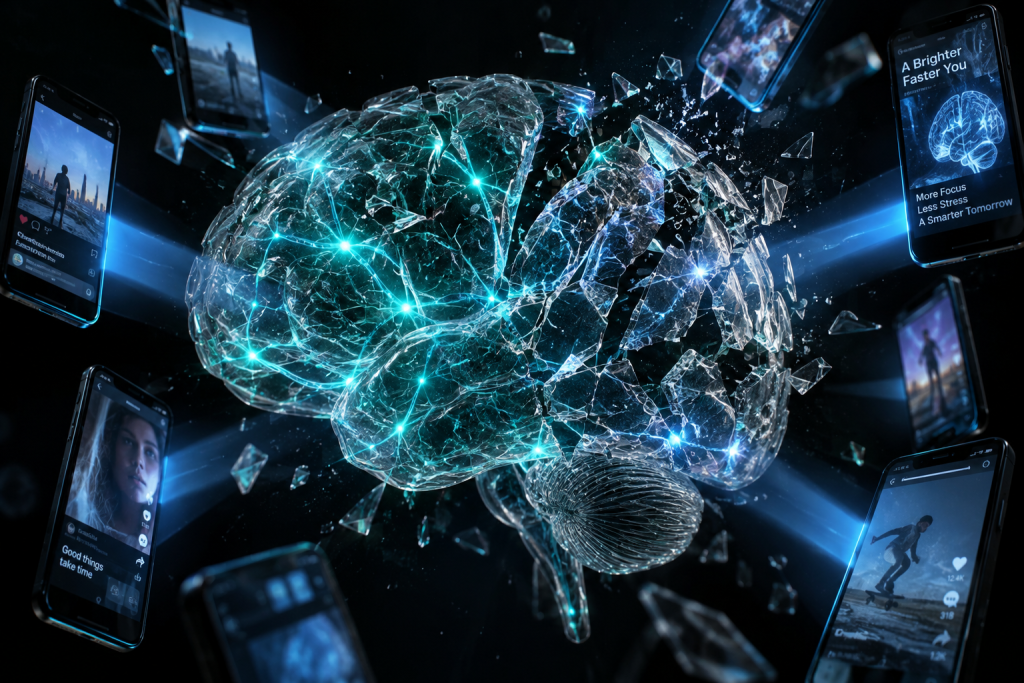
Image generated by AI
You begin reading an article, and within minutes, your thumb drifts toward your phone. A notification glimmers. You tell yourself you’ll just check it for thirty seconds. Twenty minutes later, you’ve forgotten what you were originally reading. This isn’t a personal failing—it’s the result of ancient neural machinery colliding with technologies designed to capture and hold your attention. The average person now checks their phone approximately 96 times per day, yet we feel perpetually behind, as though our attention is slipping through our fingers like sand.
The crisis of attention has become one of the defining challenges of modern life. Students report struggling to focus during lectures. Office workers spend less than three minutes on a single task before switching contexts. Parents and educators worry that young people lack the capacity for deep, sustained concentration that previous generations took for granted. Yet paradoxically, understanding why this happens requires us to examine not the weakness of human attention, but rather its elegant and ancient design—a design that was never meant to contend with the attention economy of the 21st century.
What Is Digital Distraction and Attention Span?
Digital distraction refers to the involuntary pulling away of cognitive focus caused by digital devices and the internet, while attention span describes the length of time a person can concentrate on a single task without shifting focus. These are not new phenomena—humans have always been distractible, and attention has always been a finite resource. What is new is the scale and sophistication of the forces competing for that attention. Digital distraction isn’t simply a distraction in the classical sense, where a loud noise might break your concentration; it’s a persistent, personalized, and algorithmically optimized assault on your capacity to focus.
The scientific study of attention as a psychological phenomenon began in earnest during the late 19th century, with pioneering psychologist William James famously describing attention as the taking possession by the mind, in clear and vivid form, of one out of what seem several simultaneously possible objects. However, the modern study of digital distraction is far more recent, accelerating dramatically after 2007, when the iPhone emerged and smartphones began their rapid integration into daily life. Researchers like Gloria Mark at UC Irvine began tracking how digital interruptions affected worker productivity, while neuroscientists using functional MRI scans examined how constant connectivity altered brain structure and function.
What the Science Says
At the neurological level, attention operates through an interplay of several brain systems, each with distinct functions. The anterior cingulate cortex and prefrontal cortex work together to maintain focus on a chosen goal, suppressing irrelevant information. Simultaneously, the anterior insula monitors for novel or surprising stimuli—the evolutionary equivalent of a sentinel watching for predators. When a notification arrives, this sentinel system activates, triggering what neuroscientists call a “reorienting response.” This response evolved to keep our ancestors alive; a rustling in the bushes demanded immediate attention. Your smartphone exploits this ancient circuit by mimicking novelty and unpredictability. Every notification is a potential threat, a potential reward, a potential piece of social validation.
Consider the mechanism of variable reward schedules, a principle discovered by B.F. Skinner in the 1950s through his work with pigeons. Skinner found that pigeons would peck at a lever much more persistently if rewards came unpredictably rather than on a fixed schedule. Social media platforms employ this exact principle: you scroll through your feed not knowing when the next “hit” of engagement—a like, a comment, a compelling post—will arrive. This unpredictability is far more addictive than a guaranteed reward would be. Your brain cannot habituate to it; it remains perpetually alert, perpetually hoping that the next scroll will deliver something rewarding. This is why checking your phone feels compulsive rather than deliberate.
How This Affects Everyday Life
The consequences of chronic digital distraction ripple across every domain of modern life. Students who study with their phones nearby score lower on exams, even if they never actually use the phone, a phenomenon researchers call the “mere presence effect.” Workers in offices with open layouts and constant communication tools experience what Gloria Mark’s research quantifies as an average task-switch every 3 minutes and 5 seconds, with an average of 23 minutes required to return to the original task once interrupted. Parents who are distracted by phones show reduced sensitivity to their children’s emotional cues. Over time, these small erosions of attention accumulate into measurable cognitive consequences: reduced working memory, decreased ability to engage in deep reading, and impaired capacity for complex problem-solving.
The effects manifest across institutions and professions in concrete ways. Medical schools report that students struggle with the sustained attention required to master complex anatomical knowledge, leading some schools to institute phone-free study periods. Tech companies themselves, from Apple to Google to Microsoft, have begun implementing “focus modes” and screen-time limiting features, suggesting that even the architects of digital platforms recognize the problem. The education sector has seen explosive growth in attention-deficit diagnoses, though researchers debate whether this reflects a true increase in the condition or simply greater recognition of a problem that was always present but masked by less demanding technological environments.
Recent Breakthroughs in Digital Distraction and Attention Span
Recent neuroscience research has provided unexpected insights into how digital distraction literally rewires the brain. A 2023 study published in the journal Nature Communications found that people who regularly experience digital interruptions show reduced gray matter density in areas associated with cognitive control. More intriguingly, this change appears somewhat reversible; when people deliberately reduced their digital distractions for several weeks, some restoration of neural density occurred. This suggests that attention is not a fixed trait but rather a skill that can be trained and retrained, depending on environmental pressures. Neuroscientist Adam Gazzaley’s laboratory has been developing video games specifically designed to improve attention spans, based on principles from neuroscience about how the brain allocates cognitive resources.
Researchers are now investigating the temporal dynamics of attention in the digital age with unprecedented precision. Eye-tracking studies reveal how algorithms subtly modify feed content to maximize engagement, and neuroimaging studies show that the anticipation of a notification activates reward circuitry even before the notification arrives. One intriguing frontier involves understanding individual differences: why some people seem naturally resistant to digital distraction while others find it nearly impossible to resist. Preliminary evidence suggests that differences in dopamine sensitivity, genetic variations in attention-related genes, and early childhood experiences with technology all play roles, though no single factor explains the variation.
Why Digital Distraction and Attention Span Matters for the Future
The implications extend far beyond individual productivity or academic performance. If an entire generation grows up with fragmented attention, the downstream effects could reshape what kinds of knowledge work our society can accomplish. Complex scientific research, novel writing, mathematical proof-writing, and strategic long-term planning all require sustained, deep attention. There is a genuine concern among cognitive scientists that we risk losing the cultural capacity for these activities. Conversely, the constant context-switching required by digital environments may be cultivating different cognitive strengths: the ability to integrate information from multiple sources quickly, pattern-matching across diverse domains, and meta-attention—the ability to monitor and adjust your own attention in real time.
Several critical questions remain unresolved. Is the decline in attention span we observe primarily a matter of environmental design, or does it reflect deeper changes in how young brains develop when immersed in digital environments from infancy? Can we redesign our digital tools to work with human attention rather than against it, or is the business model of attention-capture too fundamental to change? And crucially: what role should schools, governments, and technology companies play in managing this collective challenge? Some researchers argue for digital literacy education, teaching people to use attention as a deliberate resource. Others advocate for regulatory approaches. Still others believe the solution lies in technological redesign—creating tools that respect human attention rather than exploit it.
Key Takeaways
- Digital distraction exploits ancient neural systems evolved to detect novel and potentially threatening stimuli, making modern notifications genuinely difficult to resist rather than simply inconvenient.
- The mechanism of unpredictable rewards on social media platforms uses principles identical to those discovered in behavioral psychology studies from the 1950s, creating persistent engagement that feels compulsive.
- Recent research shows that the neural changes associated with chronic digital distraction are partially reversible through deliberate attention training, suggesting attention is a trainable skill rather than a fixed capacity.
- Current research is mapping the neurobiological basis of individual differences in attention resilience and exploring how algorithms specifically target and exploit human attentional vulnerabilities.
- Understanding digital distraction matters for the future because it will determine whether upcoming generations can engage in the kind of sustained, deep thinking required for scientific discovery, creative work, and complex problem-solving.
Explore TED Talks on Digital Distraction and Attention Span:
TED content is used under CC BY-NC-ND 4.0. © TED Conferences, LLC.
Frequently Asked Questions
Why does the article describe attention as 'ancient neural machinery' that conflicts with modern technology?
The human brain's attention system evolved over millennia to detect immediate threats and opportunities in the physical environment, not to resist engineered stimuli designed by tech companies to trigger dopamine responses. Modern digital devices exploit this ancient neural architecture by presenting novel, unpredictable rewards that our brains are neurologically predisposed to prioritize.
What is the scientific difference between digital distraction and simply having a short attention span?
Attention span is an individual's inherent capacity to sustain focus on a task over time, while digital distraction is the external interference that interrupts that focus through notifications and competing stimuli. Digital distraction is involuntary and environmentally triggered, whereas attention span reflects the brain's baseline ability to maintain concentration.
How does the frequency of phone checking (96 times per day) affect the brain's ability to concentrate on complex tasks?
Frequent context-switching trains the brain to operate in a fragmented state, reducing the sustained neural activation required for deep focus and working memory integration. This habitual switching can weaken the prefrontal cortex's executive control functions, making it progressively harder to maintain concentration on demanding cognitive work.
Is the decline in attention span a cognitive limitation that is permanent, or can neural plasticity reverse distraction-related changes?
The brain exhibits neuroplasticity, meaning attention capacity can be restored through deliberate practice and reduced exposure to digital interruptions, though this requires sustained effort to rebuild neural pathways associated with sustained focus. The changes are not permanent, but reversing them requires retraining attention systems away from fragmentation.