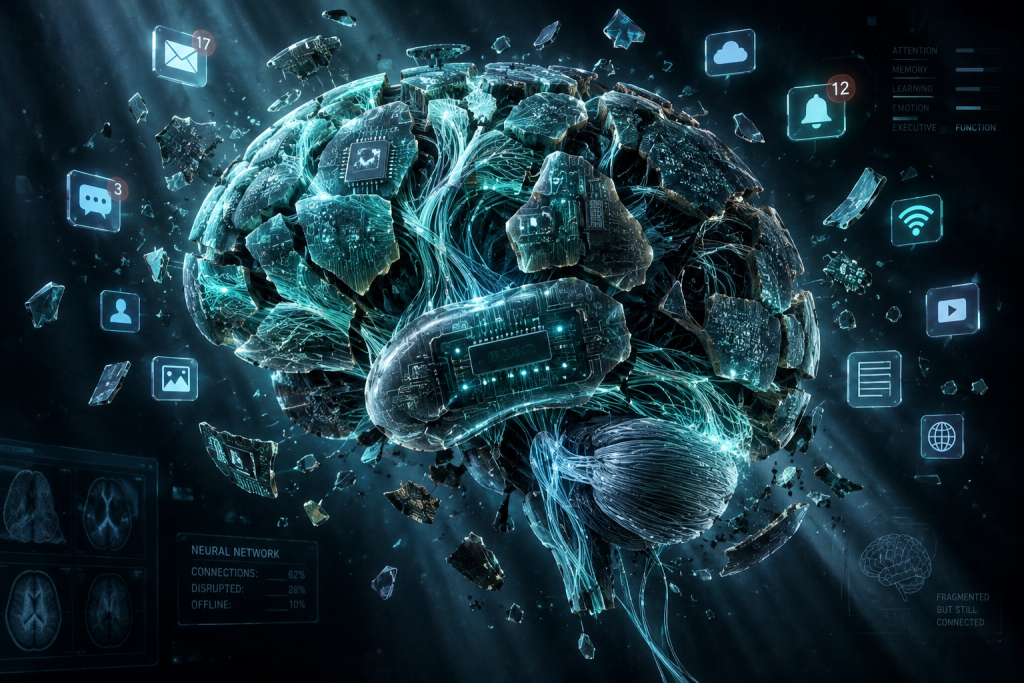
Image generated by AI
You sit down to write a report. Within minutes, a notification pings. Then another. Your hand moves toward your phone before your conscious mind catches up. By the time you refocus on the task at hand, fifteen minutes have vanished, and you’ve lost the thread of your thinking entirely. This isn’t a personal failing—it’s a collision between ancient human instincts and technologies explicitly designed to capture your attention, and neuroscience is only now revealing just how profound the mismatch has become.
The decline in sustained focus represents one of the defining cognitive challenges of our era. A 2023 study published in the journal Nature Communications found that average human attention spans have shortened measurably over the past two decades, with the average person now able to maintain focus for approximately 47 seconds before experiencing an urge to switch tasks—down from several minutes just a generation ago. This isn’t merely an inconvenience; it’s reshaping how we learn, work, and think, with implications that reach from individual productivity to the collective ability of society to tackle complex problems.
What Is Digital Distraction and Focus Decline?
Digital distraction refers to the involuntary or semi-voluntary shifting of attention away from a primary task toward digital stimuli—notifications, messages, social media feeds, or the mere possibility of engagement with a device. Focus decline, by contrast, describes the broader deterioration in our capacity for sustained, deep attention over time. These phenomena are interconnected: when we repeatedly interrupt focused work to attend to digital stimuli, we gradually weaken our ability to maintain concentration, much like a muscle that atrophies from disuse. The process is insidious because each distraction feels minor in isolation; it’s the cumulative effect that rewires our cognitive architecture.
The systematic study of attention and distraction traces back decades, but modern research on digital distraction accelerated sharply in the early 2010s as smartphones became ubiquitous. Gloria Mark, a researcher at UC Irvine who has spent over two decades studying interruptions and attention, conducted pioneering studies showing that office workers switch tasks approximately every three minutes on average. Her work, along with research by Adam Gazzaley at the University of California, San Francisco, established that multitasking with digital devices doesn’t simply divide our attention—it fundamentally alters how our brains process information and form memories. These foundational studies revealed that what appears to be efficient task-switching is actually a costly cognitive process.
What the Science Says
At its core, digital distraction exploits a cognitive mechanism called the “attentional blink,” combined with what neuroscientists term the “novelty-seeking system.” When we encounter something new or unexpected, our brains are biologically primed to notice it—an evolutionary adaptation that once helped our ancestors spot predators or opportunities. Digital devices, particularly social media platforms and messaging apps, are engineered to trigger this system repeatedly and reliably. Each notification represents a novel stimulus that demands processing, and our brains struggle to ignore stimuli designed specifically to be attention-grabbing. This isn’t weakness; it’s the normal functioning of a nervous system that hasn’t yet evolved to handle environments saturated with designed stimuli.
Consider how a social media feed works: as you scroll, variable rewards appear unpredictably—a like, a comment, an interesting video. This pattern mirrors the behavior of slot machines, which neuroscience has shown activate the same dopaminergic reward pathways that drive addiction. Your brain doesn’t know when the next reward is coming, so it keeps checking, keeps scrolling. This is called a “variable ratio reward schedule,” and it’s one of the most powerful behavioral reinforcement patterns known to psychology. The smartphone in your pocket is, in a very real sense, a personal slot machine engineered by teams of designers whose explicit goal is to maximize engagement—a euphemism for “time captured.”
How This Affects Everyday Life
The consequences of chronic digital distraction ripple through every domain of modern life. In education, research by Ophir et al. in 2009 demonstrated that “heavy media multitaskers”—students who regularly used multiple digital media simultaneously—performed worse on tests measuring their ability to filter irrelevant information and sustain attention compared to light multitaskers. More recent studies from 2022 and 2023 have found that even the mere presence of a smartphone on a desk, even if turned off, reduces cognitive performance on complex tasks by approximately 10 to 20 percent. The phenomenon is called “brain drain,” and it occurs because your cognitive resources are partially allocated to actively resisting the temptation to check your phone.
In the workplace, this translates to reduced productivity and creativity. A 2023 study from the American Psychological Association found that knowledge workers now spend an average of 2 hours and 26 minutes per day in “deep work”—uninterrupted focus on cognitively demanding tasks—compared to roughly 5 to 6 hours two decades ago. This decline has profound consequences: deep work is where meaningful problem-solving happens, where insights emerge, where learning becomes durable. In creative fields—software development, design, writing, research—the cost of context-switching is particularly severe. It can take 15 to 25 minutes to reach a state of deep focus once lost, meaning a single distraction can effectively destroy an hour of productivity. Neuroscientists call this the “cognitive switching penalty,” and it’s now one of the most-cited obstacles to productivity in modern organizations.
Recent Breakthroughs in Digital Distraction and Focus Decline
The past three years have brought significant advances in our understanding of how chronic digital distraction rewires the brain. A landmark 2023 study using functional MRI neuroimaging found that heavy social media users showed reduced gray matter volume in regions associated with sustained attention and impulse control—particularly the prefrontal cortex and anterior cingulate cortex. These aren’t permanent changes, the researchers noted, but they do suggest that extended exposure to attention-fragmenting environments may alter brain structure itself. Simultaneously, researchers at the University of Pennsylvania discovered that exposure to notifications—even notifications you don’t read—impairs performance on tasks requiring working memory and executive function through a mechanism related to “attentional residue,” where mental resources remain partially engaged with the source of the notification.
One of the most surprising recent findings involves the concept of “attention residue,” formalized by Sophie Leroy at the University of Minnesota. Leroy’s research shows that when you switch from one task to another, your attention doesn’t fully transition—part of your cognitive resources remain focused on the previous task, creating a kind of mental “drag” that degrades performance on the new task. The implications are profound: if you’re frequently switching between email, messages, and primary work, you’re never fully present on any of them. Current research is now exploring intervention strategies, including “attention restoration theory,” which proposes that time in nature or engaging in non-stimulating activities can restore depleted attentional capacity. Tech companies are also beginning to implement “friction-based” design—intentionally making notifications harder to receive or check, based on research suggesting that reducing access frequency improves focus.
Why Digital Distraction and Focus Decline Matters for the Future
The stakes extend far beyond individual productivity. In an era where we need sustained, collective focus to address climate change, pandemic preparedness, and other complex systemic challenges, a widespread decline in attention capacity is genuinely concerning. Science itself depends on the ability of researchers to maintain deep focus for weeks or months on difficult problems. Complex reasoning—the kind required for mathematics, engineering, policy-making, and scientific discovery—demands sustained attention that is increasingly rare. Moreover, the cognitive decline associated with chronic distraction appears to be affecting younger generations most severely, raising questions about whether we’re altering the developmental trajectory of human cognition itself. Some neuroscientists worry that if attention-restoration practices don’t become more widespread, we may be cultivating a generation whose brains are fundamentally less capable of sustained focus.
The challenge ahead involves fundamentally rethinking how we design technology and structure our environments. Most current solutions—app blockers, digital detoxes, “Do Not Disturb” modes—place the burden on individuals to resist technologies explicitly designed to undermine resistance. Some researchers argue this is fundamentally unfair and that the real solution requires regulatory approaches, similar to how we regulate advertising directed at children. Others advocate for a “right to disconnect” movement gaining traction in Europe, which would legally protect time free from work communications. The open question remains: can we redesign digital environments to respect human attention as a finite resource worthy of protection, rather than treating it as a commodity to be harvested?
Key Takeaways
- Digital distraction exploits biological attention systems evolved for survival in low-stimulation environments, not the high-engagement world of modern technology.
- When we repeatedly interrupt focused work, we weaken our capacity for sustained attention through a process similar to cognitive atrophy, with measurable effects on brain structure in heavy users.
- The most promising interventions involve redesigning technology itself to respect attention as a limited resource, rather than relying solely on individual willpower.
- Recent neuroimaging studies have documented structural brain changes in chronic heavy media users, though these changes appear potentially reversible with behavioral modification.
- As complex global challenges require unprecedented levels of sustained collective focus, the decline in human attention capacity represents a fundamental threat to our ability to solve civilization-scale problems.
Explore TED Talks on Digital Distraction and Focus Decline:
TED content is used under CC BY-NC-ND 4.0. © TED Conferences, LLC.
Frequently Asked Questions
Why does the human brain struggle more with digital distractions than with other environmental interruptions?
Digital notifications are specifically engineered to exploit the brain's evolutionary reward system by triggering dopamine release, making them more neurologically compelling than passive environmental stimuli. This creates a mismatch between our ancient attention mechanisms and modern technology designed to be maximally engaging.
What does the 47-second attention span measurement from the 2023 Nature Communications study actually represent?
The 47-second metric represents the average duration before a person experiences an urge to voluntarily switch tasks, indicating a measurable decline in sustained attention capacity over the past two decades. This measurement reflects the time individuals can maintain focused engagement on a single primary task before cognitive restlessness emerges.
How does the distinction between involuntary and semi-voluntary distraction affect our understanding of digital focus decline?
Involuntary distraction involves automatic responses to stimuli (like reflexively checking a phone upon notification), while semi-voluntary distraction involves conscious but weakly-resisted impulses, both contributing to focus decline through different neurological pathways. Understanding this distinction helps explain why willpower alone is insufficient—both automatic and deliberate processes undermine sustained attention.
Are the cognitive consequences of shortened attention spans limited to individual productivity, or do they have broader neurological implications?
The article indicates consequences extend beyond individual productivity to affect learning capacity and society's ability to solve complex problems, suggesting that chronic digital distraction may fundamentally alter how neural networks develop and consolidate information. This implies both immediate performance deficits and potentially long-term changes in cognitive architecture.