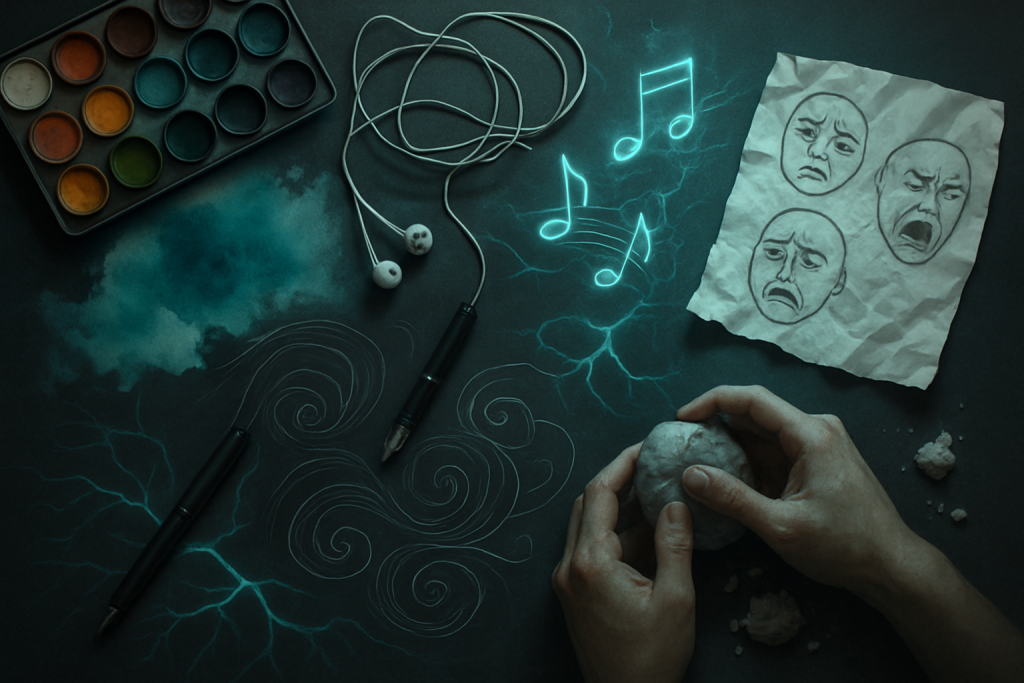
Image generated by AI
When a teenager sits down to play guitar after a difficult day at school, or when an adult loses themselves in a painting on a Sunday afternoon, something remarkable is happening inside their brain. The act of creating is not merely a pleasant distraction—it is a powerful psychological tool that fundamentally alters how the brain processes and manages emotional experiences. Yet most people who engage in these activities have little awareness of the intricate neural mechanisms that make creative expression such an effective emotion regulator.
In our increasingly stress-filled world, where anxiety and depression affect millions and traditional therapeutic resources remain scarce, understanding how creativity helps us manage our emotional lives has never been more urgent. Recent neuroscientific research is finally revealing what artists and musicians have intuitively known for centuries: engaging in creative activities triggers specific neurobiological pathways that reduce stress hormones, activate reward centers, and help us process difficult emotions in ways that talking about them alone cannot achieve.
What Is Emotion Regulation Through Creative Activities?
Emotion regulation through creative activities refers to the use of artistic, musical, literary, or other creative pursuits to deliberately manage, modulate, or transform emotional states. This is fundamentally different from simply being distracted or entertained. When we engage in genuine creative work—whether that means improvising on an instrument, painting, writing poetry, or sculpting—we activate a cascade of cognitive and emotional processes that allow us to exert some control over our internal emotional landscape. The key distinction is intentionality combined with the generative act of making something new, rather than passively consuming entertainment.
The scientific study of creativity as an emotion regulation tool gained real momentum in the 1990s and 2000s, when psychologists began systematically investigating what art therapists had observed clinically for decades. Early pioneers like Natalie Rogers developed expressive arts therapy based on the humanistic psychology tradition, but it wasn’t until functional brain imaging became widely available that researchers could observe in real time what actually happens neurologically when someone engages in creative expression. Studies beginning in the early 2000s by researchers such as Girija Kaimal at Drexel University and others began mapping these neural correlates, transforming creativity from a philosophical interest into a legitimate target of neuroscientific investigation.
What the Science Says
The neurobiological mechanism behind creative emotion regulation operates through several interconnected pathways. When you engage in a creative activity, your brain simultaneously suppresses activity in the default mode network—the constellation of brain regions active during self-referential thinking and worry—while activating your executive control and reward systems. The prefrontal cortex, responsible for conscious decision-making and impulse control, becomes more active and better coordinated with the limbic system, which governs emotional processing. Crucially, creative engagement also triggers the release of dopamine and serotonin, the same neurotransmitters targeted by many antidepressant medications. Additionally, even brief creative activities have been shown to reduce cortisol levels, the primary stress hormone, suggesting that the body’s stress response system itself is being therapeutically modulated.
Think of your emotional brain like a busy intersection during rush hour, with traffic signals not functioning properly and cars (emotional impulses) colliding unpredictably. Creative engagement is like a skilled traffic controller arriving to manage the flow. When you sit down to paint or write, you’re not suppressing the emotions—you’re channeling them through a structured activity that requires focused attention. This focused attention acts like that traffic control system, giving your emotional impulses a directed outlet while simultaneously engaging higher-order cognitive processes that literally rewire how you process the emotion. The resulting emotional state isn’t the emotion being eliminated; rather, it’s been metabolized, transformed into something observable and manageable.
How This Affects Everyday Life
The practical implications of creative emotion regulation extend far beyond the therapy office or art studio. Recent research demonstrates that even brief creative activities—just 15 to 45 minutes of engagement—can produce measurable improvements in mood, reduced anxiety, and enhanced emotional resilience. A landmark 2016 study published in the journal PLOS One found that even people with no prior artistic experience showed significant stress reduction and mood improvement after just one session of visual art-making. Schools are increasingly incorporating arts programs not merely as enrichment but as evidence-based interventions for student mental health. Workplaces are installing creative spaces and offering art-based stress management programs, recognizing that a few minutes of creative engagement between meetings can measurably enhance emotional stability and cognitive performance.
The healthcare sector has been particularly responsive to this research. Hospitals now commonly employ art therapists, musicians, and writers to work with patients managing chronic pain, PTSD, and terminal illness, with growing evidence that creative engagement improves both psychological and physiological outcomes. Digital platforms and apps designed around creative expression have emerged as accessible tools for emotion regulation, allowing people to engage in creative journaling, music creation, or digital art with increasing sophistication. Mental health clinicians are increasingly incorporating creative prescriptions alongside traditional talk therapy, with some insurance companies beginning to recognize art therapy as a reimbursable intervention.
Recent Breakthroughs in Emotion Regulation Through Creative Activities
Over the past two to three years, the field has moved beyond simply demonstrating that creative activities help with emotion regulation toward understanding the precise mechanisms and optimizing the dose and type of creative engagement for specific emotional conditions. A 2022 study from University College London used brain imaging to show that creative writing specifically activates regions associated with autobiographical processing and emotion integration—suggesting that narrative forms of creativity may be particularly effective for processing personally meaningful emotional experiences. Simultaneously, researchers at Stanford and MIT have begun exploring how real-time biofeedback systems that respond to emotional states can guide people toward the types and intensity of creative engagement most likely to produce therapeutic benefits. The emerging field of “digital creativity interventions” is creating personalized systems that adapt to individual emotional patterns and preferences.
Current research frontiers include understanding why certain creative modalities seem more effective for certain emotional conditions—why, for instance, rhythmic music-making might be particularly effective for anxiety while visual art might better serve those processing grief. Researchers are also investigating the social dimensions of creative emotion regulation, exploring whether collaborative creativity produces different neurobiological outcomes than solitary creation. The question of neuroplasticity remains particularly intriguing: does regular creative practice actually rewire emotional regulation capacity over time, potentially creating lasting improvements in emotional resilience? These questions promise to refine how we prescribe creative interventions in clinical settings.
Why Emotion Regulation Through Creative Activities Matters for the Future
As societies grapple with rising rates of anxiety, depression, and trauma-related disorders, and as traditional mental health resources remain chronically undersupplied, creative approaches to emotion regulation offer a scalable, accessible, and culturally adaptable intervention. Unlike medications or conventional therapy, which require professional gatekeeping and significant financial resources, creative activities can be practiced independently by anyone with minimal materials and training. This democratization of emotion regulation has profound implications for mental health equity, potentially extending evidence-based psychological support to populations and geographic regions currently underserved by traditional healthcare. Furthermore, the integration of creative practices into mainstream health and education systems signals a fundamental reconceptualization of mental health—moving beyond a deficit model focused on pathology toward a strengths-based model emphasizing human creative capacity as a protective and generative force.
However, significant challenges remain. The field still lacks standardized protocols for prescribing specific creative interventions for specific conditions, making it difficult for clinicians to integrate these approaches systematically into practice. Questions about access, equity, and cultural appropriateness persist—creative practices carry cultural meanings that cannot be universalized across all populations. Additionally, while the evidence for short-term emotional benefits is robust, longitudinal studies examining lasting personality change and emotional resilience remain limited. The relationship between amateur creative engagement and professional-grade artistic practice is also poorly understood, raising questions about whether you need to be “good” at something for it to provide emotional benefits.
Key Takeaways
- Creative activities regulate emotions by reducing activity in the brain’s default mode network (associated with worry) while activating executive control and reward systems, simultaneously lowering stress hormones like cortisol.
- Even brief creative engagement—15 to 45 minutes—produces measurable improvements in mood and emotional resilience, regardless of artistic skill or prior experience.
- Hospitals, schools, and workplaces are increasingly integrating art, music, and writing programs as evidence-based interventions for emotional and psychological challenges.
- Current research is moving toward understanding which creative modalities work best for specific emotional conditions and whether regular creative practice produces lasting changes in emotional regulation capacity.
- As mental health crises intensify globally, creative emotion regulation offers a scalable, accessible, and culturally adaptable approach to psychological wellbeing that could democratize mental health support across underserved populations.
Explore TED Talks on Emotion Regulation Through Creative Activities:
TED content is used under CC BY-NC-ND 4.0. © TED Conferences, LLC.
Frequently Asked Questions
What specific neurobiological pathways are activated when someone engages in creative activities for emotion regulation?
According to the article, creative activities trigger neurobiological pathways that reduce stress hormones and activate reward centers in the brain. These pathways allow the brain to process difficult emotions through creative expression in ways that verbal discussion alone cannot achieve.
How does emotion regulation through creative activities differ mechanistically from simply talking about one's emotions?
Creative activities engage distinct neural mechanisms that process emotions differently than verbal expression; they reduce stress hormones and activate reward centers simultaneously. This dual action allows for emotional transformation rather than just cognitive discussion of emotional content.
Why might creative activities be particularly effective for managing emotions in populations with limited access to traditional therapy?
Creative activities provide a direct neurobiological intervention that reduces stress hormones and activates reward pathways without requiring professional therapeutic resources. This makes them an accessible tool for emotion regulation in communities where traditional mental health services are scarce.
Is the emotion regulation effect of creative activities intentional, or does it occur automatically during creative engagement?
The article defines emotion regulation through creative activities as a deliberate process where individuals consciously use artistic pursuits to manage and modulate their emotional states. This suggests the effect requires intentional engagement, though the underlying neurobiological mechanisms operate automatically once the creative activity is initiated.