AI Insight
The Arsia Mons Elongated Cloud (AMEC) is an unusually long water-ice cloud on Mars that forms near the volcano Arsia Mons, extending over 1,500 kilometers downstream due to wind. First observed by NASA's Viking Orbiter 2 in 1977 and recently imaged in detail by ESA's Mars Express in 2018, this cloud appears only during spring and summer mornings and likely forms without dust particles, unlike typical clouds. The formation mechanism differs from familiar cloud-forming processes due to the thin Martian atmosphere and lack of dust at high altitudes.
Why it matters
Understanding the AMEC formation process could provide insights into atmospheric dynamics on Mars and potentially improve our understanding of cloud formation mechanisms on Earth, particularly in low-dust, thin-atmosphere conditions.
Understand the Science
APOD
Astronomy Picture of the Day
Discover the cosmos! Each day a different image or photograph of our fascinating universe is featured, along with a brief explanation written by a professional astronomer.
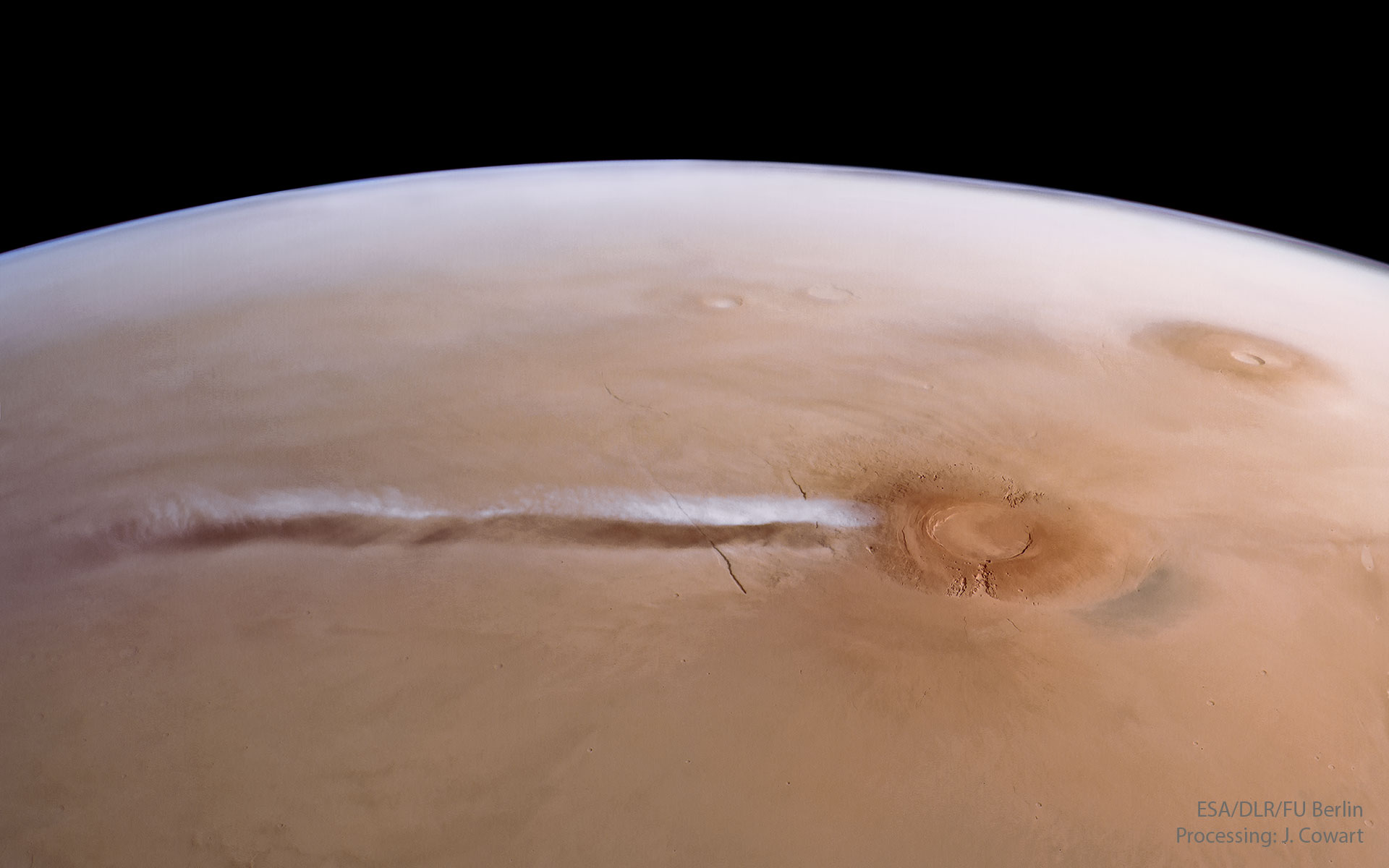
A Long Cloud on Mars
Explanation: What’s causing this unusually long cloud on Mars? Known as the Arsia Mons Elongated Cloud (AMEC) and first recorded by NASA’s Viking Orbiter 2 in 1977, the strange cloud has been imaged in greater detail more recently by ESA’s robotic Mars Express spacecraft. The featured image is from 2018. The cloud forms only during spring and summer seasons and then only during morning hours. Made of water-ice, the most familiar process that causes cloud crystals to form around bits of dust would fail due to the thinness and lack of dust high in the Martian atmosphere. Leading speculation holds that dust is not involved. After the cloud forms near the volcano Arsia Mons, wind blows the cloud downstream — creating a tail that can extend over 1500 kilometers. Efforts to better understand AMECs will continue, an understanding that may bolster a more complete view of cloud formation on Earth.
Tomorrow’s picture: eyeing a cat
| Date: | November 2, 2026 |
|---|---|
| Credit: |
ESA, DLR, FU Berlin; Processing & License: J. Cowart |
| Authors & editors: | Robert Nemiroff, Jerry Bonnell, Cecilia Chirenti, Keighley Rockcliffe |
| A service of: |
ASD at NASA / GSFC, NASA Science Activation & Michigan Tech. U. |